

TL;DR:
- Topic-driven learning enhances vocabulary retention and speaking fluency through meaningful context.
- Stories and themes create interconnected vocabulary networks, improving recall and confidence.
- Balancing interesting and challenging topics with active practice leads to steady language progress.
Most language learners assume that longer word lists equal faster progress. Drill enough flashcards, the thinking goes, and fluency will follow. But topics enhance vocabulary retention and speaking fluency for intermediate learners far more reliably than rote memorization ever could. Stories rooted in culture, history, and real-world themes give words a home — a context that makes them stick. In this article, you'll see exactly why topic-driven learning outperforms isolated drilling, which methods work best in practice, what the research actually says, and how to choose themes that keep your progress moving forward.
Table of Contents
- Why topics matter for vocabulary and fluency
- Key methods: Storytelling, themes, and topical input
- What research reveals: Interest, context, and learning impact
- Choosing the right topics: Practical strategies for intermediate learners
- Our perspective: What most guides miss about learning topics
- Ready to unlock your next level?
- Frequently asked questions
Key Takeaways
| Point | Details |
|---|---|
| Topic choice boosts learning | Learning through stories and themes is more effective than rote memorization for vocabulary and speaking. |
| Method matters | Approaches like TPRS and thematic lists provide engaging, memorable context for language growth. |
| Interest affects results | High-interest topics enhance motivation and vocabulary, but mixing in skill-building ensures balance. |
| Rotate your themes | Regularly switching topics and reflecting improves both retention and long-term interest. |
Why topics matter for vocabulary and fluency
Now that we've set the stage, let's look at what makes topic-driven learning so effective compared to traditional methods.
When you learn a word in isolation, your brain stores it without much to hold onto. When you learn that same word inside a story about the Roman Empire or a local food market in Seville, your brain creates a web of associations: characters, emotions, images, cause and effect. That web is what makes retrieval fast and reliable. Isolated memorization can help you pass a quiz on Friday. It rarely helps you speak confidently on Saturday.
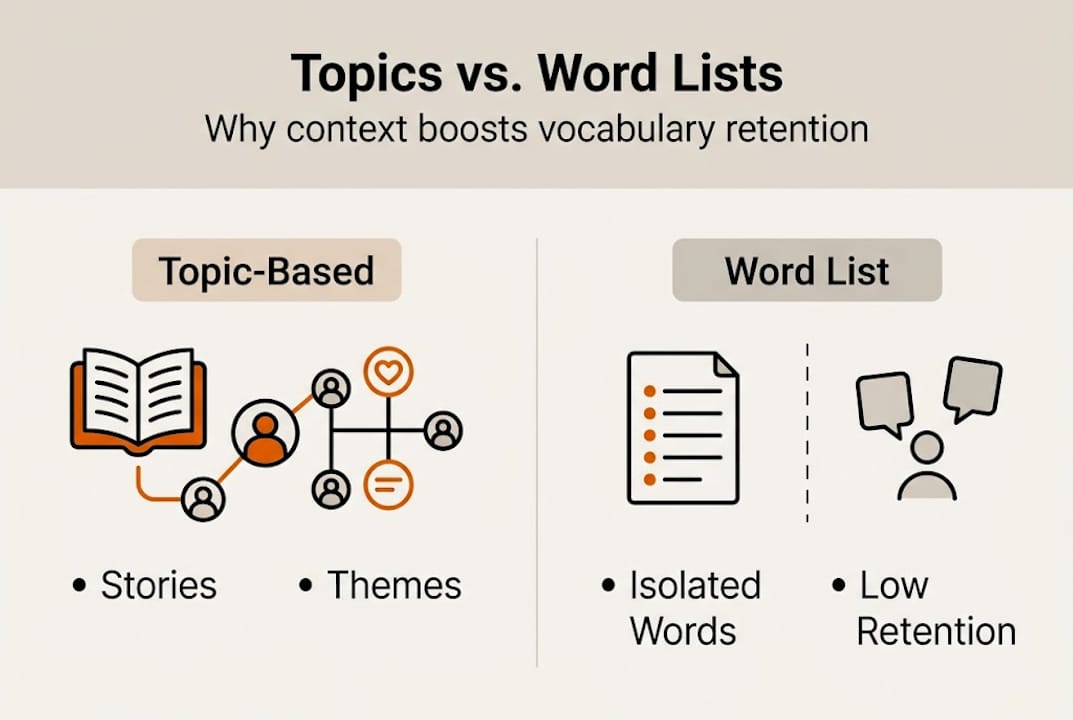
Topic interest positively correlates with lexical fluency, and rich, varied contexts lead to better vocabulary retention. This is not a minor difference. Learners who engage with high-interest topics produce more words, use them more accurately, and recover from speaking errors faster than those who rely on frequency-based lists alone.
Here's a quick comparison of how the two approaches stack up:
| Approach | Vocabulary retention | Speaking confidence | Long-term fluency |
|---|---|---|---|
| Rote word lists | Low to moderate | Low | Limited |
| Topic-driven stories | High | High | Strong |
| Thematic + grammar mix | Very high | High | Strongest |
The speaking practice advantages for intermediate learners become especially clear when topics are culturally rich. A story about a medieval Japanese court teaches you vocabulary for hierarchy, ceremony, and emotion — words that cluster naturally and reinforce each other.
Key reasons topic-based input works better:
- Words appear in meaningful sentences, not stripped of context
- Repeated exposure happens naturally across a narrative arc
- Emotional engagement signals the brain to prioritize storage
- Themes create vocabulary networks rather than isolated entries
Stat to know: Learners using topic-rich, contextualized input retain significantly more vocabulary over time compared to those using decontextualized word lists — and they report higher speaking confidence as a result.
Rote lists are not useless. They can help you recognize high-frequency words quickly. But if your goal is to actually use the language — to speak, respond, and express yourself — topic-driven learning is the more direct path.
Key methods: Storytelling, themes, and topical input
But how do these engaging topics get woven into lessons? Let's explore the most effective methods for bringing themes to life.
Three approaches stand out for intermediate learners: thematic vocabulary organization, TPRS, and narrative-based input. Each works differently, but all share one core principle — language is learned best when it means something.

Thematic vocabulary lists organize words around a topic rather than alphabetically or by frequency. Instead of memorizing 20 unrelated verbs, you learn 20 words connected to, say, ancient Egyptian trade routes. You see the same concepts from multiple angles, which creates the repetition your brain needs without the boredom.
TPRS (Teaching Proficiency through Reading and Storytelling) is a method built on comprehensible input and repeated exposure for natural vocabulary growth. A teacher or story presents language just above your current level, using culture and history themes to make the content compelling. You hear and read the same structures many times, in slightly different forms, until they feel automatic. Think of it like learning to cook from a recipe you make three times in a row — by the third time, you stop measuring.
The story-based workflow benefits are well documented, and story-based writing methods add another layer of active processing that deepens retention. Writing about what you've read forces you to retrieve and produce language, not just recognize it.
Here's how these methods compare in practice:
| Method | Best for | Repetition style | Grammar integration |
|---|---|---|---|
| Thematic lists | Vocabulary building | Deliberate review | Moderate |
| TPRS | Fluency and listening | Embedded in story | Natural |
| Narrative input | Reading and writing | Story-driven | Explicit when needed |
A practical sequence for intermediate learners:
- Choose a theme you find genuinely interesting (history, mythology, travel)
- Read or listen to a story built around that theme
- Review thematic vocabulary from the story, not from a separate list
- Write a short response or summary using new words
- Speak your summary aloud, then check your pronunciation
For a deeper look at how TPRS methodology works in classroom and self-study settings, the research is worth exploring.
Pro Tip: Blend story-based input with at least one explicit grammar focus per session. Noticing a grammar pattern inside a story you care about makes it far more memorable than studying it from a textbook in isolation.
What research reveals: Interest, context, and learning impact
Now that you know the methods, let's dig into what science says about why this approach works and where to stay alert.
The evidence is consistent and encouraging. High topic interest fuels lexical fluency for intermediate learners, and meaning-first vocabulary teaching — presenting words in context before drilling their isolated forms — is measurably more effective than the reverse. One finding puts the advantage at 37% better retention for meaning-first approaches.
But research also flags a nuance worth knowing. Topic interest mainly supports vocabulary and speaking (lexical) skills. It does not automatically transfer to complex grammar. If you only follow your interests without structured grammar practice, you may plateau with expressive vocabulary but struggle with sentence-level accuracy.
Positive psychological factors like enjoyment and curiosity increase learning outcomes in measurable ways. When you're engaged, you pay closer attention, process input more deeply, and return to practice more consistently. Motivation is not a soft benefit — it's a cognitive multiplier.
Key research findings for intermediate learners:
- Topic interest reliably boosts vocabulary breadth and speaking fluency
- Enjoyment increases time-on-task, which compounds learning gains
- Meaning-first input leads to stronger long-term retention than form-first drilling
- Grammar complexity requires explicit instruction alongside topic-based input
- Language learning outcomes improve when emotional engagement is high
"Learners who engage with high-interest topics don't just learn more words — they use those words more flexibly and recover from errors faster in real conversation."
The motivation and speaking success connection is real, and so is the risk of over-relying on enjoyment alone. The smartest approach pairs topic interest with deliberate skill-building. And if you want to see how writing boosts fluency, adding a short written reflection after each story session is one of the highest-return habits you can build.
The takeaway is clear: topics work, but they work best as part of a balanced system, not as the only ingredient.
Choosing the right topics: Practical strategies for intermediate learners
With research insights in mind, how can you choose topics that keep learning fresh and effective? Here's how to put it into action.
The most common mistake intermediate learners make is sticking exclusively to topics they already love. That feels comfortable, but comfort and growth are not always the same thing. Using diverse stories, especially from culture and history, boosts engagement and helps avoid vocabulary interference — the confusion that happens when similar words from the same narrow topic blur together in memory.
Practical strategies for smarter topic selection:
- Alternate between high-interest and challenge themes. If you love food culture, pair it with a history unit that pushes your vocabulary into unfamiliar territory.
- Match story complexity to your current level. A story that's too dense will frustrate more than it teaches. Aim for content where you understand about 80% without help.
- Use personal reflection to lock in new vocabulary. After reading a story, write three sentences using words you want to remember. This active retrieval is more effective than re-reading.
- Set a rotation schedule. Spend two weeks on one theme, then shift. This prevents topic fatigue and ensures you build vocabulary across different domains.
- Track which topics produce the most new words. You may find that history stories teach you more transferable vocabulary than travel stories, even if travel feels more immediately useful.
The reflection ideas for stories that work best are specific and personal. Don't just summarize the plot. Ask yourself: which character's choice surprised me? What would I have done differently? Answering in your target language forces you to produce language under mild cognitive pressure — exactly the condition that builds fluency.
Pro Tip: When you run out of ideas for what to study next, use AI-powered language prompts to generate story scenarios based on your current level and interests. A well-crafted prompt can give you a week's worth of fresh input in minutes.
Our perspective: What most guides miss about learning topics
Having outlined strategies and evidence-based tips, let's zoom out to reflect on what truly makes topic-based learning most effective.
Most guides tell you to follow your passions. Pick what excites you, and learning will feel effortless. That advice is partly right — but it leaves out something important. Passion without challenge produces comfort, not competence. We've seen intermediate learners spend months on topics they love and still plateau, because they never pushed into unfamiliar vocabulary territory.
The real insight is this: the best topic is not always the most interesting one. It's the one that sits at the edge of what you can handle. A story that stretches your vocabulary by 15 to 20% beyond your current range, while staying emotionally engaging, produces the fastest gains. Too easy, and you're not learning. Too hard, and you disengage.
Rotating between high-interest stories and skill-based challenges keeps progress balanced. Periodic review of core topics prevents gaps from forming. The learners who make the most consistent progress mix curiosity, challenge, and reflection — not just what feels fun in the moment. Active learning methods that push you to produce language, not just consume it, are what separate steady progress from stagnation.
Ready to unlock your next level?
If you're eager to put these insights to work and go beyond self-study, here's the next step.
AktivLang is built exactly for this kind of learning. You pick a theme — mythology, history, culture, travel, science, and more — read a story in your target language, then practice with 12+ exercise types covering vocabulary, comprehension, speaking, and grammar. Every exercise gives you instant feedback, so you always know what to improve.
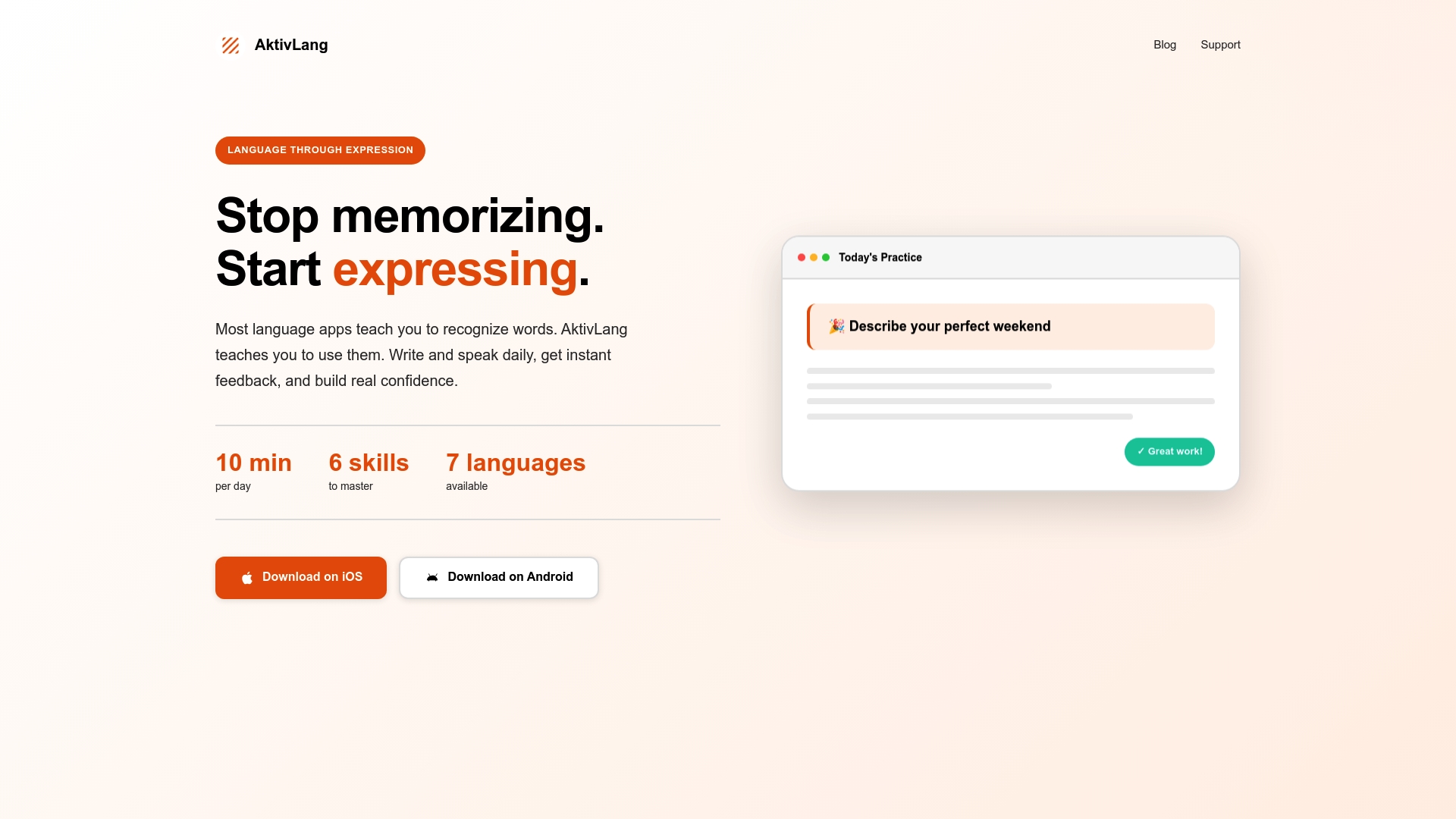
Whether you're learning French, Spanish, German, Dutch, Italian, or Portuguese, AktivLang language resources match your interests to curated stories at your level. Speaking exercises include AI-powered fluency and accuracy scores, so you're not just reading — you're producing. That's the difference between recognizing a language and actually using it. Start with a theme you care about, and let the stories do the heavy lifting.
Frequently asked questions
Is it better to learn vocabulary by theme or by frequency?
Thematic and contextualized input is more effective for vocabulary retention and speaking fluency for intermediate learners, particularly when stories and real-world context are involved. Frequency-based lists are useful for recognizing common words but less effective for active production.
What kinds of topics work best for intermediate language learners?
Cultural and historical themes improve engagement and vocabulary gain because they provide rich, emotionally resonant contexts where words appear repeatedly and meaningfully. Real-life scenarios and travel topics also perform well when matched to the learner's level.
Do topics help with grammar as much as vocabulary?
Topic interest mainly supports lexical skills over syntactic ones, meaning vocabulary and speaking benefit most. Explicit grammar practice should run alongside topic-based learning for balanced, accurate language development.
How do I avoid getting stuck on the same topics?
Rotate your themes every two to three weeks, set small vocabulary challenges within each new topic, and use short written reflections to consolidate what you've learned. Mixing diverse themes prevents vocabulary interference and keeps your progress moving across different language domains.