

TL;DR:
- The intermediate plateau can be overcome with targeted speaking exercises under mild pressure.
- Effective exercises focus on pronunciation, real-life context, immediate feedback, and appropriate difficulty.
- Consistent daily practice of 10 to 30 minutes accelerates fluency more than infrequent long sessions.
You study every day, you know your vocabulary, and you can read a menu or follow a podcast. Yet when someone asks you a question in French, Spanish, or German, your brain freezes. That frustrating gap between understanding and speaking is called the intermediate plateau, and it affects almost every learner at this stage. The good news is that it is not a sign of failure. It is a sign that passive input alone is no longer enough. Targeted speaking exercises, the kind that force you to produce language under mild pressure, are exactly what break that plateau and push you toward real fluency.
Table of Contents
- How to choose effective speaking exercises
- Top examples of speaking exercises for each language
- Comparison: Which exercise types deliver the fastest results?
- Adapting exercises to your learning style and goals
- Our perspective: What most learners miss about speaking exercises
- Next steps: Take your speaking practice further
- Frequently asked questions
Key Takeaways
| Point | Details |
|---|---|
| Practice daily in short bursts | Consistent 15–30 min sessions speed up fluency gains. |
| Tailor exercises to your language | Focus drills on key sounds and conversational needs of each language. |
| Monitor progress with feedback tools | Record yourself and use AI scoring for instant, actionable feedback. |
| Personalize your routine | Mix exercises and adjust methods based on your goals and weak spots. |
How to choose effective speaking exercises
Not all speaking exercises are created equal. Some feel productive but deliver little real improvement. Others feel uncomfortable at first and deliver enormous gains. Knowing how to evaluate an exercise before you invest time in it saves weeks of spinning your wheels.
Here are four criteria worth applying to any speaking exercise you consider:
- Pronunciation focus. Does the exercise target a specific sound or pattern in your target language? Generic "talk about yourself" prompts rarely fix a persistent accent problem. Exercises built around specific phonemes do.
- Immediate feedback. Can you hear or see whether you got it right within seconds? Delayed feedback is far less effective for building automaticity (the ability to produce language without conscious effort).
- Real-life context. Does the exercise mirror a situation you will actually face? Role-plays, story-based dialogs, and topic-driven conversations transfer to real life far better than abstract drills.
- Appropriate difficulty. The exercise should feel slightly challenging but not overwhelming. If you can do it perfectly on the first try, it is too easy.
The methodology behind guided speaking exercises consistently points to the same conclusion: daily sessions of 10 to 30 minutes, progressing from slow and accurate to fast and fluent, produce more consistent gains than occasional long sessions. Recording yourself and comparing your output to a native speaker is one of the most honest forms of feedback available. AI grading tools take that a step further by giving you an instant score.
Understanding the advantages of speaking practice also means recognizing that language-specific challenges matter. The exercises that help a French learner master nasal vowels are not the same ones that help a German learner tame the guttural R. Adapt your selection accordingly.
Pro Tip: Record a 60-second voice memo in your target language every morning. Listen back immediately. You will spot hesitations and mispronunciations far faster than any teacher will.
Top examples of speaking exercises for each language
With a selection strategy in mind, let's jump into specific practice exercises tailored for each language. Daily 10 to 15 minute drills targeting key phonemes, combined with recording yourself and comparing to native audio, accelerate progress across all six languages.
French
- Read-aloud drills focusing on nasal vowels (un, on, an, in) and liaisons. Take a short paragraph and read it aloud slowly, then at natural speed.
- Shadow a native speaker on a 30-second audio clip. Pause, repeat, and match the rhythm.
- Practice the silent-E rule in connected speech to sound less robotic.
Spanish
- Rolled R drills: repeat words like "perro" and "ferrocarril" in sets of ten, focusing on tongue placement.
- Rapid verb conjugation challenges: set a timer for 60 seconds and conjugate a verb through all persons as fast as possible.
- Record yourself telling a short story and listen for vowel clarity.
German
- Umlaut minimal pairs: practice Mutter vs. Mütter, or schon vs. schön, back to back to train your ear and mouth simultaneously.
- Guttural ch and R shadowing: use audio clips of native speakers and mimic the throat placement.
Italian
- Double consonant exercises: contrast "pala" (shovel) and "palla" (ball) to hear and produce the length difference.
- Dramatic role-play: Italian prosody (the rhythm and melody of speech) is best learned by exaggerating emotion in practice.
Dutch
- Guttural G practice: record yourself and compare to native audio on conversation practice resources.
- UI and EU vowel drills: these sounds have no English equivalent, so repetition with native audio is essential.
Portuguese
- Nasal vowel repetition: use text-to-speech tools to generate native-quality audio for any sentence, then repeat and record yourself.
Pro Tip: Pick one phoneme per week. Drill it daily for seven days before moving on. Depth beats breadth every time.
Comparison: Which exercise types deliver the fastest results?
Armed with language-specific exercise options, it is smart to compare approaches and monitor your improvement.
| Exercise type | Speed of visible gains | Best for | Feedback method |
|---|---|---|---|
| Read-aloud drills | Fast (1 to 2 weeks) | Pronunciation accuracy | Self-recording, AI grading |
| Conversation role-play | Medium (2 to 4 weeks) | Fluency and real-life transfer | Native speaker, AI scoring |
| Minimal pair drills | Fast (1 to 2 weeks) | Accent reduction | Self-recording |
| Shadowing | Fast (1 to 3 weeks) | Rhythm and intonation | Self-recording vs. native |
| Verb conjugation sprints | Medium (2 to 3 weeks) | Grammatical automaticity | Self-check, flashcard apps |
| Storytelling prompts | Slower (3 to 5 weeks) | Extended fluency | Native feedback, AI scoring |
The data is clear: 15 to 30 minutes daily leads to measurable fluency gains in two to three weeks. AI grading tools that produce a score between 80 and 99 percent native match are a reliable indicator of real proficiency progress.
Consistency matters more than duration. A 20-minute session every day outperforms a two-hour session on the weekend. The brain builds active language learning methods through repeated, spaced exposure, not cramming.
Conversation role-play and read-alouds consistently produce the fastest measurable gains because they combine pronunciation, grammar, and real-world context in a single exercise. If you only have time for one type, choose role-play built around a story or scenario you care about.

Adapting exercises to your learning style and goals
Every learner is different, and here is how to make these speaking exercises work for you specifically.
Start by identifying your two or three biggest weak points. Are you struggling with specific sounds, or is your hesitation more about finding words quickly? The answer changes your exercise priority.
- Identify your CEFR level. The Common European Framework of Reference (CEFR) describes B1 learners as able to handle familiar topics and B2 learners as able to interact with fluency on a wide range of subjects. Knowing where you sit gives you a realistic target and helps you personalize your language routine instead of following a generic plan.
- Match exercises to your interests. If you love history, practice speaking by summarizing historical stories. If you follow sports, describe a game in your target language. Motivation is a performance multiplier.
- Build a troubleshooting habit. If you hit a wall, switch methods. Sticking with the same exercise that stopped working is one of the most common reasons intermediate learners plateau.
- Integrate story-based practice into your routine. Reading a story first gives you vocabulary and context that makes the speaking exercise far more productive.
"Use CEFR B1 and B2 benchmarks alongside innovative practice methods for consistent, measurable gains." Matching your exercises to a clear proficiency target removes guesswork and keeps you moving forward.
Review your progress every two weeks. If your AI scores are not improving, or if you still hesitate on the same sounds, that is your signal to adjust. Consistent benchmarking using CEFR tasks and AI feedback keeps you honest about where you actually stand.
Our perspective: What most learners miss about speaking exercises
Here is something most guides will not tell you: the exercises that feel comfortable are usually the ones delivering the least improvement.
Most intermediate learners gravitate toward exercises where they already perform reasonably well. It feels like progress. It is not. Real speaking gains come from the exercises that make you stumble, self-correct, and try again. That productive discomfort is where fluency actually builds.
Perfection is also a trap. Waiting until you can say something perfectly before you say it out loud is the fastest way to stay stuck. Errors are not failures. They are data. Every mispronunciation you catch and correct in practice is one you will not make in a real conversation.
One underrated strategy: write a short script before you speak. Preparing a three-sentence mini-script on a topic forces you to think about grammar and vocabulary in writing first, which then transfers directly to your spoken output. Writing to support speaking is not a shortcut. It is a legitimate accelerator that most learners overlook entirely.
Next steps: Take your speaking practice further
Ready to put these insights into action? Here is your next step.
Knowing which exercises work is only half the equation. The other half is having a structured environment where you can practice them consistently and get real feedback on your performance.
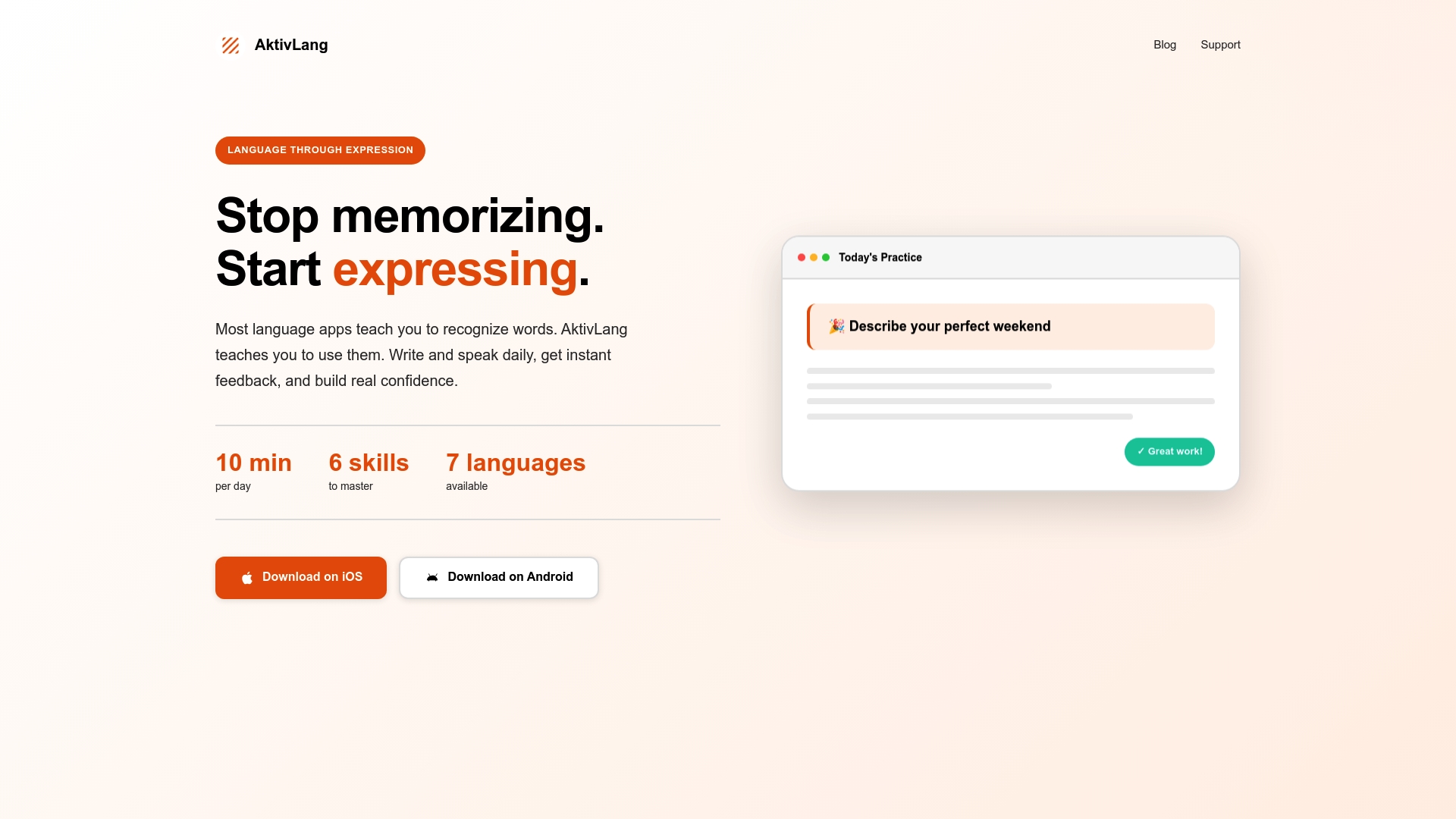
AktivLang is built exactly for this stage of your learning. You read engaging stories in French, Spanish, German, Dutch, Italian, or Portuguese, then practice what you learned through speaking exercises with AI pronunciation grading and fluency scores. Every session gives you instant feedback so you always know what to improve. Explore guided speaking exercises built around stories and themes you actually care about, and start building a speaking routine that moves the needle every single day.
Frequently asked questions
How often should I practice speaking exercises to see improvement?
Daily sessions of 15 to 30 minutes typically produce noticeable fluency gains within two to three weeks. Consistency matters far more than the length of any single session.
What are the best speaking exercises for improving pronunciation?
Read-aloud drills, minimal pair exercises, and AI-feedback tools are the most effective options. Daily 10 to 15 minute drills targeting specific phonemes, combined with recording yourself and comparing to native audio, deliver the clearest results.
How can I track my speaking progress?
Use AI grading tools, compare self-recordings to native speakers, and complete CEFR B1 and B2 benchmark tasks regularly. AI scores of 80 to 99 percent native match are a reliable indicator of real proficiency gains.
What if I'm not confident to speak with others yet?
Start with solo practice such as reading aloud and repeating after native audio, then gradually add role-plays or short scripted conversations. Progressing from slow and accurate to fast and fluent builds confidence before you ever need to speak with another person.