

Most language learners spend hours consuming content, reading articles, watching videos, and listening to podcasts in their target language. Yet when it's time to speak or write, the words vanish. This frustrating gap exists because passive exposure builds recognition, not production. Active language learning flips this dynamic by prioritizing deliberate output and retrieval. This guide clarifies what active learning truly means, why it outperforms passive methods, and how you can apply evidence-backed strategies like spaced retrieval, story-based practice, and interactive exercises to transform your language skills from dormant knowledge into confident fluency.
Table of Contents
- Key takeaways
- Understanding active language learning and why it matters
- Core active learning methods and evidence-backed strategies
- Enhancing active skills through story-based practice and interactive exercises
- Balancing passive input with active recall: expert insights and practical advice
- Elevate your active language learning with AktivLang
- Frequently asked questions
Key Takeaways
| Point | Details |
|---|---|
| Active language output | Active learning centers on producing and recalling language through output activities rather than passive input alone. |
| Retrieval strengthens production | Forcing yourself to recall words and structures strengthens neural pathways and speeds real time speech. |
| Spaced retrieval practice | Reviewing material at increasing intervals dramatically improves long term retention. |
| Story based practice | Using narratives to practice language engages context and strengthens recall in meaningful ways. |
Understanding active language learning and why it matters
Active language learning refers to methods where learners actively engage in producing and recalling language through techniques like active recall, retrieval practice, and output activities. This contrasts sharply with passive methods such as reading or listening without deliberate production. When you passively consume content, you build recognition vocabulary—words you understand when you see or hear them. But recognition doesn't guarantee production ability.
The distinction matters because fluency demands more than comprehension. Speaking and writing require you to retrieve words from memory, construct grammatically correct sentences, and apply vocabulary in real-time contexts. Passive learning creates a recognition-production gap that frustrates intermediate learners who understand everything but struggle to respond. Research shows native speakers have about 20,000 active vocabulary words versus 40,000 passive words, illustrating how production vocabulary naturally lags behind recognition.
Active learning bridges this gap through deliberate practice:
- Active recall: Forcing yourself to retrieve information from memory without prompts strengthens neural pathways
- Retrieval practice: Repeatedly recalling words and structures in varied contexts builds automaticity
- Output activities: Speaking, writing, and translation exercises convert passive knowledge into active skills
- Self-testing: Quizzing yourself on vocabulary and grammar identifies weak spots and reinforces retention
"The act of retrieving information from memory fundamentally changes how that information is stored, making it more accessible for future use and building the production pathways necessary for fluent communication."
Without active practice, you remain stuck in the recognition phase. You might understand a conversation perfectly but freeze when asked a question. You can read articles fluently but struggle to write a simple email. Active learning forces you to produce language repeatedly, transforming dormant knowledge into accessible skills. For intermediate learners ready to move beyond comprehension exercises, prioritizing output through conversation practice becomes essential for breaking through plateaus and achieving genuine fluency.
Core active learning methods and evidence-backed strategies
Several proven techniques form the foundation of effective active language learning. These methods consistently outperform passive review in retention studies and practical application.
-
Active recall with flashcards: Create flashcards that prompt production, not just recognition. Instead of seeing a word and flipping to its translation, see the translation and produce the target word. Better yet, use full sentence prompts that require you to construct grammatically correct responses.
-
Reverse translation: Translate sentences from your native language into your target language. This forces you to recall vocabulary, apply grammar rules, and construct natural-sounding phrases without relying on recognition cues.
-
Spaced retrieval practice: Review material at increasing intervals (one day, three days, one week, two weeks). This spacing effect dramatically improves long-term retention compared to cramming or passive rereading.
-
Self-testing routines: Quiz yourself regularly on vocabulary, verb conjugations, and sentence structures. Testing isn't just assessment; it's a powerful learning tool that strengthens memory pathways.
-
Output-focused exercises: Prioritize speaking and writing activities over passive listening and reading. Even simple exercises like describing your day or narrating actions build production fluency.
Research demonstrates the power of these approaches. Active recall methods like reverse translation and self-testing dramatically improve retention compared to passive review. Studies on spaced retrieval practice show that interactive flashcards and timed reviews support long-term vocabulary retention far better than continuous exposure alone.
| Method | Retention Rate | Best For |
|---|---|---|
| Passive reading/listening | 20-30% after one week | Initial exposure and comprehension |
| Active recall flashcards | 60-70% after one week | Vocabulary and phrase memorization |
| Spaced retrieval practice | 75-85% after one month | Long-term retention and automaticity |
| Output exercises (speaking/writing) | 80-90% after one month | Production fluency and real-world application |
"Combining mnemonic techniques with retrieval practice creates retention rates exceeding 80% after multiple review rounds, while passive methods plateau around 30% regardless of exposure time."
For intermediate learners, the key is consistency. Dedicate 20% of your study time to active output even when it feels harder than passive review. The discomfort signals learning. Apply these language learning tips systematically, and you'll notice vocabulary becoming more accessible during conversations and writing sessions within weeks.
Enhancing active skills through story-based practice and interactive exercises
Story immersion adds crucial context to active learning methods. While flashcards and self-testing build raw recall ability, stories provide meaningful frameworks that anchor vocabulary and grammar to memorable scenarios. This contextual learning dramatically improves retention and makes language practice more engaging.
Several story-based approaches support active learning:
- TPRS (Teaching Proficiency through Reading and Storytelling): This method uses repetitive storytelling with comprehension checks and student participation, forcing learners to process and produce language in context rather than memorizing isolated items.
- AI roleplay scenarios: Interactive conversations with AI characters in realistic situations require you to produce appropriate responses, building both vocabulary and pragmatic language skills.
- Interactive narratives: Stories with decision points or comprehension exercises that require active responses keep you engaged and force retrieval throughout the reading experience.
- Story retelling: After reading or listening to a story, retell it in your own words without looking at the original. This combines comprehension with active production.
Research confirms the advantage. Story-based practice anchors vocabulary and grammar to context, retaining information 2-3 times longer than traditional drills. When you learn the word "disappointed" through a flashcard, you might remember it temporarily. When you encounter it in a story about a character missing an important opportunity, the emotional context creates stronger memory associations.

Stories also provide natural opportunities for varied practice. You can read for comprehension, answer questions to test understanding, retell the plot to practice speaking, write alternative endings to build writing skills, or analyze character motivations to deepen grammatical understanding. This variety keeps practice fresh while hitting multiple skill areas.
Pro Tip: Personalize story scenarios by adapting them to your own experiences or interests. If a story involves traveling to a new city, imagine yourself in that situation and describe what you would do differently. This personal connection strengthens memory formation and makes vocabulary more accessible during real conversations.
Combining story-based learning with systematic recall creates powerful synergy. Stories provide the context and engagement that make learning enjoyable, while active recall exercises ensure the vocabulary and structures actually stick. Use creative writing prompts to extend story practice into original production, and incorporate regular speaking practice to verbalize the language patterns you've absorbed through reading. This balanced approach addresses both the motivation challenge of repetitive drills and the retention challenge of purely passive content consumption.
Balancing passive input with active recall: expert insights and practical advice
The language learning community debates the optimal balance between passive input and active output. Some advocate for massive input through extensive reading and listening, arguing that acquisition happens naturally with enough exposure. Others emphasize deliberate practice and production from day one. The evidence suggests both matter, but in different proportions.
Experts recommend an 80% passive input and 20% active output language learning ratio for best fluency development. This balance provides sufficient exposure to natural language patterns while ensuring you regularly practice production. Passive input builds your mental model of the language, exposing you to vocabulary, grammar structures, and cultural context. Active output transforms that model into usable skills.
The ratio reflects practical learning dynamics. You can consume passive content for hours daily through podcasts during commutes, videos during meals, or reading before bed. Active practice demands more focused attention and mental energy, making it harder to sustain for long periods. A 20% output allocation might translate to 30 minutes of speaking or writing practice in a 2.5-hour daily study routine, which is both achievable and effective.
| Learning Type | Benefits | Limitations |
|---|---|---|
| Passive input | Builds recognition vocabulary, exposes natural patterns, requires less mental effort, easily integrated into daily life | Creates recognition-production gap, doesn't build active recall pathways, limited fluency improvement without output |
| Active output | Strengthens production pathways, builds speaking/writing fluency, identifies knowledge gaps, improves retention through retrieval | Requires focused effort, mentally demanding, harder to sustain for long periods, needs correction feedback |
Importantly, retrieval practice benefits grow with repeated rounds. The first time you actively recall a word, retention improves modestly. The third or fourth retrieval creates much stronger memory traces. This means consistent, spaced active practice delivers compounding returns. Relying solely on passive input builds recognition but not fluent production, leaving you perpetually stuck understanding everything while saying nothing.
Pro Tip: Track your output activities weekly to maintain active practice consistency. Log speaking sessions, writing exercises, and self-testing rounds. When you see the numbers, you'll notice patterns and ensure you're hitting that 20% output target rather than defaulting entirely to comfortable passive consumption.
The balance also shifts with proficiency level. Beginners benefit from higher input ratios (90/10) to build foundational vocabulary and grammar awareness. Intermediate learners should increase output to 20-30% to develop production fluency. Advanced learners might push output even higher when preparing for specific goals like presentations or exams. Adjust based on your current needs, but always maintain some active practice. Personalizing your language learning approach ensures you're addressing your specific weaknesses rather than following generic advice that might not match your situation.
Elevate your active language learning with AktivLang
Understanding active learning principles is one thing. Applying them consistently is another. You need tools that make active practice engaging rather than tedious, provide immediate feedback to correct mistakes, and integrate seamlessly into your routine.
AktivLang builds active learning into every interaction. Read compelling stories in French, Spanish, German, Dutch, Italian, or Portuguese, then immediately practice what you've learned through 12+ exercise types designed to force retrieval and production. Vocabulary exercises require you to produce words, not just recognize them. Comprehension questions test understanding through active response. Speaking exercises with AI feedback let you practice pronunciation and fluency scoring in real-time.
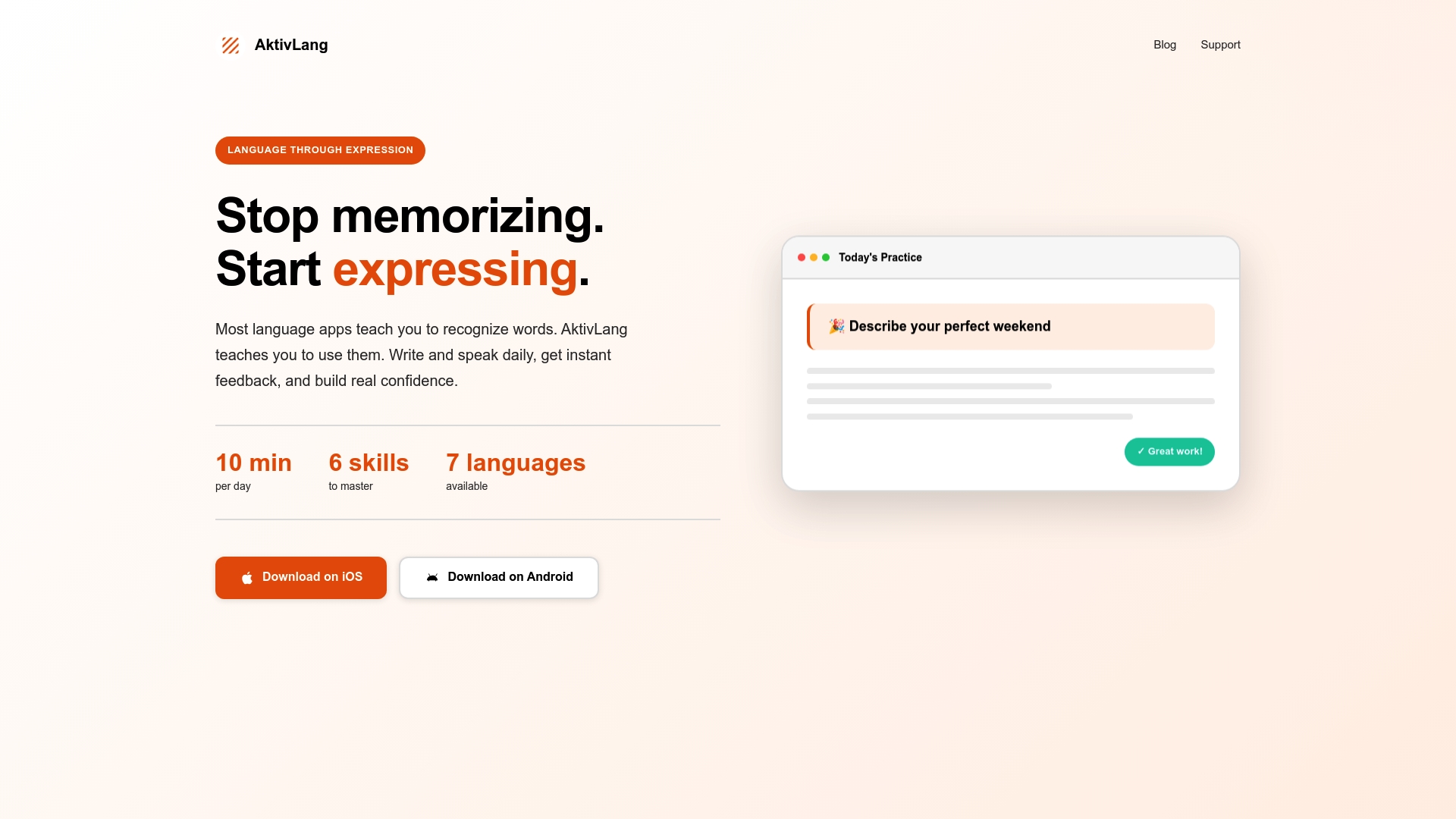
The platform balances input and output naturally. Stories provide the engaging context that makes vocabulary memorable, while interactive exercises ensure you're actively recalling and producing language rather than passively consuming. Track your progress across vocabulary, grammar, and speaking with weekly insights that show exactly where you're improving and where you need more practice. Whether you're an intermediate learner ready to break through plateaus or preparing for real-world conversations, AktivLang transforms the active learning strategies covered in this guide into practical daily practice.
Frequently asked questions
What is active language learning?
Active language learning involves methods that require you to produce and recall language deliberately, such as speaking exercises, writing practice, self-testing, and retrieval drills. Unlike passive learning (reading or listening without output), active learning builds the neural pathways necessary for fluent production. It bridges the gap between understanding language and actually using it in real-time conversations or writing.
How does active recall improve language retention?
Active recall forces your brain to retrieve information from memory without prompts, strengthening the neural connections associated with that knowledge. Each retrieval makes the information more accessible for future use. Research shows active recall can improve retention rates by 60-80% compared to passive review methods. The effort of retrieval itself creates stronger memory traces than simply re-reading or re-listening to material.
What's the difference between recognition and production vocabulary?
Recognition vocabulary includes words you understand when reading or hearing them, while production vocabulary consists of words you can actively use when speaking or writing. Native speakers typically have twice as many recognition words as production words. Passive learning builds recognition vocabulary, but only active practice through speaking, writing, and deliberate recall converts recognition into production ability.
How much time should I spend on active versus passive practice?
Experts recommend dedicating approximately 20% of your study time to active output (speaking, writing, self-testing) and 80% to passive input (reading, listening, watching content). This balance provides sufficient exposure to natural language patterns while ensuring regular production practice. Adjust based on your level: beginners might use 90/10, while advanced learners preparing for specific goals might increase output to 30-40%.
Why is story-based learning more effective than isolated drills?
Stories provide meaningful context that anchors vocabulary and grammar to memorable scenarios, creating stronger associations than isolated word lists. Contextual learning helps your brain organize information around narrative frameworks rather than arbitrary groupings. Research shows story-based practice retains vocabulary 2-3 times longer than traditional drills because the emotional and situational context creates multiple retrieval cues that make words more accessible during real conversations.
Can I improve fluency through active learning without a teacher?
Yes, many active learning methods work effectively for self-study. Self-testing with flashcards, writing practice with online correction tools, speaking exercises with AI feedback, and story-based apps with interactive exercises all support independent active learning. The key is consistency and honest self-assessment. While teachers provide valuable correction and conversation practice, structured self-study using active methods can deliver significant fluency improvements, especially for intermediate learners building production skills.