

Most intermediate language learners pour hours into conversation practice, convinced that speaking is the fastest path to fluency. Yet research reveals a surprising truth: writing in your target language activates cognitive processes that speaking alone cannot replicate. When you write, you engage deeper linguistic structures, wrestle with grammar in real time, and internalize vocabulary patterns that transform passive knowledge into active command. This article unpacks why writing accelerates fluency gains, how it develops collocational proficiency that native speakers recognize instantly, and practical strategies to make your writing practice both effective and engaging.
Table of Contents
- Key takeaways
- How writing uniquely benefits language learning
- Why collocations and fluency improve through writing practice
- Tailoring writing exercises to your background and learning goals
- Putting it all together: practical tips for effective writing practice
- Explore AktivLang for immersive writing practice
- Frequently asked questions
Key Takeaways
| Point | Details |
|---|---|
| Grammar awareness through writing | Writing forces precise grammar practice and helps you notice errors you would miss in speech. |
| Collocation mastery through writing | Writing prompts deliberate word choices and helps internalize natural word pairings that native speakers expect. |
| Writing as diagnostic tool | A written record lets you review patterns over time and target specific weaknesses rather than practicing randomly. |
| Think in the language | Regular writing helps you think in the target language rather than translating from your native tongue, boosting fluency and accuracy. |
How writing uniquely benefits language learning
Writing demands a level of linguistic precision that speaking often lets you sidestep. When you speak, gestures, intonation, and immediate context fill gaps in your vocabulary. Writing strips away these safety nets. You must select exact words, construct grammatically sound sentences, and organize thoughts coherently without real-time feedback from a conversation partner.
This active production strengthens your internalization of vocabulary and grammar in ways passive exposure cannot match. Research demonstrates that L1 influences L2 writing complexity with lexical and grammatical features predicting proficiency levels. Your native language patterns shape how you approach writing in the target language, revealing gaps in your understanding that speaking practice might mask.
Consider these cognitive advantages of regular writing practice:
- Forces retrieval of vocabulary from memory rather than recognition from context
- Exposes grammatical weaknesses that require conscious correction
- Builds awareness of sentence structure patterns specific to the target language
- Develops meta-linguistic thinking about how the language actually works
Writing also serves as a diagnostic tool. When you commit words to paper or screen, you create a permanent record of your language use. You can review what you wrote yesterday, last week, or last month and spot patterns in your errors. This self-awareness accelerates improvement because you can target specific weaknesses rather than practicing randomly.
"Writing complexity parameters including lexical diversity, syntactic sophistication, and grammatical accuracy reliably predict overall language proficiency across learner levels."
The relationship between writing and proficiency runs deeper than simple practice effects. Writing quality reflects your command of the linguistic system itself. As you write more, you internalize the rhythm and flow of the target language. You begin to think in that language rather than translating from your native tongue. This cognitive shift marks the transition from intermediate competence to advanced fluency. Explore more insights on the language learning through writing blog for additional strategies.
Why collocations and fluency improve through writing practice
Collocations are word combinations that native speakers use instinctively but learners must acquire deliberately. In English, we say "make a decision" not "do a decision," "heavy rain" not "strong rain." Every language has thousands of these natural pairings. Mastering them separates intermediate learners who sound textbook-correct from advanced speakers who sound genuinely fluent.
Writing practice accelerates collocation acquisition because it forces you to make deliberate word choices. When speaking, you might rush past a collocation error without noticing. When writing, you pause, consider alternatives, and often look up the correct pairing. This conscious processing embeds the collocation in memory far more effectively than passive exposure through reading or listening.

Research confirms that collocational proficiency features positively impact expert ratings of L2 writing quality. Native speakers judge writing fluency not primarily by grammatical accuracy but by whether word combinations sound natural. A text with perfect grammar but awkward collocations reads as foreign. A text with minor grammatical slips but native-like collocations reads as fluent.
Fluency in writing manifests as smooth flow with minimal pausing and revision. Studies show that fluency and pausing behaviors link strongly to complexity and accuracy in independent writing. When you write fluently, you produce text continuously without stopping to search for words or reconstruct sentences. This automaticity indicates deep internalization of linguistic patterns.
| Aspect | Writing practice impact | Speaking practice impact |
|---|---|---|
| Collocation acquisition | High - deliberate word choice builds awareness | Moderate - real-time pressure limits conscious processing |
| Fluency development | High - visible pausing patterns reveal processing gaps | Moderate - conversational flow masks underlying struggles |
| Error correction | High - permanent record enables self-review | Low - errors disappear immediately without feedback |
| Complexity growth | High - time to construct sophisticated structures | Moderate - pressure favors simpler, safer constructions |
Pro Tip: When writing stories in your target language, keep a collocation journal. Each time you look up a natural word pairing, write it down with an example sentence. Review this journal weekly. You'll internalize high-impact collocations faster than through reading alone, and your writing will sound increasingly native. For structured approaches, check out this writing practice workflow guide.
Tailoring writing exercises to your background and learning goals
Your educational background and native language shape how quickly you develop writing skills in the target language. Learners with extensive formal education in their L1 typically transfer academic writing strategies more easily. Those with limited formal schooling face steeper initial challenges but can absolutely achieve fluency through consistent practice.
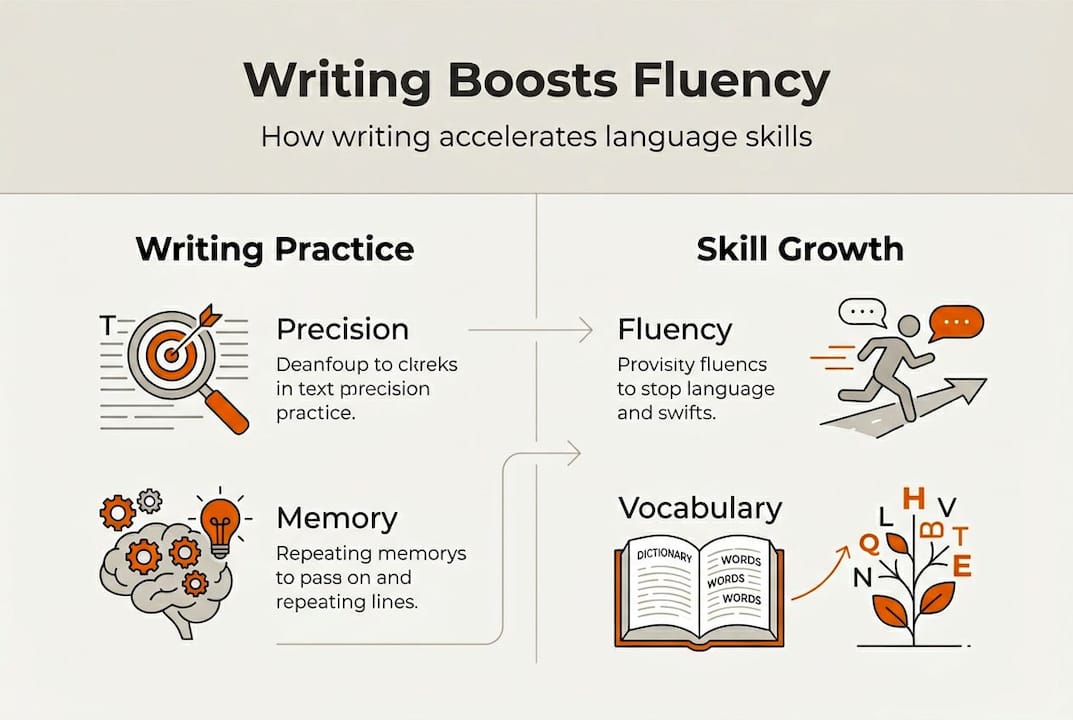
Research indicates that education level predicts L2 writing ability and development rate, with slower progress for low-education adults. This doesn't mean writing practice is less valuable for these learners. It means they benefit from different instructional approaches: more scaffolding, explicit instruction in text organization, and patience with the learning curve.
| Learner background | Common writing challenges | Effective strategies |
|---|---|---|
| High formal education in L1 | Over-reliance on L1 academic conventions; translating complex structures | Focus on target language rhetorical patterns; read extensively in the genre you want to write |
| Limited formal education | Difficulty organizing longer texts; uncertainty about punctuation and formatting | Start with structured templates; practice paragraph-level writing before essays |
| L1 with similar writing system | False friends in vocabulary; assuming parallel grammar structures | Explicit contrastive analysis; highlight differences between L1 and L2 patterns |
| L1 with different writing system | Mechanical challenges with script; slower processing speed | Separate handwriting practice from composition; use typing initially to reduce cognitive load |
To optimize your writing practice regardless of background, follow these steps:
- Assess your current writing level honestly by writing a short text and identifying specific weaknesses.
- Set targeted goals that address those weaknesses rather than generic "write more" intentions.
- Choose writing tasks that match your proficiency and gradually increase difficulty.
- Incorporate story-based prompts that provide context and vocabulary scaffolding.
- Review your writing after 24 hours to spot errors your brain missed during composition.
- Track progress by comparing texts written weeks apart to see tangible improvement.
Pro Tip: Balance grammar-focused exercises with creative writing to maintain motivation. Spend 70% of your writing time on structured practice that targets specific skills, and 30% on free writing about topics you genuinely care about. This mix builds competence while keeping the process enjoyable. Discover how to boost language skills through integrated practice methods, and explore more on the language writing blog post.
Your learning goals should drive your writing practice format. Preparing for an exam? Focus on timed writing and formal register. Building conversational fluency? Practice informal messages and dialogue writing. Planning to work in the target language? Write professional emails and reports. Aligning practice with real-world applications keeps you motivated and ensures your skills transfer when you need them.
Putting it all together: practical tips for effective writing practice
Transforming writing from an intimidating task into a daily habit requires strategic planning and realistic expectations. Start by setting specific, measurable goals. Instead of "write more in Spanish," commit to "write three paragraphs about my day every evening" or "compose one short story per week using vocabulary from my reading."
Balance accuracy with creativity in your practice. Spending every writing session obsessing over perfect grammar kills motivation and limits fluency development. Alternate between focused accuracy work where you revise extensively and fluency work where you write freely without stopping to correct errors. Both modes develop different aspects of writing competence.
Story-based and real-life topics maintain engagement far better than abstract prompts. Write about your actual experiences, retell movies or books you love, or create fictional scenarios involving characters you care about. Context-rich writing embeds vocabulary in memorable situations rather than isolated lists. When you recall the story, you recall the words.
Incorporate feedback loops into your routine:
- Self-review your writing 24-48 hours after composition when you have fresh perspective
- Use language exchange partners who can comment on naturalness and clarity
- Join online communities where native speakers provide informal corrections
- Track recurring errors in a log and create targeted exercises to address them
Regular practice develops complexity, accuracy, and fluency simultaneously. Research confirms that active language production through writing supports simultaneous development of all three dimensions when practiced consistently. You don't need to perfect one before working on others. Write regularly, and all aspects improve together over time.
Pro Tip: Integrate writing with speaking practice for synergistic gains. After writing a paragraph, read it aloud and record yourself. Listen for awkward phrasing that sounds fine on paper but clunky when spoken. Revise for natural flow, then record again. This combined approach builds both written and oral fluency while reinforcing vocabulary and grammar patterns. For detailed workflows, explore this writing practice workflow and additional tips on the language learning writing blog.
Consistency matters more than intensity. Writing for 15 minutes daily produces better results than cramming two hours once weekly. Daily practice keeps the target language active in your mind, reinforces patterns through repetition, and builds the habit that sustains long-term progress. Start small, maintain consistency, and gradually increase duration as writing becomes easier and more enjoyable.
Explore AktivLang for immersive writing practice
If you're ready to accelerate your fluency through structured writing practice, AktivLang offers a platform specifically designed for active language production. Unlike passive apps that focus on recognition, AktivLang builds fluency through story-based writing exercises in French, Spanish, German, Dutch, Italian, and Portuguese.
The platform guides you through engaging stories, then challenges you to actively produce language through writing tasks that target vocabulary, grammar, and natural expression. Each exercise provides immediate feedback, helping you spot errors and internalize correct patterns faster than self-study alone. Intermediate learners benefit from personalized workflows that adapt to your proficiency level and learning goals, ensuring practice remains challenging but achievable. The community of dedicated learners shares tips, celebrates progress, and makes the journey toward fluency less isolated and more motivating.
Frequently asked questions
What are simple ways to start writing if I'm shy or unsure?
Begin with private journaling about your daily activities in simple sentences. No one will read it, so perfectionism can't hold you back. Write three sentences each evening describing what you did, felt, or thought. Gradually expand to five sentences, then a full paragraph. This low-pressure approach builds confidence and habit simultaneously.
How often should I write to see real progress in my language skills?
Daily practice produces the fastest results, even if just 10-15 minutes per session. Consistency matters more than duration. Writing five days per week shows noticeable improvement within 4-6 weeks. Less frequent practice still helps but slows progress. Aim for at least three sessions weekly as a minimum effective dose.
Is it better to write stories or journal entries in my target language?
Both formats offer unique benefits, so alternate between them. Journal entries develop everyday vocabulary and conversational structures useful for daily communication. Stories build narrative skills, descriptive language, and creative expression. Mixing formats prevents boredom while developing a broader range of linguistic competencies.
Can writing practice help me speak more fluently?
Absolutely. Writing builds vocabulary depth, grammatical accuracy, and sentence construction skills that transfer directly to speaking. Many learners find that regular writing makes speaking easier because they've already wrestled with linguistic structures on paper. The cognitive processing required for writing strengthens the neural pathways used during speech production.
Do I need feedback to improve my writing effectively?
Feedback accelerates improvement but isn't absolutely required, especially at intermediate levels. Self-review catches many errors once you develop awareness of your common mistakes. However, native speaker feedback helps identify unnatural phrasing and collocation errors you might miss. Combine self-correction with periodic feedback from language partners or tutors for optimal progress.