

You practice writing every day, yet when someone asks you a question in your target language, the words vanish. Sound familiar? Many intermediate learners discover that writing exercises alone don't translate into fluid speaking skills. The missing piece isn't more practice but a smarter workflow that connects what you write to how you speak. This guide walks you through a proven system to prepare, execute, and verify writing practice that genuinely improves your conversation abilities in French, Spanish, German, Dutch, Italian, or Portuguese.
Table of Contents
- Understanding The Problem: Why Typical Writing Practice Falls Short
- Preparation: Setting Goals And Organizing Resources For Your Writing Workflow
- Execution: Implementing A Daily Writing Practice Aligned With Speaking Skills
- Verification: Assessing Progress And Refining Your Writing Practice Workflow
- Boost Your Language Skills With AktivLang
- FAQ
Key takeaways
| Point | Details |
|---|---|
| Structured workflow bridges writing and speaking | A clear system transforms isolated writing into conversation-ready skills |
| Preparation sets success foundations | Goal setting and resource organization maximize practice productivity |
| Daily execution integrates both modalities | Writing coupled with speaking exercises accelerates fluency gains |
| Verification refines your approach | Regular feedback and assessment identify weak spots and boost confidence |
| Consistency drives measurable progress | Small daily sessions outperform sporadic intensive practice |
Understanding the problem: why typical writing practice falls short
Most language learners treat writing as a separate skill, disconnected from the conversations they want to have. You complete grammar exercises, translate sentences, or journal in your target language without ever speaking those words aloud. This creates a dangerous illusion of progress. Your brain stores vocabulary and structures in a written-only compartment, inaccessible when you need to respond quickly in real time.
The transfer problem runs deeper than simple separation. Writing practice often doesn't improve speaking skills when sessions lack clear objectives. You might write for 30 minutes without knowing whether you're building conversation vocabulary, practicing natural phrase patterns, or simply reinforcing errors. Without immediate feedback, mistakes calcify into habits that surface later during spoken exchanges.
Motivation crashes hard when you can't see results. You invest weeks writing daily entries, yet stumble through basic restaurant interactions or freeze during video calls. The disconnect between effort and outcome makes you question whether writing practice serves any purpose for speaking goals. Many learners abandon structured practice entirely, defaulting to passive listening or app-based games that feel productive but build no real output skills.
Here's what changes everything:
- Link every writing session to a specific speaking scenario you'll encounter
- Build immediate feedback loops that catch errors before they become permanent
- Track both written accuracy and spoken fluency to measure true progress
- Create accountability systems that maintain momentum through plateaus
A workflow approach solves these issues by treating writing as conversation rehearsal. When you draft a restaurant dialogue, then speak it aloud, your brain forms dual pathways for the same content. The written version gives you time to construct accurate sentences. The spoken version trains rapid retrieval and pronunciation. Together, they create the neural connections you need for real conversations.
Isolated writing practice builds vocabulary recognition but not conversation fluency. Integration creates the bridge between knowing words and using them naturally under pressure.
The gap between what you can write and what you can say shrinks dramatically when your workflow intentionally connects both skills. Preparation becomes purposeful. Execution gains focus. Verification reveals exactly where to improve next.
Preparation: setting goals and organizing resources for your writing workflow
Effective preparation starts with ruthlessly specific goals. Instead of vague targets like improve my French, define measurable outcomes such as order confidently at restaurants or discuss work projects for five minutes without hesitation. Break each goal into writing and speaking components. For restaurant conversations, you might write three dialogue variations, then record yourself speaking each one until your pronunciation matches native patterns.
Your tool selection shapes workflow efficiency. Digital platforms offer instant feedback and progress tracking, while traditional notebooks provide distraction-free focus and kinesthetic learning benefits. Many successful learners combine both: drafting in apps that check grammar, then handwriting summaries to deepen retention. Choose tools that support workflow stages from initial drafting through spoken practice and revision.
Organize resources for instant access during practice sessions. Create a digital folder or physical binder with:
- Vocabulary lists sorted by conversation topic (travel, work, hobbies, current events)
- Grammar reference sheets for your most common error patterns
- Sample dialogues demonstrating natural phrase rhythms and colloquialisms
- Recording templates that guide speaking practice after writing
- Feedback forms to track improvements and persistent mistakes
Scheduling determines whether your workflow becomes habit or fades within weeks. Block 20 to 30 minutes daily at a consistent time when mental energy runs high. Morning sessions before work distractions pile up often yield better focus than evening attempts when decision fatigue sets in. Protect this time fiercely, treating it as non-negotiable as any important meeting.
| Resource Type | Purpose | Example Tools |
|---|---|---|
| Writing Platform | Draft and revise text with grammar support | Google Docs, Notion, language apps |
| Recording Tool | Capture spoken practice for review | Voice memos, Audacity, specialized apps |
| Feedback Source | Identify errors and improvement areas | Language partners, tutors, AI platforms |
| Progress Tracker | Monitor fluency gains over time | Spreadsheets, habit apps, journals |
Pro Tip: Prepare tomorrow's writing prompt tonight. Your subconscious processes the topic overnight, making the next day's session flow faster and produce more natural language.
Gather conversation models from native speakers. Podcast transcripts, movie subtitles, and social media posts reveal how real people structure thoughts and use informal expressions. Copy phrases that match your goals, adapt them to your situations, then practice writing variations. This preparation grounds your practice in authentic language rather than textbook formality that sounds awkward in actual conversations.
The preparation phase feels tedious but pays exponential dividends. Every minute spent organizing resources saves five minutes of frustrated searching during practice. Clear goals prevent aimless writing that builds no conversation skills. When execution begins, you'll have everything needed to make each session count.
Execution: implementing a daily writing practice aligned with speaking skills
Start every session with a five-minute warm-up that primes your brain for language production. Write three sentences about your current mood, morning routine, or immediate surroundings without consulting references. This low-stakes exercise activates vocabulary retrieval and shifts your mental mode from passive consumption to active creation. The warm-up quality matters less than the habit of producing language immediately.

Your main writing task should directly serve conversation goals. Draft short dialogues imagining realistic scenarios: asking directions, explaining your job, debating a current event, or describing a recent experience. Keep dialogues between 100 and 150 words so you can speak the entire exchange without losing focus. Write both sides of the conversation to practice question formation and response patterns.
Focused daily writing coupled with speaking integration accelerates conversational fluency by creating immediate application opportunities. After drafting your dialogue, follow this sequence:
- Read the entire dialogue silently, noting any phrases that feel unnatural or overly formal
- Revise awkward sections using simpler, more conversational alternatives
- Read the dialogue aloud slowly, focusing on pronunciation and natural rhythm
- Record yourself speaking both roles without reading, using only memory
- Listen to the recording, marking hesitations, mispronunciations, or grammatical errors
- Revise your written dialogue based on spoken mistakes, then record again
This cycle links text and speech in both directions. Writing gives you time to construct accurate sentences. Speaking reveals which structures you can't yet produce automatically. Revision based on spoken errors ensures your writing practice targets real conversation weaknesses rather than imaginary ones.
Time management keeps sessions productive without burnout. Set a timer for your main writing task, typically 15 minutes. When time expires, move to speaking practice even if the dialogue feels incomplete. Perfectionism kills momentum. Better to practice speaking an imperfect dialogue than spend 40 minutes crafting text you never vocalize.
Pro Tip: Record yourself explaining your writing topic before you write. The recording reveals which vocabulary and structures you lack, making your writing session a targeted solution rather than random practice.
Integrate peer or tutor feedback weekly. Share your written dialogues and recordings with a language partner or teacher who can identify persistent errors and suggest more natural alternatives. External feedback catches blind spots your self-assessment misses. Schedule these reviews consistently so you're always working toward the next feedback session, maintaining accountability.
Variation prevents stagnation. Rotate between dialogue types throughout the week: Monday focuses on social conversations, Wednesday tackles professional scenarios, Friday practices storytelling or explanations. This variety builds versatile conversation skills rather than narrow competence in one domain. Each format challenges different aspects of fluency and keeps practice engaging.
The execution phase transforms abstract language knowledge into usable conversation skills. Writing provides the scaffolding. Speaking builds the neural pathways. Together, they create the automaticity you need when real conversations don't pause for you to mentally translate or consult references.
Verification: assessing progress and refining your writing practice workflow
Progress tracking starts with simple self-assessment checklists completed after each session. Rate your clarity, fluency, and confidence on a scale from one to five. Note specific improvements like using a new verb tense correctly or pronouncing a difficult sound cluster. These micro-observations reveal patterns invisible during practice itself. After two weeks, you'll see which areas improve steadily and which remain stuck.
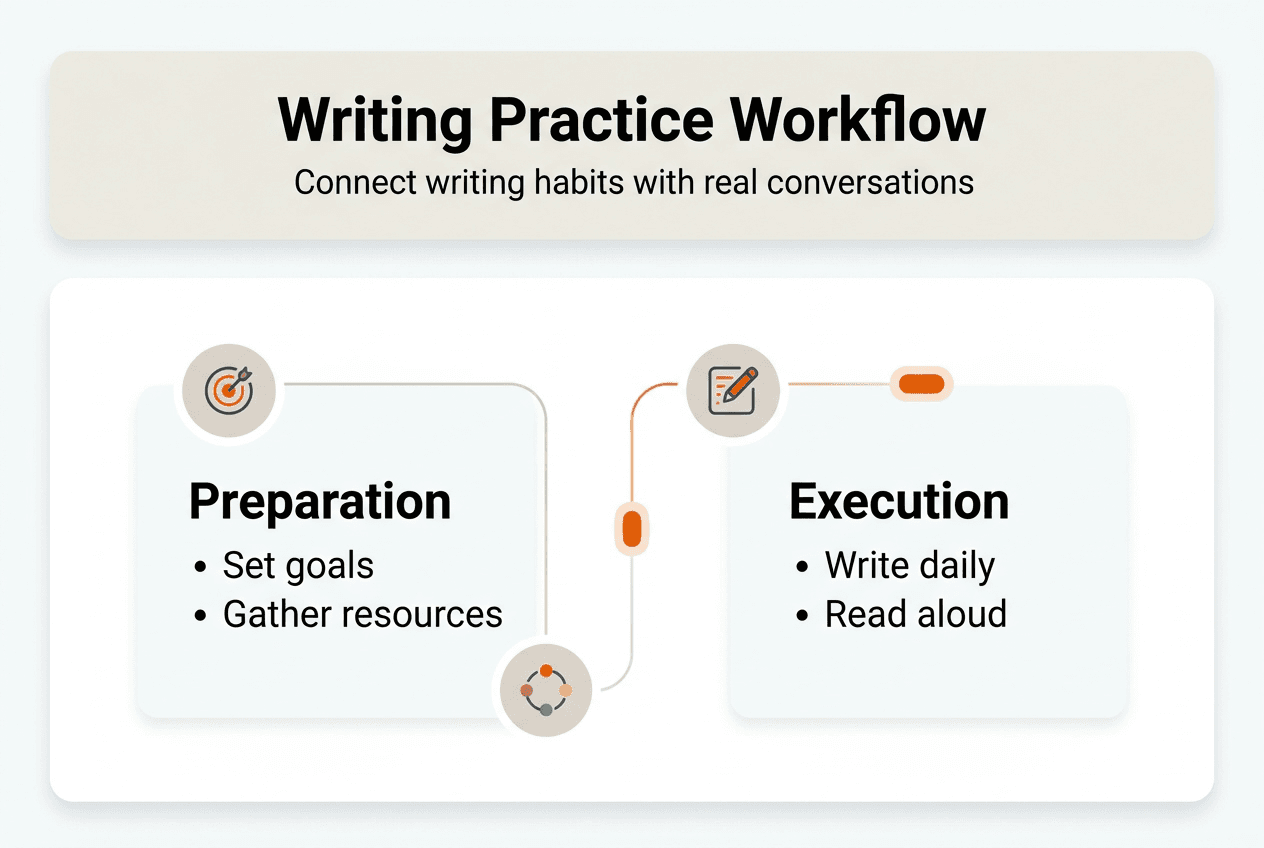
Regular review and feedback cycles help to identify problem areas and boost confidence in language use. Schedule weekly review sessions where you listen to recordings from the past seven days consecutively. The concentrated exposure makes progress obvious. Phrases that felt clumsy on Monday flow smoothly by Friday. Hesitations that plagued early recordings vanish as vocabulary becomes automatic.
Identify recurring errors through systematic analysis. Create a mistake log with three columns: the error, the correct form, and the underlying rule. When the same mistake appears three times, it signals a knowledge gap requiring targeted study. Maybe you consistently confuse verb conjugations or misplace adjectives. Recognizing patterns lets you address root causes rather than randomly practicing everything.
Adjust your workflow based on verification results. If speaking recordings reveal strong grammar but weak pronunciation, shift more session time to phonetic practice and shadowing native speakers. If writing flows easily but spoken production lags, increase the ratio of speaking to writing within each session. Your workflow should evolve as your skills develop, always targeting current weaknesses while maintaining strengths.
| Assessment Method | Frequency | Key Metrics |
|---|---|---|
| Self-rating checklist | After each session | Clarity, fluency, confidence scores |
| Recording review | Weekly | Hesitation frequency, pronunciation accuracy |
| Mistake log analysis | Bi-weekly | Error patterns, correction success rate |
| External feedback | Monthly | Native speaker comprehension, naturalness rating |
Celebrate milestones to maintain motivation through inevitable plateaus. When you complete 30 consecutive days of practice, reward yourself. When a language partner compliments your improved fluency, document that win. Progress in language learning arrives in sudden jumps after long periods of invisible improvement. Recognition of small victories sustains effort during the invisible phases.
Solicit structured feedback from language mentors using specific questions. Instead of asking how was my French, request targeted input: did my restaurant dialogue sound natural, or which three errors should I prioritize fixing? Specific questions yield actionable answers that drive measurable improvement. Generic feedback provides encouragement but rarely changes behavior.
Common troubleshooting scenarios:
- Writing improves but speaking lags: Increase recording frequency and reduce writing time
- Motivation drops after three weeks: Add variety through new topics or practice formats
- Same errors persist despite practice: Seek expert explanation of the underlying grammar concept
- Progress plateaus completely: Increase difficulty by tackling more complex conversation scenarios
Verification transforms practice from hopeful repetition into strategic skill building. Data reveals what works. Feedback exposes blind spots. Adjustments optimize your limited practice time for maximum conversation impact. The workflow becomes a self-correcting system that continuously improves as you do.
Boost your language skills with AktivLang
Ready to implement this workflow with tools designed specifically for conversation-focused practice? AktivLang practice platform combines writing and speaking modes in one seamless experience. Pick daily prompts across topics you care about, write your response, then record yourself speaking it. You'll receive instant feedback on grammar, pronunciation, and fluency, all explained in your native language so you understand exactly what to improve.
Join intermediate learners who've discovered that real conversation skills come from producing language, not passive exercises. Track your progress across six skill areas, review weekly reflections on your improvement patterns, and build the self-correction habits that stick. Available for French, Spanish, German, Dutch, Italian, and Portuguese learners ready to move beyond basics. Your privacy and learning goals matter. Review our terms and start practicing the language you want to live in today.
FAQ
How long should each writing practice session be?
Sessions of 20 to 30 minutes daily are ideal to build habit and allow focused practice without burnout. Consistency trumps session length for long-term progress. Even 15-minute sessions done daily outperform hour-long sessions twice weekly because daily practice keeps vocabulary active and builds automaticity faster.
How can I effectively turn writing practice into better speaking skills?
Practice reading your writing aloud and record it to improve pronunciation. Use dialogues or role-plays based on writing to practice natural speech. Linking writing to speaking through speaking exercises accelerates conversational fluency by creating dual neural pathways for the same content. The key is never writing without eventually speaking those same words.
What's the best way to stay motivated with a writing practice workflow?
Set small, achievable goals and track your progress regularly. Celebrate improvements, no matter how small, like using a new verb tense correctly or speaking a full minute without hesitation. Engage with language communities for support and accountability. Sharing your practice journey with others creates external motivation that carries you through periods when internal drive fades.
Should I correct all my mistakes immediately or focus on fluency first?
Balance both by correcting critical errors that block comprehension while letting minor mistakes slide during initial speaking practice. In writing, aim for accuracy since you have time to revise. In speaking, prioritize fluency and natural flow, then address persistent errors during your revision phase. Over-correcting during spoken practice creates hesitation that damages conversational rhythm.
How do I know if my workflow is actually improving my conversation skills?
Record baseline conversations at the start, then compare monthly. Notice whether you hesitate less, use more varied vocabulary, and recover faster from mistakes. Real-world tests matter most: can you handle actual conversations more comfortably than before? If yes, your workflow succeeds. If no, adjust the balance between writing preparation and speaking practice until results improve.