

Most language learners believe speaking practice alone will make them fluent. They focus on conversation apps, language exchanges, and pronunciation drills while treating writing as an optional skill reserved for academics or professional translators. This misconception overlooks how writing actively reinforces grammar patterns, expands vocabulary retention, and deepens understanding of language structure in ways that speaking alone cannot achieve. For intermediate learners seeking to move beyond basic communication, writing practice becomes essential to reaching true fluency across all language dimensions.
Table of Contents
- Key takeaways
- How writing reinforces language skills for intermediate learners
- The power of task-based writing: sequencing, modeling, and projects
- Engaging stories and interactive exercises for confident writing
- Editing, revision, and routines to perfect your writing accuracy
- Enhance your writing skills with AktivLang
- FAQ
Key Takeaways
| Point | Details |
|---|---|
| Writing reinforces grammar and vocabulary | Writing actively reinforces grammar patterns and expands vocabulary retention, strengthening overall language competence beyond what speaking alone can achieve. |
| Task based writing boosts complexity | Task based writing progressively increases syntactic and lexical complexity, promoting more sophisticated language production. |
| Interactive writing reduces anxiety | Interactive writing practices reduce anxiety and build confidence by turning practice into productive and tangible output. |
| Guided editing enhances accuracy | Guided editing helps learners notice errors earlier and develop metalinguistic awareness for accuracy. |
| Review prior writing improves accuracy | Reviewing prior writing sessions strengthens self correction and reinforces consistent patterns that improve accuracy. |
How writing reinforces language skills for intermediate learners
Writing transforms passive language knowledge into active production capability. When you write, your brain must retrieve vocabulary, apply grammar rules, and construct coherent sentences simultaneously. This cognitive demand creates stronger neural pathways than simply recognizing words during reading or mimicking phrases in conversation. Writing reinforces grammar, vocabulary, and syntax in L2 acquisition for intermediate learners through deliberate practice that builds lasting competency.
Interactive writing strategies push you beyond surface-level comprehension. Unlike passive reading where your eyes scan text without deep processing, writing requires you to make deliberate choices about word order, verb conjugation, and sentence structure. Each decision strengthens your understanding of how the language actually functions. You notice patterns that remained invisible during conversation, where speed and spontaneity often hide structural weaknesses.
The cognitive processing involved in writing creates deeper memory traces than other language activities. When you compose sentences, you engage multiple brain regions responsible for language production, working memory, and executive function. This multi-system activation explains why vocabulary learned through writing practice shows better retention rates than words encountered only through listening or reading exercises.
Structured writing activities systematically develop production skills that transfer to speaking. Consider these evidence-based benefits:
- Writing slows down language production, allowing you to notice and correct errors before they become fossilized habits
- Composing text builds awareness of grammatical structures that improve spontaneous speech accuracy
- Regular writing practice expands your active vocabulary beyond the limited set used in casual conversation
- Written output provides permanent records you can review, analyze, and learn from over time
Pro Tip: Start each writing session by reviewing previous work to identify recurring errors. This metacognitive practice accelerates accuracy improvement by making you consciously aware of your specific weak points.
For intermediate learners, writing bridges the gap between understanding language concepts and using them fluently. You might recognize the subjunctive mood when reading or understand conditional structures when listening, but writing forces you to produce these forms correctly. This production practice cements knowledge in ways that recognition exercises cannot match. Engaging with language learning through writing creates the foundation for advanced proficiency across all skill areas.
The power of task-based writing: sequencing, modeling, and projects
Not all writing practice delivers equal results. Research comparing different instructional approaches reveals significant differences in how various methods develop writing complexity and fluency. Task sequencing outperforms text modeling and repetition in developing syntactic and lexical complexity in L2 writing, making it the most effective approach for intermediate learners seeking sophisticated language production.
Task sequencing involves building writing assignments in progressive difficulty levels. You start with simpler structures and gradually tackle more complex linguistic features. This scaffolded approach allows your brain to consolidate each new pattern before adding additional complexity. The result is writing that demonstrates both accuracy and sophistication rather than error-filled attempts at advanced structures.

| Method | Strengths | Limitations |
|---|---|---|
| Task Sequencing | Develops syntactic complexity, builds progressive mastery, transfers to spontaneous production | Requires careful planning and structured curriculum |
| Text Modeling | Provides clear examples, reduces initial anxiety, good for genre awareness | May encourage imitation over original production |
| Repetition Practice | Builds automaticity with specific structures, reinforces accuracy | Limited creativity, can become monotonous |
Project-based writing tasks engage multiple language skills while maintaining high motivation levels. Project-based learning significantly enhances EFL writing performance, idea generation, and cooperation among learners. These extended assignments require you to research topics, organize information, and present ideas coherently over multiple drafts. The sustained engagement builds stamina for longer compositions while developing critical thinking skills alongside language proficiency.
Implementing effective task-based writing requires systematic planning. Follow these steps to maximize your writing development:
- Identify your current proficiency level through diagnostic writing samples that reveal strengths and gaps
- Select writing tasks slightly above your comfort zone to promote growth without overwhelming cognitive capacity
- Complete pre-writing activities like brainstorming, outlining, or vocabulary gathering to reduce working memory load
- Draft your text focusing on content and organization before worrying about perfect grammar
- Revise systematically, addressing one linguistic feature at a time rather than trying to fix everything simultaneously
- Seek feedback from teachers, language partners, or AI tools to identify blind spots in your writing
- Rewrite sections incorporating feedback, then compare your revised version to the original draft
Pro Tip: Keep a writing portfolio tracking your progress over months. Reviewing early drafts after significant practice reveals concrete improvement that motivates continued effort.
The writing practice workflow you establish matters as much as the specific tasks you complete. Consistency builds automaticity with language structures, freeing cognitive resources for more creative expression. Intermediate learners who write regularly, even in short sessions, develop fluency that sporadic intensive practice cannot match. This principle applies across language teaching contexts, as highlighted in ESL teaching tips 2025 focused on building oral proficiency through integrated skills practice.
Engaging stories and interactive exercises for confident writing
Stories provide the meaningful context that makes vocabulary and grammar stick in long-term memory. When you encounter new words within a compelling narrative, your brain naturally connects them to plot events, character emotions, and thematic elements. This rich associative network creates multiple retrieval pathways that isolated vocabulary lists cannot provide. Stories and interactive exercises engage intermediates globally, reducing anxiety while building mechanics via context that feels purposeful rather than purely academic.
Copywork and story continuation exercises build structural awareness without the pressure of generating entirely original content. When you copy well-crafted sentences by hand, you internalize rhythm, punctuation patterns, and stylistic choices that improve your own writing. Story continuation tasks provide plot scaffolding while requiring you to maintain consistent tone, vocabulary level, and grammatical structures. Copywork, daily recounting, book summaries, and story continuation build creativity and synthesis skills that transfer to independent writing tasks.
Interactive writing transforms solitary composition into an engaging activity that maintains motivation over time. These exercises reduce the anxiety many learners feel when facing a blank page:
- Collaborative storytelling where you contribute one sentence to a shared narrative builds confidence through low-stakes participation
- Dialogue completion exercises require you to maintain character voice while practicing conversational structures
- Picture description tasks provide visual scaffolding that reduces the cognitive load of topic generation
- Sentence transformation drills build flexibility with grammatical structures through systematic manipulation
Multi-scaffolding approaches combine different support types to optimize learning outcomes. Peer review provides social accountability and exposes you to alternative ways of expressing similar ideas. Cognitive scaffolding through graphic organizers, sentence starters, or model texts reduces working memory demands during composition. Affective support through encouraging feedback and progress tracking maintains motivation through inevitable plateaus.
Writing within story contexts transforms grammar practice from abstract rule memorization into meaningful communication. You stop thinking about conjugation tables and start thinking about which verb tense best conveys your intended meaning within the narrative flow.
The key to sustained writing improvement lies in balancing challenge with support. Tasks too difficult create frustration and avoidance, while exercises too simple fail to promote growth. Story-based writing hits this sweet spot by providing enough context to support comprehension while leaving room for creative expression. You can focus on language production rather than content generation, making practice sessions more productive and less mentally exhausting.
For intermediate learners, writing exercises for intermediate learners should emphasize meaningful communication over perfect accuracy. You need opportunities to experiment with new structures, make mistakes in low-stakes contexts, and gradually refine your output through repeated practice cycles. Stories create this safe experimentation space while maintaining the authentic communication purpose that keeps writing practice engaging rather than tedious.
Editing, revision, and routines to perfect your writing accuracy
Editing instruction transforms writing practice from simple output generation into a metacognitive learning process. When you learn to identify and correct your own errors, you develop the metalinguistic awareness that separates intermediate learners from advanced users. Editing instruction and guided revision improve writing accuracy and metalinguistic skills by making language structure visible and manipulable rather than intuitive and automatic.
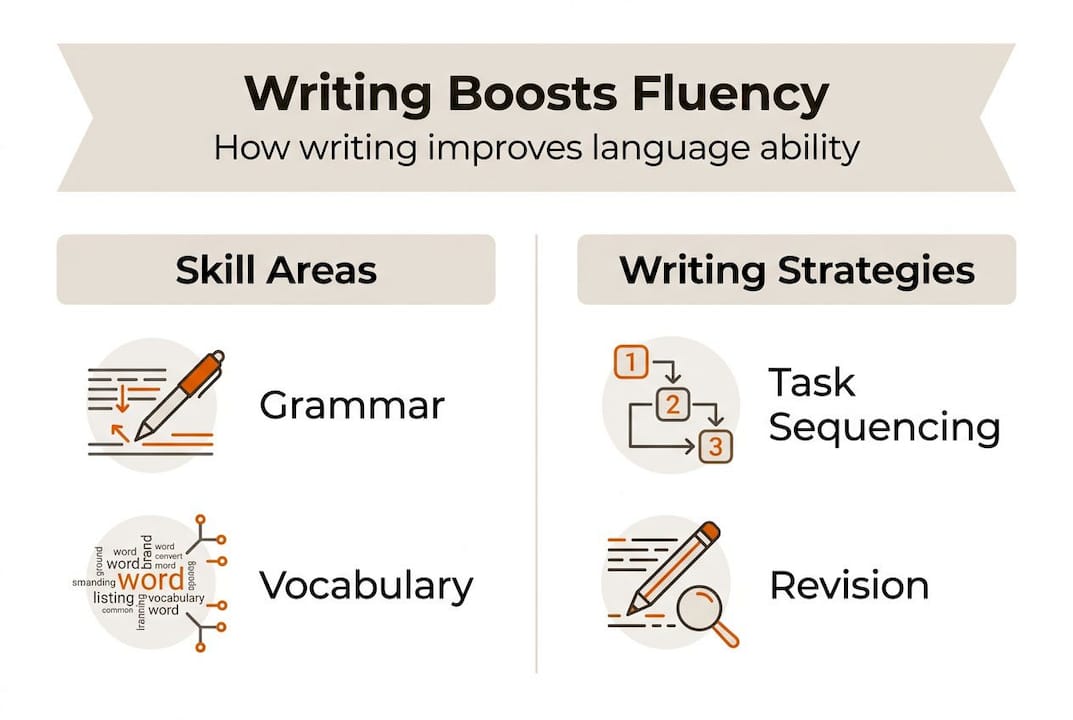
Guided revision differs fundamentally from simple error correction. Rather than having a teacher mark every mistake, you receive targeted feedback on specific error categories. This focused approach prevents cognitive overload while building systematic error detection skills. You might spend one revision session addressing only verb agreement issues, then tackle preposition usage in the next round. This incremental refinement develops editing capabilities that transfer to future writing tasks.
Weekly writing routines build the consistency required for measurable progress. Progressive methods focusing on grammar, vocabulary enrichment, and weekly routines enhance writing mechanics for French learners, principles that apply across target languages. Regular practice prevents skill decay between sessions and allows you to track improvement over time through concrete output samples.
Implement these editing strategies to maximize accuracy gains:
- Wait 24 hours after drafting before editing to create psychological distance from your text
- Read your writing aloud to catch awkward phrasing and rhythm problems that silent reading misses
- Use a reverse editing technique, starting from the last sentence and working backward to focus on language rather than content
- Create a personal error log tracking your most frequent mistakes to guide focused practice
- Compare your writing to model texts in the same genre, noting differences in structure and vocabulary choice
- Seek feedback specifically on your identified weak areas rather than general commentary
| Approach | Accuracy Improvement | Engagement Level | Time Investment |
|---|---|---|---|
| Self-editing with checklist | Moderate (15-25%) | Medium | Low |
| Peer review with rubric | High (25-35%) | High | Medium |
| Teacher-guided revision | Very High (35-50%) | Medium | High |
| AI-assisted error detection | Moderate (20-30%) | Medium | Low |
Pro Tip: Record yourself reading your writing aloud, then listen back while following along with the text. This dual-mode processing reveals errors that remain invisible during silent proofreading.
The revision process teaches you to view your writing as a reader rather than a writer. This perspective shift helps you identify unclear explanations, missing transitions, and logical gaps that seemed obvious while composing. You develop the critical distance required to evaluate whether your text actually communicates your intended meaning to someone without your background knowledge.
Consistent writing schedules matter more than session length. Three 20-minute sessions per week produce better results than one 90-minute marathon. The distributed practice allows consolidation between sessions and prevents the mental fatigue that degrades output quality. Your brain continues processing language patterns between active practice sessions, strengthening neural connections without conscious effort.
Building language skills and writing accuracy requires patience with the non-linear nature of language acquisition. You will experience plateaus where progress seems invisible, followed by sudden breakthroughs where previously difficult structures become automatic. Regular writing practice with systematic revision creates the conditions for these breakthrough moments by maintaining engagement during plateau periods.
Enhance your writing skills with AktivLang
You have learned how writing practice strengthens grammar, expands vocabulary, and builds the confidence needed for fluent communication. AktivLang transforms these principles into an engaging practice platform where you read compelling stories in French, Spanish, German, Dutch, Italian, or Portuguese, then master what you have learned through interactive exercises specifically designed to develop writing and speaking skills simultaneously.

The AktivLang language practice platform provides the structured yet flexible environment intermediate learners need to progress beyond basic communication. You practice writing within meaningful story contexts that reduce anxiety while building accuracy through immediate feedback on vocabulary, grammar, and sentence construction exercises. The platform adapts to your interests with themes spanning mythology, history, culture, and daily life, ensuring practice sessions remain engaging rather than repetitive. Join thousands of learners who have discovered that consistent, story-based practice creates the foundation for true language mastery across all communication modes.
FAQ
What is the main benefit of writing for language learners?
Writing actively strengthens grammar, vocabulary, and language structure through deliberate practice that builds lasting proficiency. It complements speaking and reading skills by forcing active production rather than passive recognition, creating balanced language acquisition. The cognitive processing required for written composition develops metalinguistic awareness that transfers to improved speaking accuracy and comprehension.
How can beginner-to-intermediate learners use stories to improve writing?
Stories provide meaningful context that reduces learning anxiety while making vocabulary and grammar memorable through narrative connections. They help practice multiple skills simultaneously by requiring you to understand plot, analyze character motivations, and express ideas using target language structures. Story-based writing tasks offer content scaffolding that lets you focus on language production rather than topic generation, making practice sessions more productive.
What are the most effective writing strategies for intermediate learners?
Task sequencing, project-based tasks, and guided revision prove most effective for developing writing complexity and accuracy. Regular practice combined with systematic editing improves both fluency and precision by building automaticity with language structures. Multi-scaffolding approaches that combine peer review, model texts, and targeted feedback create optimal conditions for sustained improvement across all writing dimensions.
How often should intermediate learners practice writing?
Three to four short sessions per week produce better results than infrequent intensive practice. Distributed practice allows consolidation between sessions and prevents mental fatigue that degrades output quality. Even 15 to 20 minutes of focused writing with brief revision builds momentum that leads to measurable progress over weeks and months of consistent effort.