
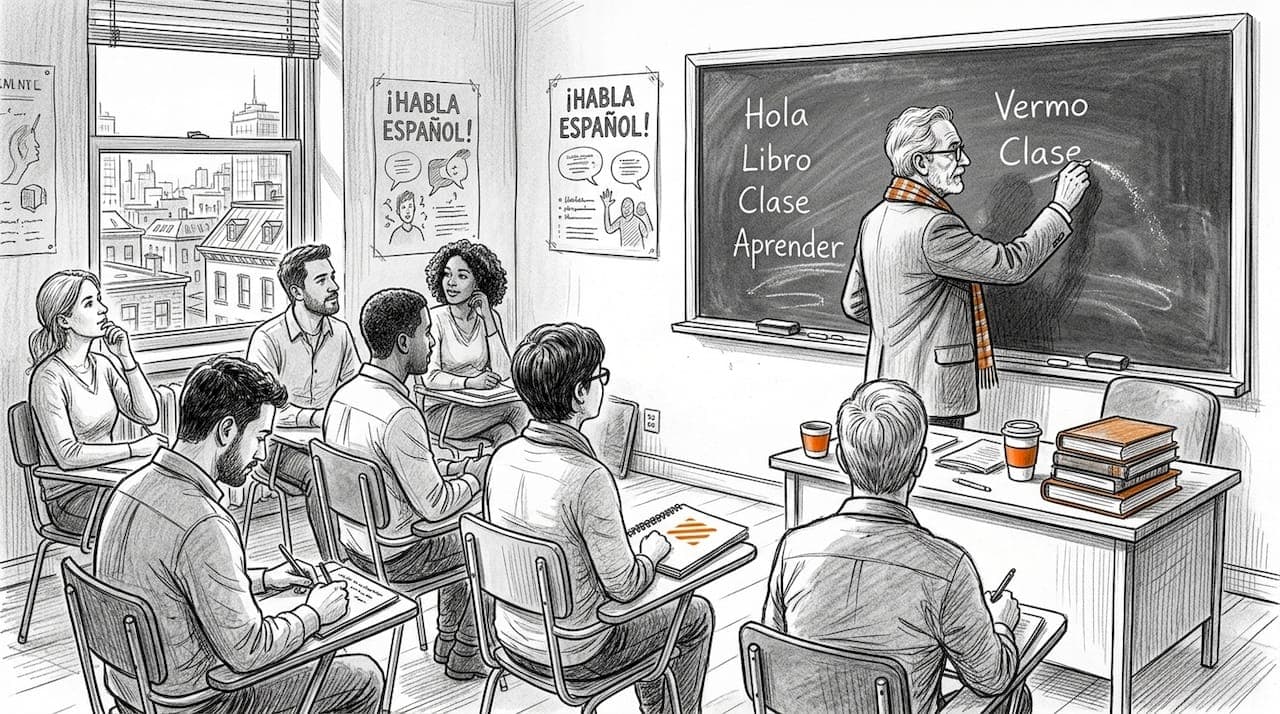
Most intermediate language learners hit a frustrating wall. You've mastered the basics, but traditional courses still push the same rigid curriculum at everyone, ignoring your unique interests, pace, and goals. This one-size-fits-all approach leaves you bored with irrelevant content and struggling with material that moves too fast or too slow. Personalized language learning changes this by adapting content, pacing, and support to your individual needs through AI-driven systems. When your learning path reflects your background, preferences, and progress, vocabulary sticks better, grammar becomes clearer, and pronunciation improves faster. This article explores why personalization transforms language learning for intermediate students ready to break through plateaus.
Table of Contents
- Key takeaways
- Understanding the limitations of traditional language learning
- How AI-driven personalization transforms language learning
- The power of story-based personalized practice for intermediate learners
- Balancing advantages and challenges of personalized AI language learning
- Explore personalized language practice with AktivLang
- Frequently asked questions
Key Takeaways
| Point | Details |
|---|---|
| Adaptive pacing | AI driven systems tailor content and pacing to your background, preferences, and progress, boosting motivation and learning effectiveness. |
| Vocab and Pronunciation | Adaptive content helps you retain vocabulary, understand grammar more clearly, and improve pronunciation by targeting your specific patterns. |
| Motivation and Anxiety | Personalized pacing and relevant content reduce boredom and anxiety, keeping you engaged. |
| Balanced Approach | A balanced mix of human guidance and AI personalization yields the most durable learning progress. |
| Biases and Access | Awareness of biases and digital divides helps ensure equitable access to personalized learning. |
Understanding the limitations of traditional language learning
Traditional language classrooms and generic apps treat all learners identically. A Spanish course designed for business professionals gets assigned to travelers, students, and immigrants alike. The curriculum moves at a fixed pace regardless of whether you grasp concepts quickly or need more time. This approach ignores fundamental reality: learners bring vastly different backgrounds, motivations, learning styles, and prior knowledge to their studies.
When content doesn't match your interests, motivation plummets. Studying restaurant vocabulary feels pointless if you're learning German for academic research. Grammar drills on subjunctive mood frustrate beginners while boring advanced learners. Fixed pacing creates two problems simultaneously. Fast learners grow impatient waiting for others to catch up. Slower learners feel overwhelmed and fall behind, building anxiety that blocks further progress.
This mismatch between learner needs and instructional design creates disengagement. You complete exercises mechanically without genuine comprehension. Pronunciation practice feels generic because feedback doesn't address your specific accent patterns. Vocabulary lists include words you'll never use while omitting terms crucial for your goals. The result? Learners abandon courses, switch apps repeatedly searching for better fits, or persist unhappily through materials that deliver minimal value.
The language learning blog documents countless stories of intermediate learners stuck in this cycle. They've proven they can learn but lack tools that adapt to their evolving needs. Breaking this pattern requires systems that recognize you as an individual, not a generic student.
"One-size-fits-all language instruction fails because it assumes uniform learner characteristics, ignoring the diversity of backgrounds, goals, and cognitive styles that shape how individuals acquire new languages."
Key limitations of traditional approaches:
- Rigid curriculum ignores individual learning speeds and preferences
- Generic content fails to connect with personal interests or professional needs
- Lack of adaptive feedback leaves learners guessing about actual progress
- Fixed difficulty levels either bore advanced students or overwhelm struggling ones
- Minimal personalization reduces emotional engagement and intrinsic motivation
How AI-driven personalization transforms language learning
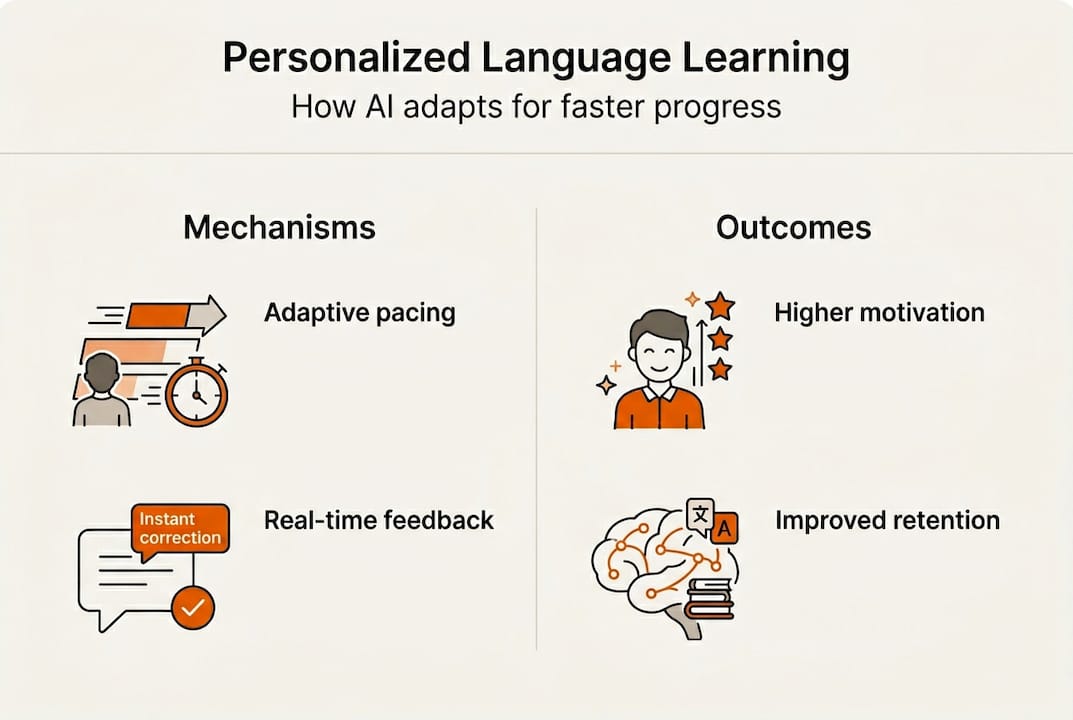
Artificial intelligence revolutionizes language learning by creating truly adaptive experiences. Advanced algorithms like LSTM (Long Short-Term Memory) networks and Transformer models analyze your performance patterns in real time, adjusting content difficulty, pacing, and focus areas automatically. Instead of following predetermined lesson sequences, the system responds to your actual progress.

These AI systems monitor dozens of variables simultaneously. They track which vocabulary you retain easily versus words requiring repeated exposure. They identify grammar structures you've mastered and those needing more practice. They analyze pronunciation attempts to pinpoint specific phonemes causing difficulty. This continuous assessment creates a dynamic learning path that evolves with you.
AI-enhanced engagement benefits include increased motivation, reduced anxiety, and improved self-efficacy compared to static traditional methods. When exercises match your current ability level precisely, you experience optimal challenge. Tasks feel achievable yet stimulating, keeping you in the productive zone between boredom and frustration.
Empirical results demonstrate measurable improvements. LSTM-based recommendation increases exercise completion by 8.5% while boosting accuracy by 8%. Transformer-based automated scoring reduces teacher workload by 38.5%, freeing instructors to focus on nuanced cultural guidance rather than mechanical grading. Learner satisfaction ratings jumped from 3.2 to 4.2 out of 5 when AI personalization was implemented.
The technology works through several mechanisms. Adaptive algorithms select next exercises based on your performance history, ensuring continuous appropriate challenge. Natural language processing analyzes your written and spoken output, providing specific feedback on errors. Spaced repetition systems schedule vocabulary review at optimal intervals for long-term retention. Sentiment analysis detects frustration or boredom, triggering content adjustments before you disengage.
| AI Technology | Learning Impact | Measured Benefit |
|---|---|---|
| LSTM recommendation | Personalized exercise selection | 8.5% higher completion rate |
| Transformer scoring | Automated feedback accuracy | 8% accuracy improvement |
| Adaptive pacing | Optimized difficulty progression | 38.5% reduced teacher workload |
| Real-time monitoring | Immediate performance adjustment | Satisfaction increase 3.2 to 4.2/5 |
Pro Tip: Look for language apps that explain how their AI adapts to you. Transparent systems let you understand why certain exercises appear, building trust in the personalization process.
This technological foundation enables truly individualized learning at scale. What once required expensive one-on-one tutoring now reaches millions of learners simultaneously. The system remembers your entire learning history, something even dedicated human teachers struggle to track across dozens of students. For intermediate learners specifically, AI personalization addresses the plateau problem by identifying precise skill gaps blocking advancement and targeting practice accordingly.
The conversation practice boost becomes more effective when AI tailors speaking exercises to vocabulary you've recently learned and grammar structures you're currently mastering.
The power of story-based personalized practice for intermediate learners
Stories provide the ideal vehicle for personalized language practice. Unlike isolated vocabulary lists or disconnected grammar drills, narratives create meaningful context that mirrors how you'll actually use the language. When you read about a character navigating a French market, you encounter vocabulary, grammar, and cultural nuances simultaneously in authentic situations.
Story-based personalization excels by immersing you in narratives matched to your interests while AI ensures comprehensible input slightly beyond your current level. This "i+1" principle, where input contains mostly familiar elements plus manageable new material, optimizes acquisition. You understand enough to follow the plot while encountering new language in context that clarifies meaning.
For intermediate learners, story-based approaches solve a critical problem. You've moved beyond basic survival phrases but lack the vocabulary breadth and grammatical flexibility for authentic materials like novels or news articles. Personalized stories bridge this gap by adjusting complexity to your exact proficiency. The narrative maintains engagement while vocabulary density, sentence complexity, and idiomatic usage scale to challenge without overwhelming.
The multi-skill integration happens naturally. Reading the story builds vocabulary and grammar recognition. Comprehension exercises verify understanding. Speaking practice has you voice character dialogue, improving pronunciation. Writing tasks extend the narrative, applying new structures creatively. This holistic approach mirrors real language use far better than isolated skill drills.
Emotional engagement amplifies learning. Stories activate different brain regions than abstract exercises. You remember vocabulary encountered during a suspenseful plot twist more vividly than words from flashcard lists. Characters' struggles create empathy, making cultural concepts concrete rather than abstract. When you care about narrative outcomes, attention intensifies, deepening encoding.
Personalization enhances story-based learning through several mechanisms:
- Topic selection matches your interests, whether mythology, technology, sports, or daily life
- Difficulty adjusts based on your demonstrated vocabulary and grammar mastery
- Pacing allows you to spend more time on challenging passages without holding back others
- Branching narratives let you explore themes most relevant to your goals
- Integrated exercises target specific weaknesses revealed in your story comprehension
Pro Tip: When practicing with stories, read each passage twice. First pass for general comprehension and enjoyment, second pass analyzing how specific grammar structures and vocabulary create meaning. This dual approach balances fluency with accuracy development.
The storytelling in language learning approach proves especially powerful for intermediate students because it provides the contextual richness you need to move beyond basic communication toward nuanced expression. You're not just learning words, you're seeing how native speakers combine them to create meaning, convey emotion, and navigate social situations.
Balancing advantages and challenges of personalized AI language learning
While AI personalization offers substantial benefits, responsible implementation requires acknowledging limitations and potential harms. Algorithmic biases, reduced social interaction, and need for human oversight represent significant challenges that learners and developers must address.
Algorithmic bias emerges when training data reflects existing prejudices or cultural assumptions. An AI system trained predominantly on European Spanish might inadequately serve learners targeting Latin American varieties. English-centric models can distort pragmatic norms when applied to other languages, teaching communication patterns that feel unnatural to native speakers. These biases disadvantage learners from underrepresented backgrounds, potentially reinforcing rather than reducing educational inequities.
Reduced social interaction poses another concern. Language fundamentally serves communication between people. Over-reliance on AI practice partners may develop technical accuracy while neglecting crucial social skills like turn-taking, reading conversational cues, or navigating cultural expectations. Intermediate learners especially need authentic human interaction to develop pragmatic competence beyond grammatical correctness.
Human teacher integration remains essential. AI excels at repetitive practice, immediate feedback, and data-driven progress tracking. Human instructors provide cultural context, motivational support, creative problem-solving, and nuanced error correction that algorithms miss. The most effective personalized learning combines both, using AI for scalable individualization while preserving human relationships for guidance and social learning.
Contrasting views on AI personalization highlight this tension. Proponents emphasize increased self-regulation, motivation, and accessibility. Critics warn of pragmatic communication failures and cultural homogenization when AI systems impose dominant language varieties and interaction norms globally. Both perspectives contain truth, demanding thoughtful implementation.
Balancing personalization benefits with potential drawbacks requires:
- Diverse training data representing multiple language varieties, accents, and cultural contexts
- Transparent algorithms that explain personalization decisions to learners and teachers
- Regular human teacher check-ins to provide social context and cultural guidance
- Opportunities for peer interaction alongside AI practice to develop social communication skills
- Critical evaluation of AI recommendations rather than blind acceptance of system suggestions
- Inclusive design processes involving learners from varied backgrounds in development
Digital access disparities create equity concerns. Personalized AI systems require reliable internet, modern devices, and often subscription fees. These barriers exclude learners in under-resourced communities, potentially widening rather than narrowing educational gaps. Addressing this requires both technological solutions like offline functionality and policy interventions ensuring equitable access.
| Advantage | Challenge | Balanced Approach |
|---|---|---|
| Adaptive pacing | Algorithmic bias | Use diverse training data and regular bias audits |
| Immediate feedback | Reduced social interaction | Combine AI practice with human conversation partners |
| Scalable individualization | Cultural homogenization | Include multiple language varieties and cultural contexts |
| Data-driven insights | Privacy concerns | Implement transparent data policies and user control |
| 24/7 availability | Digital divide | Offer offline options and tiered pricing |
The writing practice workflow demonstrates how balancing AI feedback with human review creates optimal learning conditions. Automated systems catch mechanical errors instantly while human readers provide feedback on style, cultural appropriateness, and communicative effectiveness.
Ethical personalized learning prioritizes learner agency. You should understand how the system adapts to you, control what data gets collected, and override AI recommendations when they don't serve your goals. Transparency builds trust while respecting your autonomy as an active participant rather than passive recipient of algorithmically determined instruction.
Explore personalized language practice with AktivLang
Ready to experience how personalized, story-based learning accelerates your progress? AktivLang language practice combines engaging narratives with AI-powered feedback across vocabulary, grammar, and pronunciation. Choose stories matching your interests from mythology to travel to science, then master content through 12+ interactive exercise types.
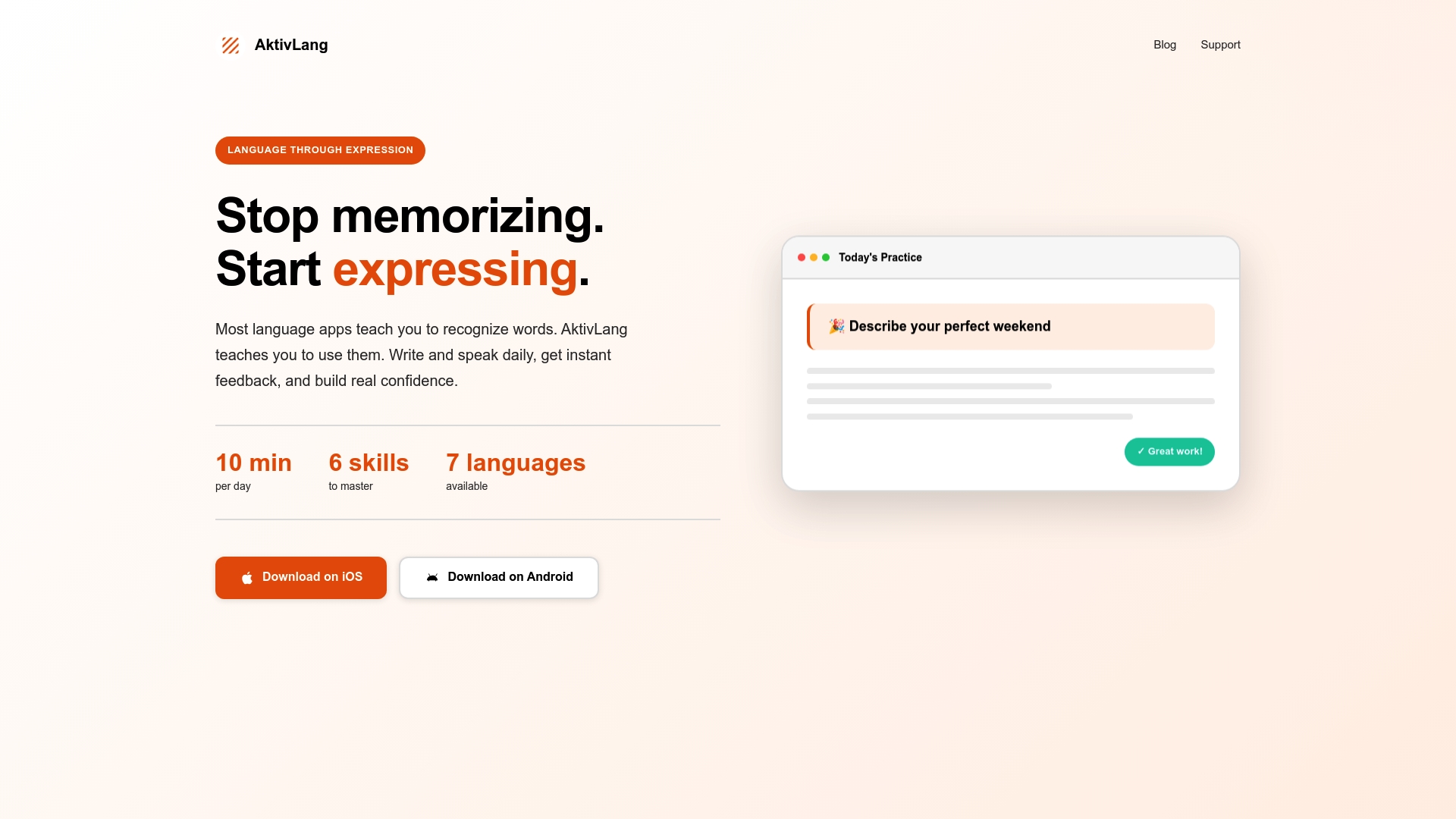
Each story adapts to your level, ensuring you encounter appropriately challenging material that builds skills without frustration. Speaking exercises provide detailed pronunciation analysis and fluency scores, showing exactly where to improve. Weekly reflections offer personalized insights on your learning patterns, helping you understand your progress and optimize practice strategies. Whether you're learning French, Spanish, German, Dutch, Italian, or Portuguese, the platform tailors content to your goals while maintaining the human element through carefully crafted stories and culturally authentic contexts. Your privacy remains protected as you practice, with transparent policies governing data use.
Frequently asked questions
Why is personalization crucial beyond traditional methods?
Traditional methods ignore individual differences in pace, interests, and learning styles, leading to disengagement. Personalization adapts content and difficulty to your specific needs, maintaining motivation through relevant challenges. This targeted approach helps you progress faster by focusing practice on your actual weaknesses rather than generic curriculum.
How does AI feedback improve learning efficiency?
AI analyzes your performance in real time, identifying patterns you might miss. It provides immediate, specific feedback on pronunciation, grammar, and vocabulary usage, allowing instant correction. Research shows this increases exercise completion by 8.5% and accuracy by 8% compared to delayed or generic feedback.
What are challenges to watch for when using AI-based personalized learning?
Algorithmic bias can favor certain language varieties or cultural norms over others. Over-reliance on AI reduces valuable social interaction needed for pragmatic communication skills. Digital access disparities may exclude learners without reliable internet or modern devices. Choose platforms with diverse training data and combine AI practice with human conversation.
How can intermediate learners ensure balance between AI use and human interaction?
Use AI for repetitive practice, immediate feedback, and skill drilling while seeking human teachers or conversation partners for cultural context, motivation, and social communication development. Schedule regular speaking sessions with native speakers alongside AI pronunciation practice. This combination leverages technological efficiency without sacrificing human connection essential for authentic communication.
Are story-based practices suitable for all language skills?
Yes, stories naturally integrate reading, listening, speaking, and writing. Reading builds vocabulary and grammar recognition. Listening to narrated stories improves comprehension. Speaking exercises using story dialogue enhance pronunciation. Writing tasks extending narratives apply new structures creatively. This multi-skill approach mirrors authentic language use more effectively than isolated drills.