

Intermediate language learners often struggle to find speaking practice methods that deliver real fluency gains without wasting time. You've built a solid vocabulary foundation and understand basic grammar, but converting that knowledge into confident, natural speech remains frustratingly difficult. Speaking practice accelerates fluency, pronunciation, and confidence by shifting from translation thinking to direct language use. This article presents seven research-backed advantages of structured speaking practice, helping you select the most efficient approaches to reach conversational proficiency faster.
Table of Contents
- Key takeaways
- Criteria for effective speaking practice for intermediate learners
- Advantage 1: Accelerated fluency and confidence through daily speaking practice
- Advantage 2: Enhanced pronunciation and vocabulary through story-based exercises
- Advantage 3: Empirical gains in oral proficiency through retelling and peer/tech-supported methods
- Advantage 4: Improved self-efficacy and accuracy via self-assessment tools
- Advantage 5: Fluency-focused practice reduces anxiety and enhances motivation
- Advantage 6: Dialogic speaking tasks outperform monologic for fluency gains
- Advantage 7: Integrating grammar as scaffold supports fluency without blocking progress
- Discover AktivLang to practice the language you want to live in
- Frequently asked questions about speaking practice advantages
Key Takeaways
| Point | Details |
|---|---|
| Daily short practice | Just 10 to 15 minutes of focused speaking each day can dramatically improve fluency by training you to think in the target language rather than translate. |
| Direct language thinking | The practice shifts away from translation to using language directly, speeding up speech and reducing hesitation. |
| Story based practice | Using stories that interest you engages emotion and context, which reduces anxiety and helps vocabulary stick. |
| Structured feedback builds confidence | Feedback that targets fluency and pronunciation helps learners improve confidence and accuracy over time. |
Criteria for effective speaking practice for intermediate learners
Selecting the right speaking practice method requires understanding what actually drives fluency gains for intermediate learners. Effective practice must be time-efficient, engaging, focused on fluency development, and confidence-building to sustain long-term progress.
Time efficiency matters because most learners juggle language study with work, family, and other commitments. Practice sessions should deliver measurable results without requiring hours of daily commitment. Research shows fluency should take priority over grammar perfection, especially when practice time is limited, as grammar-heavy approaches reduce motivation and slow conversational development.
Engagement through storytelling and meaningful content reduces the anxiety that blocks fluent speech. When you practice with stories that interest you rather than sterile textbook dialogues, your brain processes language more naturally. This emotional connection helps vocabulary stick and makes practice sessions something you look forward to rather than dread.
Key criteria for evaluating speaking practice advantages:
- Delivers fluency gains within 10-15 minute daily sessions
- Uses contextual, story-based content that maintains interest
- Prioritizes communication over grammatical perfection
- Builds learner confidence through structured feedback
- Reduces speaking anxiety through engaging formats
When assessing conversation practice methods, focus on approaches that balance these criteria. The following advantages demonstrate how specific speaking practice strategies meet these standards and accelerate your path to conversational proficiency.
Advantage 1: Accelerated fluency and confidence through daily speaking practice
Daily focused speaking practice of just 10-15 minutes produces dramatic fluency improvements by training your brain to think directly in your target language rather than translating from your native tongue. This shift eliminates the mental bottleneck that causes hesitation and awkward pauses in conversation.
Speaking practice accelerates fluency, pronunciation, and confidence for intermediate learners by shifting from translation thinking to direct language use, with daily 10-15 minutes yielding noticeable improvements. The consistency matters more than duration. Short daily sessions create neural pathways that strengthen each time you practice, similar to how musicians develop muscle memory through regular rehearsal.

Your pronunciation improves naturally as you hear yourself speak and self-correct in real time. This immediate feedback loop helps you internalize correct sound patterns without needing a teacher present for every practice session. Confidence grows as you notice yourself forming sentences more quickly and with less mental effort.
Key benefits of brief daily speaking sessions:
- Eliminates translation delay by building direct language processing
- Strengthens pronunciation through repeated vocal practice
- Reduces hesitation as sentence structures become automatic
- Builds momentum that carries into real conversations
Pro Tip: Schedule your daily speaking practice at the same time each day to build an unbreakable habit. Morning sessions work well because your mind is fresh and you can apply what you practiced throughout the day.
The transformation from halting, translated speech to fluid, direct communication typically becomes noticeable within two to three weeks of consistent practice. This rapid progress fuels motivation and creates a positive feedback loop that sustains your learning momentum.
Advantage 2: Enhanced pronunciation and vocabulary through story-based exercises
Story-based speaking exercises like storytelling, role-plays, and story cubes create engaging contexts that simultaneously improve pronunciation, expand vocabulary, and build conversational comfort. These methods work because your brain processes language more deeply when it's embedded in meaningful narratives rather than isolated drills.
Story-based exercises enhance pronunciation, fluency, vocabulary, and conversational skills through engaging, contextual practice for intermediate learners. Story cubes provide visual prompts that trigger spontaneous storytelling, forcing you to construct narratives on the spot. Pass-the-story activities build collaborative speaking skills as you continue narratives started by others. Picture prompts offer rich visual contexts that naturally elicit descriptive language.
These exercises reduce anxiety because the story framework gives you something concrete to talk about, eliminating the blank-page paralysis that often blocks speaking practice. You focus on conveying the narrative rather than obsessing over perfect grammar, which paradoxically leads to more natural, accurate speech over time.
| Exercise Type | Primary Benefit | Best For |
|---|---|---|
| Story cubes | Spontaneous narrative construction | Building fluency under time pressure |
| Pass-the-story | Collaborative speaking | Developing conversational turn-taking |
| Picture prompts | Descriptive vocabulary expansion | Enriching adjective and verb usage |
| Role-play scenarios | Situational language practice | Preparing for real-world interactions |
Vocabulary naturally expands through narrative use because stories require varied expressions to maintain listener interest. You learn words in context, which dramatically improves retention compared to memorizing isolated vocabulary lists. The emotional engagement with story content creates stronger memory associations.
Pro Tip: Record yourself doing storytelling speaking exercises and listen back after 24 hours. You'll notice pronunciation issues and vocabulary gaps more objectively than during the initial performance, creating targeted improvement opportunities.
Advantage 3: Empirical gains in oral proficiency through retelling and peer/tech-supported methods
Research provides concrete evidence that specific speaking practice methods produce measurable oral proficiency improvements. Empirical studies show significant gains in oral proficiency, with task-based learning combined with peer and technology feedback improving fluency and accuracy, while recitation boosts oral expressions and retelling stories raised speaking scores from 34.67 to 52.83 in experimental groups.
These dramatic score improvements demonstrate that retelling stories with structured feedback creates powerful learning conditions. The retelling process forces you to reconstruct narratives using your own words, which deepens language processing beyond simple repetition. Technology-assisted feedback provides immediate correction without the social anxiety some learners experience with peer evaluation.
| Method | Average Score Gain | Key Mechanism |
|---|---|---|
| Story retelling | +18.16 points | Active reconstruction of narrative |
| Task-based learning with tech | Significant fluency/accuracy gains | Immediate feedback loop |
| Recitation practice | Enhanced oral expression | Memorization and performance |
Peer feedback adds social accountability and exposes you to different speaking styles and vocabulary choices. When combined with technology tools that track pronunciation accuracy and fluency metrics, you gain both human insight and objective data about your progress.
The recitation component improves oral expression by training your mouth and vocal apparatus to produce target language sounds smoothly. This physical practice element complements the cognitive benefits of story reconstruction. Together, these methods address multiple dimensions of speaking proficiency simultaneously.
Integrating oral proficiency research findings into your practice routine means prioritizing retelling exercises and seeking both technological and peer feedback rather than practicing in isolation.
Advantage 4: Improved self-efficacy and accuracy via self-assessment tools
Self-assessment tools produce greater gains in speaking accuracy, complexity, and learner confidence compared to peer assessment alone. Self-assessment via tools yields greater gains in accuracy, complexity, and self-efficacy than peer assessment for L2 speaking proficiency.
This advantage stems from the metacognitive awareness self-assessment develops. When you evaluate your own speaking performance using structured rubrics or technology feedback, you internalize quality standards more deeply than when receiving external correction. You become your own coach, identifying patterns in your errors and systematically addressing weaknesses.
Self-efficacy, your belief in your ability to succeed at language tasks, directly predicts persistence and ultimate proficiency. Self-assessment builds this confidence because you witness your own improvement through concrete metrics. Seeing your pronunciation accuracy climb from 65% to 85% over several weeks provides motivational fuel that vague encouragement cannot match.
Key benefits of self-assessment in speaking practice:
- Develops internal quality standards for pronunciation and fluency
- Increases awareness of personal error patterns
- Builds confidence through visible progress tracking
- Enhances speaking complexity as you challenge yourself
- Creates ownership of the learning process
Pro Tip: Use self-assessment speaking tools that provide both numerical scores and specific feedback on pronunciation, fluency, and grammatical accuracy. The combination of quantitative and qualitative feedback gives you actionable improvement targets. For additional techniques, explore self-assessment methods that complement technology tools.
Combining self-assessment with occasional peer feedback yields the best outcomes. Self-assessment provides consistent, judgment-free evaluation, while peer feedback offers fresh perspectives and catches blind spots in your self-evaluation.
Advantage 5: Fluency-focused practice reduces anxiety and enhances motivation
Prioritizing fluency over grammatical perfection creates a psychologically safe practice environment that reduces speaking anxiety and maintains long-term motivation. Fluency-first prioritizes communication over perfection, especially with limited class time, as grammar-heavy approaches reduce motivation.
When you focus on expressing ideas rather than avoiding mistakes, you develop the communicative courage essential for real-world language use. Grammar-obsessed practice creates a fear of errors that paralyzes speech production. This fear becomes a self-fulfilling prophecy as anxiety blocks access to the language knowledge you actually possess.
Fluency-focused practice treats grammar as scaffolding that supports communication rather than a barrier that must be perfected before speaking. You learn grammatical structures through repeated use in meaningful contexts rather than through isolated drill exercises. This approach mirrors how children acquire their first language naturally and efficiently.
Key psychological benefits of fluency-first practice:
- Reduces performance anxiety by removing perfectionist pressure
- Maintains motivation through visible communication success
- Builds speaking momentum that carries into grammar improvement
- Creates positive associations with language practice
As one expert notes:
Grammar instruction serves learners best when positioned as a tool for clearer communication, not a gatekeeper preventing speech. Fluency creates the foundation upon which accuracy naturally builds through continued exposure and practice.
This mindset shift proves especially valuable when practice time is limited. Spending 80% of your session on fluent communication and 20% on targeted grammar refinement produces better outcomes than the reverse ratio. Visit our fluency motivation research for additional insights on maintaining practice consistency.
Advantage 6: Dialogic speaking tasks outperform monologic for fluency gains
Conversation-based speaking exercises produce stronger fluency improvements than monologue-style tasks for intermediate learners. Dialogic tasks outperform monologic for intermediate proficiency gains, with L1 speaking style influencing L2 fluency development.
Dialogic tasks better simulate real-world language use because they require you to process incoming speech, formulate responses, and manage conversational turn-taking. These cognitive demands mirror actual conversations, making the practice directly transferable to real interactions. Monologue practice develops presentation skills but doesn't train the rapid processing needed for spontaneous dialogue.
Your first language speaking style influences how you approach L2 fluency. Learners from cultures with rapid conversational turn-taking may find dialogic practice more natural, while those from cultures favoring longer speaking turns may need explicit training in conversational dynamics.
| Task Type | Fluency Impact | Cognitive Demand | Real-World Transfer |
|---|---|---|---|
| Dialogic (conversation) | High | Processing + production | Direct |
| Monologic (presentation) | Moderate | Production focus | Indirect |
| Mixed practice | Highest | Varied demands | Comprehensive |
Balancing dialogic and monologic practice provides comprehensive fluency development:
- Dialogic tasks for conversational fluency and turn-taking
- Monologic tasks for extended discourse and presentation skills
- Mixed practice for versatile communication ability
Pro Tip: Practice dialogic vs monologic speaking by alternating between conversation simulations and storytelling monologues within the same session. This variety trains your brain to switch between communication modes flexibly.
Advantage 7: Integrating grammar as scaffold supports fluency without blocking progress
Viewing grammar as supportive scaffolding rather than a rigid barrier allows you to build speaking fluency while gradually improving accuracy. Integrate self and peer feedback in story exercises, prioritize fluency to avoid apprehension, and use grammar as scaffold not barrier.
This integration approach means you learn grammatical structures through communicative use rather than studying them in isolation before attempting speech. When a grammar point blocks communication, you address it. When a grammar error doesn't impede understanding, you note it for later refinement rather than stopping your practice flow.
Grammar supports accurate communication by providing patterns that make your speech clearer and more precise. But perfectionist grammar focus creates speaking apprehension that outweighs the accuracy benefits. The scaffold metaphor captures the proper relationship: grammar provides structure that supports your communication, not walls that contain it.
Key principles for grammar integration:
- Address grammar issues that block communication immediately
- Note non-critical errors for later focused practice
- Learn structures through repeated use in context
- Gradually raise accuracy standards as fluency solidifies
Pro Tip: Create a "grammar parking lot" during speaking practice. When you notice a recurring error, jot it down quickly and continue speaking. After your session, spend five minutes researching that specific point. This approach maintains fluency focus while ensuring systematic grammar improvement. Explore additional strategies at our grammar support resources.
Balancing fluency and grammar reduces fear by making errors a natural part of the learning process rather than failures. This psychological shift sustains motivation and accelerates overall proficiency development.
Discover AktivLang to practice the language you want to live in
These seven advantages come to life when you practice with structured, engaging content that implements research-backed methods. AktivLang provides story-based speaking exercises across French, Spanish, German, Dutch, Italian, and Portuguese that directly apply the principles covered in this article.
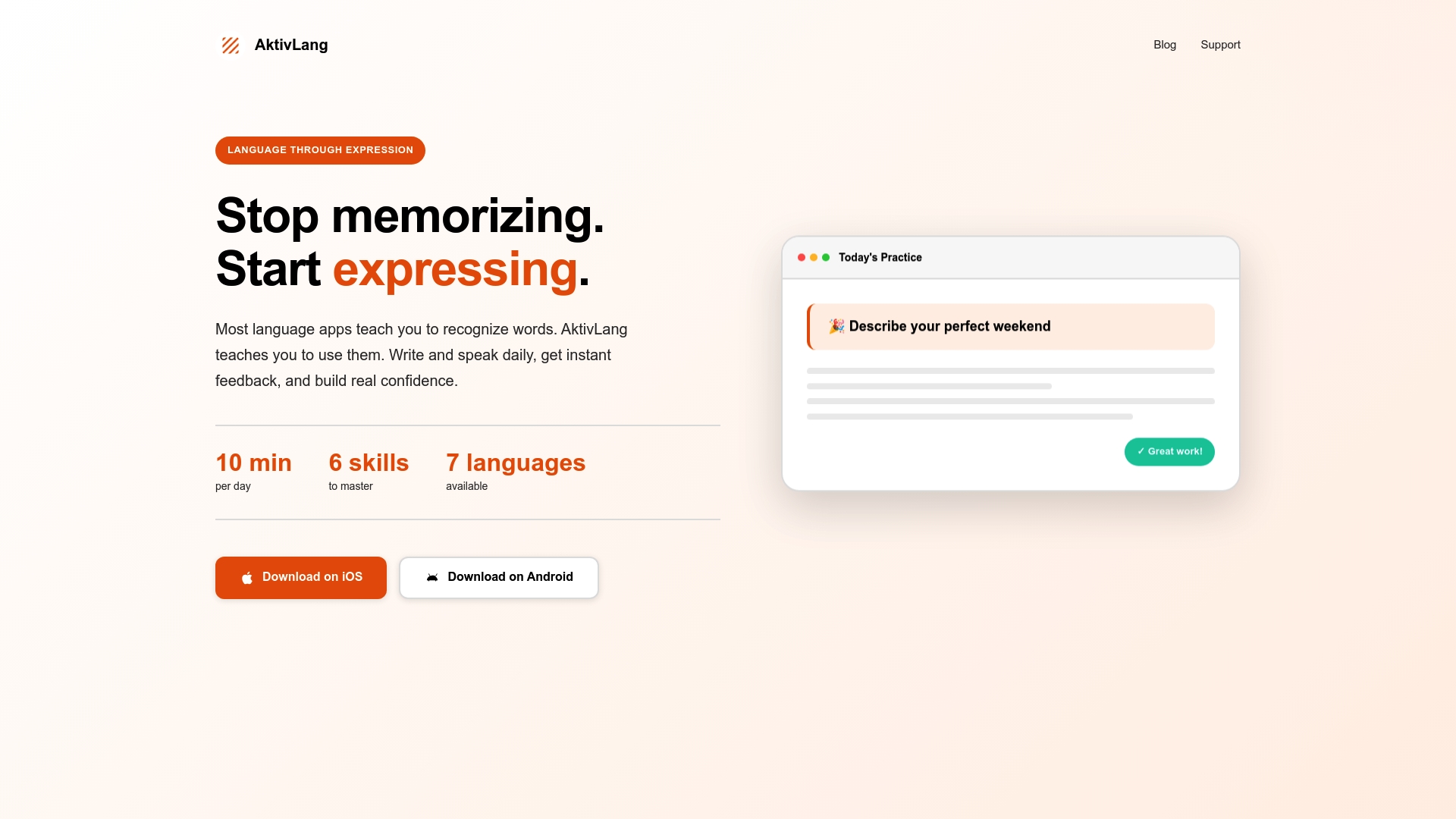
Read compelling stories in your target language, then practice speaking through retelling exercises, pronunciation drills, and conversational tasks. Self-assessment tools provide immediate feedback on fluency and accuracy, while varied exercise types keep practice engaging. The platform integrates grammar support naturally within story contexts, letting you build fluency without perfectionist barriers. Join thousands of intermediate learners using AktivLang to transform reading knowledge into confident speaking ability through daily practice that actually works.
Frequently asked questions about speaking practice advantages
How much daily speaking practice do intermediate learners need for fluency gains?
Intermediate learners see noticeable fluency improvements with just 10-15 minutes of focused daily speaking practice. Consistency matters more than duration. Brief daily sessions build neural pathways more effectively than sporadic longer sessions because regular practice strengthens automatic language processing.
Are story-based speaking exercises more effective than traditional drills?
Yes, story-based exercises enhance pronunciation, vocabulary, and conversational skills more effectively than isolated drills because contextual practice improves retention and reduces anxiety. Stories provide meaningful frameworks that help your brain process and remember language naturally, while drills often feel mechanical and disconnected from real communication.
Why does self-assessment improve speaking accuracy better than peer feedback?
Self-assessment develops metacognitive awareness and internal quality standards that peer feedback alone cannot provide. When you evaluate your own speaking using structured tools, you internalize proficiency criteria and build self-efficacy. Combining both methods yields the best results, with self-assessment providing consistent evaluation and peer feedback offering fresh perspectives.
How should intermediate learners balance grammar study with fluency-focused speaking practice?
Prioritize fluency first, using grammar as supportive scaffolding rather than a barrier to speaking. Spend approximately 80% of practice time on fluent communication and 20% on targeted grammar refinement. Address grammar issues that block communication immediately, but note non-critical errors for later focused study rather than interrupting your speaking flow.