
Most intermediate learners assume that more conversation equals more progress. Spend enough time chatting, the thinking goes, and fluency will follow naturally. But that assumption leaves a critical gap. Free conversation is valuable, yet without structure it rarely forces you to fix your weak spots. Guided speaking exercises fill that gap by giving you targeted prompts, clear feedback, and a repeatable framework for improvement. This guide explains what guided speaking exercises are, why they work especially well at the intermediate level, and how you can use them alongside story-based contexts to accelerate your progress in French, Spanish, German, Dutch, Italian, or Portuguese.
Table of Contents
- What are guided speaking exercises?
- Why guided exercises matter for intermediate learners
- Frameworks and formats for guided speaking
- Evidence-backed strategies for rapid progress
- The uncomfortable truth about guided speaking: What most learners miss
- Ready to accelerate your speaking progress?
- Frequently asked questions
Key Takeaways
| Point | Details |
|---|---|
| Guided vs free-form practice | Structured exercises offer focused feedback and greater progress than informal conversation alone. |
| Story-based learning advantage | Story contexts make guided speaking more engaging and memorable, especially at intermediate levels. |
| Empirical gains with practice | 15-minute daily guided sessions can yield up to 240% better language retention. |
| Personalized for many languages | Top language apps and tools feature guided speaking exercises across multiple European languages. |
| Technology enhances outcomes | AI-powered feedback and CAPT tools can match the effectiveness of native teachers for pronunciation. |
What are guided speaking exercises?
Not all speaking practice is created equal. There is a meaningful difference between chatting freely with a friend and working through a structured speaking task designed to build specific skills.
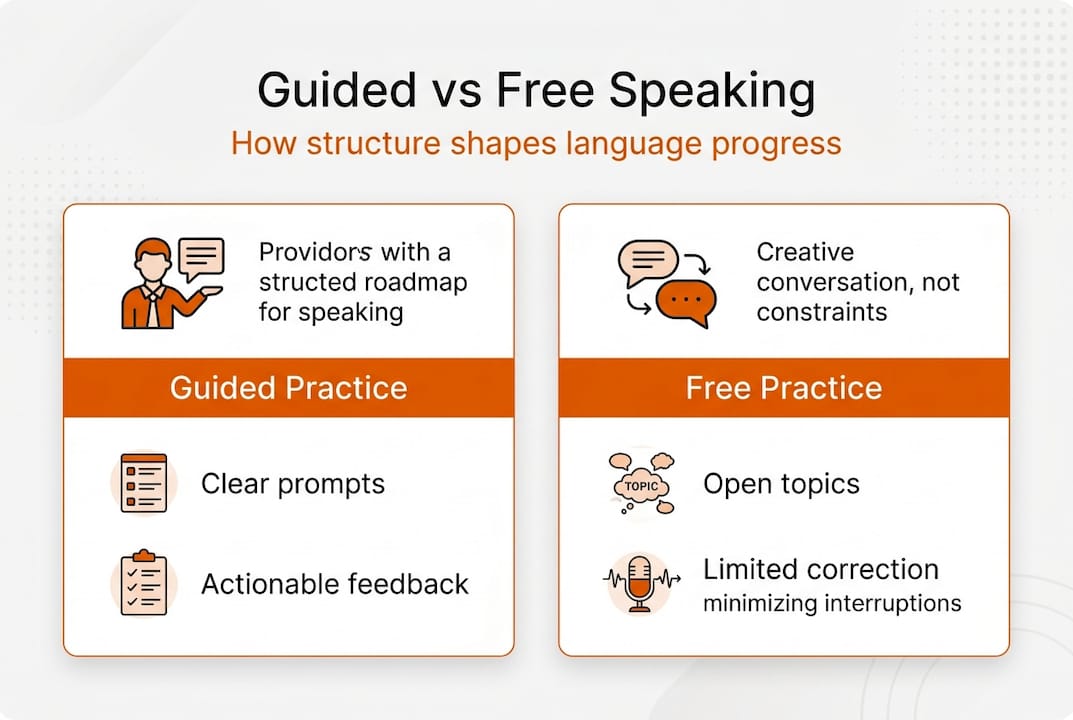
Guided speaking exercises are structured activities using prompts, scripts, or guidance to practice oral language skills. That structure is the key ingredient. Instead of hoping a conversation drifts toward the grammar point you need, a guided exercise puts that exact point front and center.
Here are the main types you will encounter:
- Prompt-based speaking: You respond to a written or audio prompt, which forces you to produce language on a specific topic.
- AI-guided dialogues: A virtual partner asks questions and evaluates your responses in real time.
- Role-plays: You take on a character or scenario, practicing vocabulary and grammar in a realistic context.
- Story-based narration: You retell or extend a story you have read, combining comprehension with production.
- Shadowing: You listen to a native speaker and repeat the audio immediately, training your ear and mouth simultaneously.
Why does structure matter so much at the intermediate level? Because intermediate learners already have a foundation. You know the basics. What you need now is not more input but more output, meaning active production of the language. The speaking practice benefits of structured output go well beyond vocabulary recall. They train automaticity, which is the ability to produce correct language without consciously thinking about every rule.
"Structure in speaking practice is not a constraint. It is a scaffold that lets you build higher than you could on your own."
Free conversation has its place, but it tends to recycle language you already know. Guided exercises push you into territory that is just beyond your comfort zone, which is exactly where growth happens. The advantages of speaking practice become most visible when exercises are designed to stretch your current proficiency rather than simply confirm it.
Why guided exercises matter for intermediate learners
Intermediate learners occupy a tricky position. You have moved past the beginner stage, but full fluency still feels distant. Free conversation can actually reinforce bad habits at this stage because you default to structures you already know.
For intermediate learners, guided exercises build on familiar topics to create full narratives and collaborative stories. That narrative element is powerful. When you practice speaking inside a story context, vocabulary sticks because it carries emotional and narrative weight, not just a dictionary definition.

Consider how different these two scenarios feel:
| Practice type | Context | Feedback | Vocabulary retention |
|---|---|---|---|
| Free conversation | Unpredictable | Minimal | Low to moderate |
| Guided story exercise | Structured narrative | Immediate | High |
| AI-guided role-play | Scenario-based | Detailed scoring | High |
The table makes the contrast clear. Guided exercises give you a context you can prepare for, feedback you can act on, and vocabulary embedded in a story you remember.
Pro Tip: Choose story themes that genuinely interest you, whether that is mythology, history, or travel. Emotional engagement with the content doubles the chance that new vocabulary transfers to long-term memory.
For learners working across A2 to C1 levels in European languages, story-based guided practice scales naturally. A beginner-intermediate learner might retell a simple folk tale in Spanish, while a C1 learner might analyze a character's motivations in German. The conversation practice methods that work best at each level share one feature: they require you to produce language, not just recognize it.
The benefits of guided tasks also include metacognitive growth, which means you start noticing your own errors. That self-awareness is a hallmark of advanced learners, and guided exercises build it faster than casual conversation ever could.
Frameworks and formats for guided speaking
Knowing that guided exercises work is one thing. Knowing which format to use and when is another. Let us look at the main frameworks.
- Dialogue practice: Two speakers follow a semi-scripted exchange. One person introduces a scenario, the other responds. This trains turn-taking, politeness markers, and register.
- Role-play scenarios: You are given a character and a goal, for example, negotiating a price at a market in Italian. The open-ended nature forces creative language use within a safe structure.
- Shadowing: You listen to a short audio clip and repeat it immediately, matching rhythm, intonation, and speed. This is one of the fastest ways to improve pronunciation.
- Story-building: You read a short story, then retell it, extend it, or change the ending. This format combines reading comprehension with speaking production.
- Picture or prompt narration: You describe an image or respond to a written cue, practicing descriptive language and spontaneous production.
Apps like Babbel and Duolingo use versions of these formats, and platforms aligned with the Common European Framework of Reference (CEFR) go further. CEFR-aligned apps provide proficiency scoring for guided speaking tasks, so you get an objective measure of where you stand and what to work on next.
Here is a quick reference for matching formats to goals:
| Format | Best for | Proficiency level |
|---|---|---|
| Shadowing | Pronunciation, rhythm | A2 to B2 |
| Role-play | Vocabulary, real-world use | B1 to C1 |
| Story narration | Fluency, grammar in context | B1 to C1 |
| Dialogue practice | Turn-taking, register | A2 to B2 |
For story-based learning specifically, story-based workflows show that reading a story first and then speaking about it creates a natural retrieval loop. You encode the vocabulary during reading and retrieve it during speaking, which strengthens the memory trace. You can also combine speaking with interactive practice techniques or use creative language prompts to keep sessions fresh and engaging.
Evidence-backed strategies for rapid progress
Good frameworks need good habits behind them. The research on guided speaking points to a few strategies that consistently produce results.
Spaced short sessions beat long marathons. Spaced short sessions of 15 minutes per day yield 240% better retention compared to infrequent longer sessions. That is not a small difference. It means that 15 focused minutes every morning will outperform a two-hour session on the weekend.
Here is a practical daily structure:
- Read a short story passage (5 minutes): Activate the vocabulary and grammar you will practice.
- Complete a guided speaking exercise (7 minutes): Use a prompt, role-play, or shadowing task tied to the story.
- Review AI feedback (3 minutes): Note one specific pronunciation or fluency issue to target tomorrow.
Pro Tip: Record yourself during speaking exercises and listen back immediately. Most learners are surprised by errors they never noticed in real time. That gap between what you think you said and what you actually said is where the fastest improvement hides.
AI-assisted pronunciation tools are genuinely effective. Computer-assisted pronunciation training (CAPT) is as effective as native teachers for improving pronunciation accuracy. This matters because access to native speakers is limited for most learners. AI tools give you unlimited repetitions with instant, objective feedback.
Combine speaking with writing for compounding gains. Active learning methods that pair speaking with writing reinforce the same vocabulary through two production channels. After a speaking exercise, write two or three sentences summarizing what you said. This dual-channel approach accelerates personalized language learning by making each session work harder. A structured writing practice workflow also helps because writing in your target language reinforces the same grammar patterns you are trying to automate in speech.
The uncomfortable truth about guided speaking: What most learners miss
Here is something most language advice glosses over. Many learners spend months in conversation groups or language exchanges and plateau. They feel busy, even productive, but their accuracy does not improve. The reason is almost always the same: they are practicing fluency without practicing precision.
Free conversation rewards you for communicating, not for communicating correctly. Guided exercises do the opposite. They create the conditions for feedback, repetition, and deliberate correction that casual chat simply cannot provide.
The other thing learners miss is the narrative dimension. When you practice speaking inside a story, you are not just drilling phrases. You are building a mental model of how the language works in context. Story-based language workflows show that this contextual encoding is what separates learners who plateau from those who keep improving.
Effective progress is not about more practice. It is about better-designed practice. Guided exercises, combined with honest feedback and regular self-reflection, are the engine behind that improvement.
Ready to accelerate your speaking progress?
You now have a clear picture of what guided speaking exercises are, why they work, and how to use them strategically. The next step is putting them into a daily practice that actually fits your life.
AktivLang is built around exactly this approach. Read a story in French, Spanish, German, Dutch, Italian, or Portuguese, then practice what you learned through guided speaking tools that give you real-time pronunciation scores, fluency ratings, and instant feedback. Every exercise is tied to a story context, so vocabulary sticks and speaking practice feels meaningful rather than mechanical. Whether your goal is travel, work, or personal growth, AktivLang gives you the structure to move forward every single day.
Frequently asked questions
How are guided speaking exercises different from regular conversation practice?
Guided exercises use prompts, structure, and feedback to focus on accuracy and fluency, while regular conversation is often informal and less targeted. The key difference is that guided practice forces you to produce specific language rather than defaulting to what you already know.
What types of guided speaking exercises help with pronunciation?
Techniques like AI-assisted drills, shadowing, and role-play with immediate feedback are highly effective for pronunciation improvement. CAPT-based technology is as effective as native teachers for building pronunciation accuracy, making it accessible to learners without regular access to native speakers.
How often should I practice guided speaking exercises?
Short daily sessions of 15 minutes spaced out over time produce the best retention and fluency gains. Research shows a 240% retention boost from spaced practice compared to longer, infrequent sessions.
Can guided speaking activities be personalized to different languages?
Yes, popular apps and language platforms offer guided exercises tailored for Spanish, German, French, Italian, Portuguese, and other European languages. Story-based apps support guided exercises across multiple languages and proficiency levels, making it easy to find content that matches your goals.