

You write in your target language regularly. You finish a story, read it back, and something feels off. The sentences are technically correct, but the narrative sounds flat. Your grammar slips in the middle paragraphs. The vocabulary feels repetitive. Sound familiar? This plateau is one of the most frustrating stages for intermediate learners, and it's more common than you think. The good news is that interactive, story-based writing practice is a proven path out of it. This guide walks you through the research, the tools, the steps, and the fixes that will help you write with more confidence, clarity, and real communicative power.
Table of Contents
- Why interactive writing practice boosts communication skills
- What you need to start: Tools, prompts, and materials
- Step-by-step guide to effective story-based writing practice
- Common mistakes and troubleshooting for intermediate writers
- How to measure your progress and recalibrate your practice
- Take your writing practice further with AktivLang
- Frequently asked questions
Key Takeaways
| Point | Details |
|---|---|
| Story-based writing delivers fluency | Interactive and sequenced story writing builds advanced vocabulary and communication. |
| AI feedback speeds grammar gains | Digital tools boost mechanics and grammar but need meaningful practice to deepen skills. |
| Sequencing tasks is most effective | Structured writing exercises outpace repetition and text modeling for complexity and fluency. |
| Avoid boring or complex plots | Simple, vivid stories with strong verbs help prevent stagnation and enhance engagement. |
| Track and recalibrate practice | Regular assessment lets you adapt your approach for sustained progress in writing quality. |
Why interactive writing practice boosts communication skills
Building on the need for better writing outcomes, let's clarify why interactive writing matters so much at the intermediate level.
Writing a story is not just a creative exercise. It forces you to retrieve vocabulary, apply grammar rules in context, and organize ideas into a sequence that another person can follow. That combination of demands is exactly what makes story-based writing so effective for language development. When you write interactively, meaning you respond to prompts, revise based on feedback, and sequence tasks deliberately, you push your language system harder than passive review ever could.
Research backs this up clearly. Lexical features predict writing quality more than syntactic features in narrative writing, which means the richness and variety of your word choices matter more than sentence length or complexity. This is a counterintuitive finding. Many learners obsess over grammar structures when they should be building a richer, more diverse vocabulary.
Here is what interactive writing specifically develops:
- Lexical diversity: Writing stories pushes you to avoid repeating the same words, which naturally expands your active vocabulary.
- Grammar in context: Applying tenses, agreement rules, and connectors inside a real narrative is far more effective than drilling isolated exercises.
- Communicative fluency: Telling a story requires you to think about your reader, which sharpens your ability to communicate meaning, not just produce correct sentences.
- Metalinguistic awareness: This is the ability to think about how language works. Writing forces you to make conscious choices that build this skill.
Additionally, task sequencing outperforms repetition for gains in both syntactic and lexical complexity. Doing the same writing task over and over produces diminishing returns. Sequencing tasks, where each new task builds on the last, drives greater fluency and complexity over time. You can also explore how writing boosts fluency and why target language writing accelerates your overall progress.
Key insight: Interaction and sequencing are not optional extras. They are the engine of writing improvement.
What you need to start: Tools, prompts, and materials
Knowing the impact of interactive writing, it's time to get prepared with the right materials. You do not need an elaborate setup. What you need is the right combination of tools, prompts, and a clear workflow.

Comparison of key tools for interactive writing
| Tool type | Examples | Best for | Limitation |
|---|---|---|---|
| Manual (pen and paper) | Notebook, journal | Slowing down, thinking deeply | No instant feedback |
| Digital writing apps | Google Docs, Notion | Drafting, organizing, revising | Requires self-discipline |
| AI writing tools | Grammarly, Quillbot | Grammar and mechanics feedback | May not deepen internalization |
| Story-based platforms | AktivLang | Context-rich vocabulary and grammar | Requires consistent use |
AI tools like Quillbot and Grammarly deliver measurable gains in vocabulary and grammar for ESL writers. They are genuinely useful. But they work best when paired with meaningful writing tasks, not as a substitute for them.
For prompts, intermediate writers benefit most from scenarios that are vivid but not overwhelming. Strong starting points include:
- A traveler who arrives in an unfamiliar city and must ask for help
- A historical figure facing a difficult decision
- A short myth explaining why something in nature exists
- A conversation between two people with opposing views on a simple topic
These creative prompts give you enough structure to start without boxing you in. You can also build a consistent writing practice workflow that keeps your sessions focused and productive.
Pro Tip: Avoid prompts that require specialized knowledge or complex world-building. The more mental energy you spend on the plot, the less you have for language production. Keep the scenario vivid but simple.
Step-by-step guide to effective story-based writing practice
With your setup ready, follow these steps for maximum impact.
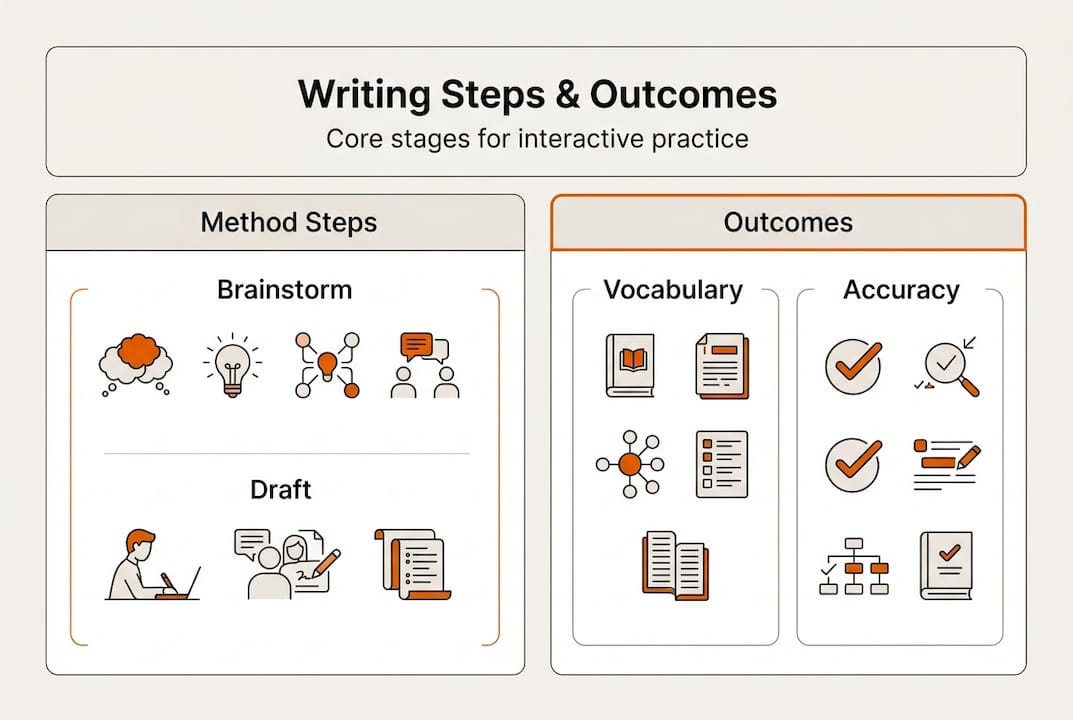
- Brainstorm: Spend five minutes listing key vocabulary, characters, and a basic conflict. Do not write full sentences yet. This primes your language system before you draft.
- Sequence your tasks: Plan two or three connected writing tasks. For example, write a scene, then write a follow-up scene from a different character's perspective. Task sequencing produces better complexity than repeating the same task or simply modeling a sample text.
- Write your first draft: Focus on communicating the story, not on perfection. Let the ideas flow. You will fix errors in revision.
- Revise with intention: Read your draft aloud. Mark sentences that sound unnatural. Replace weak verbs with stronger, more specific ones. Add sequence linkers like first, then, as a result, and finally to improve narrative flow.
- Get feedback: Use an AI tool for a first pass on grammar and mechanics. AI feedback accelerates mechanics improvement significantly. Then seek human or platform-based feedback for deeper communicative issues.
Method steps and research-backed outcomes
| Step | Action | Research-backed outcome |
|---|---|---|
| Brainstorm | Activate vocabulary before writing | Increases lexical diversity in draft |
| Sequence tasks | Build connected writing tasks | Higher syntactic and lexical complexity |
| First draft | Write for meaning, not perfection | Builds fluency and automaticity |
| Revise | Replace weak verbs, add connectors | Improves narrative quality and cohesion |
| Get feedback | Use AI tools plus human review | Faster mechanics gains and deeper internalization |
You can find a detailed writing workflow guide and practical revision tips to support each of these steps.
Pro Tip: Swap out generic verbs like said, went, and got for precise alternatives: whispered, rushed, received. Strong verbs make your writing more vivid and demonstrate lexical sophistication, which research identifies as the top predictor of writing quality.
Common mistakes and troubleshooting for intermediate writers
Even the best plans face obstacles. Here's how to stay on track and advance faster.
Intermediate writers tend to hit the same walls. Recognizing them early saves you weeks of frustration.
- Flat plot: Nothing happens, or events are listed without tension. Fix this by adding a clear problem and a moment where the character must make a choice.
- Weak verbs: Overusing to be and to have drains energy from your writing. Audit your draft and replace at least five weak verbs per session.
- Grammar gaps: Tense inconsistency is the most common issue. Pick one tense for your narrative and stick to it throughout.
- Over-complexity: Trying to write long, elaborate sentences before you have the vocabulary to support them leads to errors and confusion. Short, clear sentences with precise words outperform long, tangled ones every time.
Research on narrative writing practice is direct on this point: avoid boring plots and overcomplicated stories and prioritize vivid, selective language instead. A story with one strong image is more effective for language learning than a story with ten vague ones.
"Vivid, selective language in narrative writing does more for vocabulary retention and communicative skill than length or structural complexity ever will."
If you feel stuck and your progress has stalled, try switching your prompt type entirely. Move from personal narratives to myth-style stories, or from dialogue-heavy scenes to descriptive passages. Variety in task type is one of the fastest ways to break a plateau. You can find more targeted advice in these intermediate learner tips and across the language learning blog.
How to measure your progress and recalibrate your practice
Once you're practicing, evaluation and adjustment fuel further advancement.
Progress in writing is harder to see than progress in vocabulary quizzes. You need objective measures, not just a feeling that things are improving.
Here are practical ways to track your writing development:
- Lexical diversity score: Count how many unique words you use in a 200-word sample. Compare this number across drafts written one month apart.
- Verb audit: Count how many times you use to be versus action verbs. A lower ratio of to be verbs signals stronger, more active writing.
- Sentence variety check: Read your last three drafts and note whether your sentence lengths vary. Monotonous sentence length is a sign of stagnation.
- Error frequency: Track the types of grammar errors your AI tool flags. Are the same errors appearing? That tells you where to focus your next practice session.
- Self-assessment questions: Ask yourself after each session: Did I use any new vocabulary? Did I maintain consistent tense? Did my story have a clear beginning, middle, and end?
AI tools deliver measurable gains in mechanics and vocabulary, but internalization improves significantly when you combine AI feedback with structured scaffolding. Scaffolding means breaking the task into supported steps, like brainstorming before drafting and revising before submitting, rather than writing in one unguided session.
Recalibration is just as important as practice. Every four to six sessions, review your progress data and ask: Am I still being challenged? If the answer is no, increase the complexity of your prompts or add a new task type to your sequence. Explore active learning tips to keep your sessions dynamic and effective.
Take your writing practice further with AktivLang
Now that you're equipped with proven strategies, discover how to apply them more effectively with a platform built for exactly this kind of learning.
AktivLang is designed around the same principles this guide is built on: context-rich stories, active production, and immediate feedback. You read engaging stories in your target language, then practice vocabulary, grammar, speaking, and comprehension through 12+ exercise types. Every exercise gives you instant feedback so you always know what to improve.
For intermediate learners who want to move beyond basics, AktivLang's story-based approach means you are always writing and speaking in meaningful context, not drilling isolated rules. The platform's AI feedback helps you catch mechanics errors fast, while the structured story themes give you the vivid, interesting prompts that research shows work best. You can practice your target language with stories across mythology, history, culture, travel, and more. Pair that with a consistent writing practice workflow and you have everything you need to move forward with confidence.
Frequently asked questions
How does story-based writing improve fluency for intermediate learners?
Story-based writing pushes you to use a wider, richer vocabulary in context, and lexical features predict writing quality more than grammar structures alone. This builds both communicative skill and real fluency over time.
Which writing practice method gives the fastest gains in grammar and vocabulary?
Sequencing tasks and using AI feedback together produce the fastest gains. Task sequencing outperforms repetition for complexity, and AI tools deliver measurable grammar gains when used consistently alongside meaningful writing tasks.
What are the most common mistakes in intermediate writing practice?
The most common mistakes are flat plots with no tension, weak verbs, tense inconsistency, and trying to write overly complex sentences too soon. Research recommends focusing on vivid, selective language over length or structural complexity.
Can AI tools alone make my writing fluent?
AI tools accelerate grammar and mechanics improvement, but deep internalization requires scaffolding and structured practice alongside the feedback. Use AI as one layer of your practice, not the whole approach.
How often should I practice story-based writing to see improvement?
Practicing two to three times per week with sequenced tasks is enough to see measurable gains. Regular sequenced practice increases complexity in both vocabulary and grammar over time.