

Most language learners assume that reviewing material once or twice is enough. It isn't. Research shows that spacing out reviews can triple how much vocabulary you actually retain compared to standard repetition. The problem isn't effort. It's method. Most intermediate learners spend their revision time rereading notes or running through the same flashcard deck in the same order, which feels productive but delivers surprisingly weak results. This guide breaks down the science of smarter revision and gives you practical frameworks to strengthen both your vocabulary retention and your speaking fluency.
Table of Contents
- Why revision is the missing key for vocabulary retention
- How active recall strengthens fluency and speaking skills
- The science of story-based revision: Integrating meaning and memory
- Feedback, frequency, and edge cases: What most learners miss
- Practical frameworks: How to revise for long-term retention and fluency
- Take your language revision further with AktivLang
- Frequently asked questions
Key Takeaways
| Point | Details |
|---|---|
| Spaced revision triples memory | Reviewing at spaced intervals is proven to dramatically improve long-term vocabulary retention. |
| Active recall beats rereading | Practicing retrieval through recall tasks outperforms rereading for both memory and speaking fluency. |
| Stories boost real skills | Revising vocabulary through stories and retelling helps integrate words and grammar into natural speech. |
| Feedback accelerates learning | Getting feedback during your revision has a measurable positive impact on your language progress. |
Why revision is the missing key for vocabulary retention
With the myth debunked, let's explore what really makes vocabulary stick.
Most learners treat revision as a simple replay: read the word, check the translation, move on. That approach activates recognition memory, which is shallow. What you actually need is retrieval, the mental effort of pulling a word from memory without a prompt. That effort is what builds a durable memory trace.
Spaced repetition and active recall lead to stronger memory traces and better vocabulary retention compared to cramming or restudy. The spacing effect works because each review session forces your brain to reconstruct the memory rather than simply confirm it. Think of it like exercising a muscle: the slight strain of retrieval is exactly what makes it stronger.
The numbers back this up. Vocabulary intervention effect sizes reach 1.179, which is considered a very large effect in educational research. That means structured, active revision strategies dramatically outperform passive review. You can also explore active language strategies to see how retrieval fits into a broader learning system.
How spaced repetition and active recall work in everyday study:
- Review new words within 24 hours, then again after 3 days, then after a week
- Test yourself by covering the translation and producing the word from memory
- Mix old and new vocabulary in every session rather than isolating new words
- Use sentence-level recall, not just isolated word recall, to build context
- Track which words you miss most and prioritize those in the next session
| Revision method | Memory strength | Retention after 1 week | Effort required |
|---|---|---|---|
| Rereading notes | Low | 20-30% | Low |
| Standard flashcards | Medium | 40-50% | Low-Medium |
| Spaced retrieval | High | 70-80% | Medium |
| Active recall with feedback | Very High | 80-90% | Medium-High |
"The spacing effect doesn't just help you remember more. It changes how deeply the memory is encoded, making words easier to access under pressure, like during a real conversation."
How active recall strengthens fluency and speaking skills
Knowing the key ingredients, let's focus on how retrieval tasks turn passive knowledge into speaking skill.
Recognizing a word when you see it and producing it in conversation are two very different skills. Active recall bridges that gap. When you force yourself to retrieve a word without a visual prompt, you're training the same mental pathway you use when speaking. That's why active recall outperforms rereading for both vocabulary retention and spoken fluency.

Reverse flashcards are one of the simplest tools here. Instead of seeing the foreign word and recalling the English meaning, you see the English and produce the foreign word. Gap-fill exercises work similarly: you read a sentence with a missing word and must supply it from memory. Both techniques simulate the cognitive demand of real speech.
You can also build a habit of conversation practice that deliberately uses vocabulary from your recent revision sessions. This creates a feedback loop between study and use.
How to integrate active recall into your routine:
- After each study session, close your notes and write down every word you can remember
- Use reverse flashcards for at least half of your vocabulary review time
- Record yourself using five target words in original sentences, then listen back
- Practice gap-fill exercises with sentences from stories or texts you've already read
- Once a week, attempt a short spoken summary of a topic using only recalled vocabulary
| Method | Passive or active | Speaking benefit | Time investment |
|---|---|---|---|
| Rereading | Passive | Minimal | Low |
| Standard flashcards | Semi-active | Low | Low |
| Reverse flashcards | Active | Medium | Low-Medium |
| Gap-fill with recall | Active | High | Medium |
| Spoken recall tasks | Fully active | Very High | Medium-High |
Pro Tip: Don't wait until you feel "ready" to speak. Use your recalled vocabulary in short, low-stakes recordings. The slight discomfort of producing language before it feels automatic is exactly what accelerates fluency. Research on retrieval practice confirms that production tasks outperform recognition tasks for long-term speaking gains.
The science of story-based revision: Integrating meaning and memory
Now that recall has a clear role, let's see what happens when revision meets real communication through stories.
Stories are not just engaging. They are structurally ideal for language revision. A well-told story repeats vocabulary naturally, creates predictable language patterns that help you anticipate grammar, and demands active processing because you're following a narrative. That combination of repetition, prediction, and engagement is hard to replicate with isolated drills.
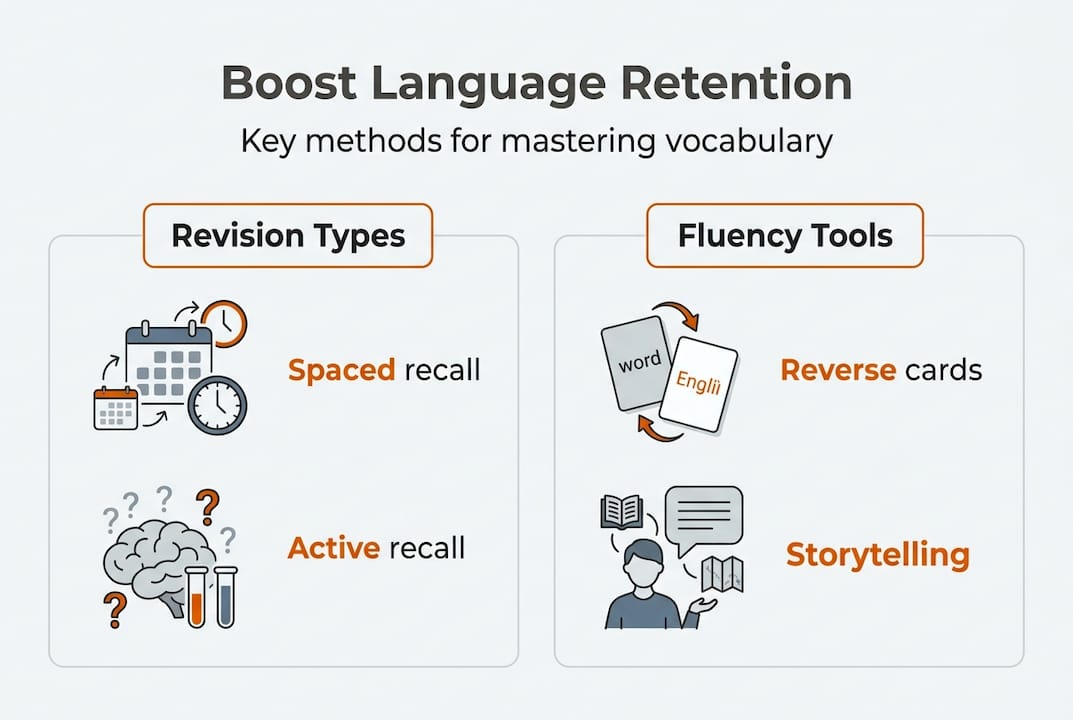
Story-based revision integrates vocabulary and grammar in context, boosting both engagement and retention. When a word appears in a story, it carries emotional weight, character association, and plot relevance. That richness creates multiple memory hooks, which is why story-learned vocabulary tends to stick longer than list-learned vocabulary.
The results are measurable. Oral skills improve significantly with regular story-based practice, with intervention studies showing gains at p<0.001. That's a strong signal that storytelling isn't just motivating. It's genuinely effective. You can see how this plays out in real learning by reading about story learning results.
"When you retell a story in your target language, you're not just practicing vocabulary. You're rehearsing the grammar structures, the connective phrases, and the emotional register that make speech sound natural."
Story-based revision activities for intermediate learners:
- Read a short story, then retell it aloud from memory using your own words
- Pause mid-story and predict what happens next, using target vocabulary in your prediction
- Role-play a scene from the story, switching character perspectives
- Rewrite the ending of a story using at least ten vocabulary words from your current revision list
- Use creative story prompts to generate original short narratives that force vocabulary production
- Explore how writing for fluency connects story-based practice to long-term speaking gains
Pro Tip: After reading a story, wait 10 minutes before retelling it. That short delay forces genuine retrieval rather than short-term repetition, which means the retelling session does double duty as both a speaking exercise and a spaced recall event.
Feedback, frequency, and edge cases: What most learners miss
Moving from the foundations, let's clarify the nuances and tricks most intermediate learners overlook.
Repetition alone is not enough. You can review a word twenty times and still struggle to use it correctly if you never receive feedback on your errors. Feedback tells your brain which version of a word or structure to consolidate. Without it, you risk reinforcing mistakes.
Retrieval benefits grow with more repetitions and with feedback, with a feedback effect size of g=0.50. That's a meaningful gain. Four rounds of retrieval practice outperform three, and adding feedback to those rounds amplifies the effect further. This is why speaking practice advantages are so significant for intermediate learners: speaking forces output, and output invites correction.
What if you can't get feedback every session? That's a real constraint for many learners. In those cases, elaborative encoding is a strong alternative. Elaborative encoding means connecting new words to existing knowledge through explanation, analogy, or personal association. It's not as powerful as retrieval with feedback, but it's far better than passive rereading.
Quick checklist: How to make each revision session stick:
- Include at least one active retrieval task, not just recognition review
- Vary the format: mix gap-fills, reverse recall, and spoken production
- Seek feedback at least twice a week, whether from an app, a tutor, or a recording review
- Space your sessions: don't review the same material two days in a row
- Use elaborative tasks on days when feedback isn't available
- Check tips for intermediates for additional session-level strategies
The biggest mistake intermediate learners make is treating revision as a passive activity. Rereading feels comfortable. Retrieval feels hard. That difficulty is the signal that learning is happening.
Practical frameworks: How to revise for long-term retention and fluency
Equipped with the science and nuance, here are practical ways to transform your study routine.
A strong revision workflow doesn't need to be complicated. It needs to be consistent and structured around active production. Here's a framework you can start using immediately.
Step-by-step revision workflow:
- Select your vocabulary set. Choose 10 to 15 words from a recent story or lesson. Don't try to revise everything at once.
- Do an initial active recall pass. Cover translations and attempt to produce each word from memory. Note which ones you miss.
- Use the words in context. Write two or three original sentences using the words you missed. This is elaborative encoding in action.
- Practice speaking. Record yourself using the target words in a short spoken summary or story retelling.
- Schedule the next review. Set a reminder for 3 days later. At that session, start with the words you missed, not the ones you got right.
- Add feedback. Use an app with AI pronunciation scoring, review your recording critically, or work with a language partner.
For tools, vocabulary intervention analysis confirms that digital flashcard mechanics with reverse techniques and cumulative testing outperform simple restudy. Apps that combine spaced repetition with speaking output give you the most return per minute of study.
Story-based revision routines to add to your practice:
- Weekly story retelling: pick one story per week and retell it on day 1, day 3, and day 7
- Vocabulary-in-context journaling: write a short daily entry using five words from your current revision set
- Prediction reading: pause at key moments in a story and write or speak your prediction before continuing
Pro Tip: Combine your writing workflow with spaced retrieval by writing short paragraphs using vocabulary from three different revision cycles simultaneously. This forces your brain to juggle old and new material, which accelerates long-term retention. You can also explore writing in your target language as a daily fluency-building habit.
Take your language revision further with AktivLang
If you're ready to accelerate your vocabulary and speaking skills, here's how to turn proven methods into effortless habits.
Everything covered in this guide, spaced retrieval, active recall, story-based practice, and feedback-rich exercises, is built into how AktivLang language practice works. You read engaging stories in French, Spanish, German, Dutch, Italian, or Portuguese, then immediately practice with 12+ exercise types that force active production rather than passive recognition.
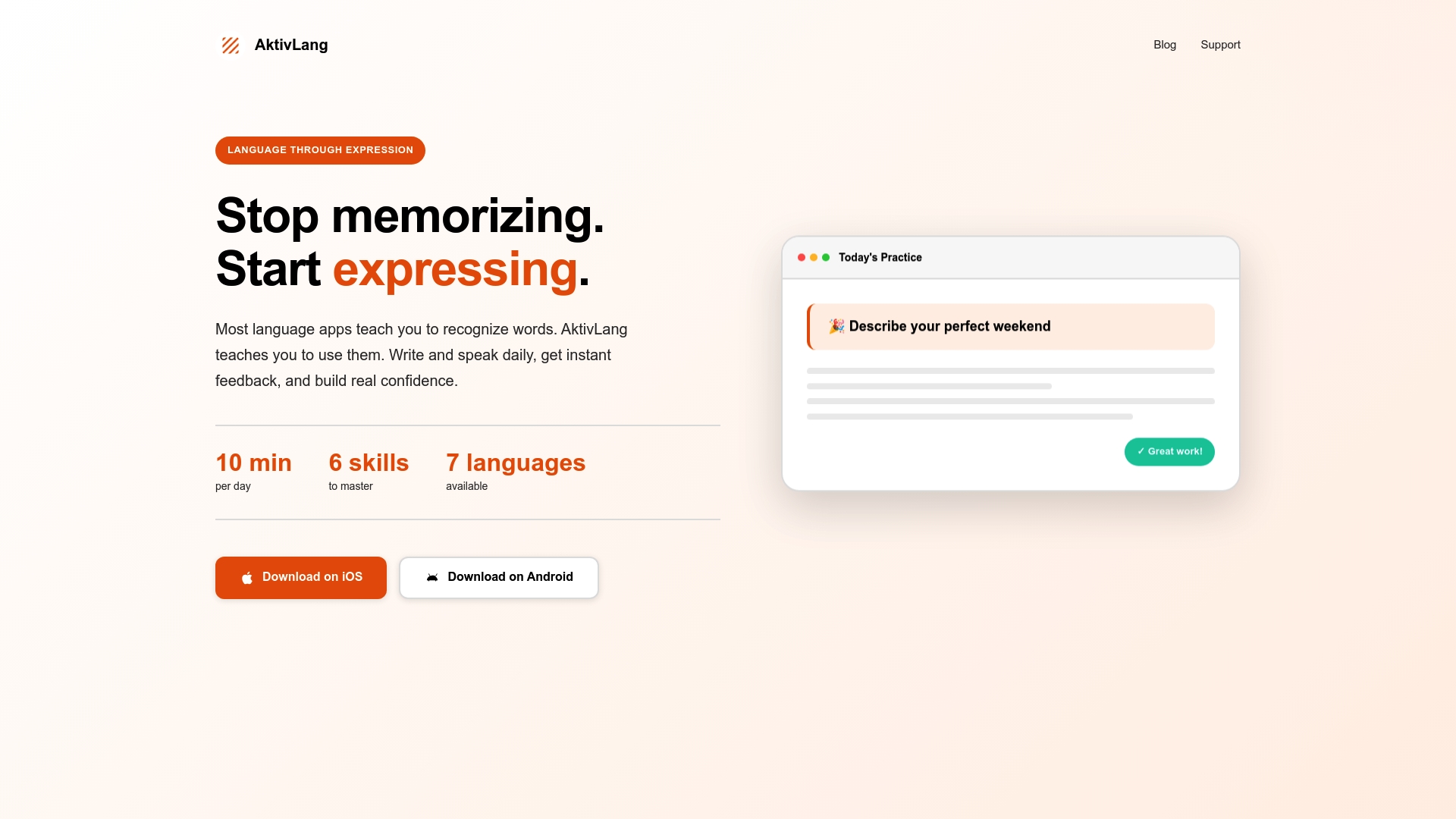
AktivLang's speaking exercises give you AI-powered fluency and accuracy scores so you always know what to improve. Vocabulary exercises move from meaning-matching to pronunciation practice. Grammar exercises push you to produce correct structures from scratch. Weekly reflections analyze your learning patterns and highlight your focus areas. It's a complete revision system built around the science of how memory actually works. Start with a theme you care about and let the stories do the heavy lifting.
Frequently asked questions
What is the most effective way to revise vocabulary for long-term retention?
Spaced retrieval triples retention compared to standard repetition or rereading. Combining spacing with active recall, where you produce words from memory rather than just recognize them, delivers the strongest long-term results.
How does story-based practice improve my speaking skills?
Stories provide natural repetition, grammar context, and emotional engagement that isolated drills can't match. Oral skills improve significantly with regular story-based practice, and retelling exercises train the same retrieval pathways you use in real conversation.
Can I still benefit from revision even if I can't get feedback every time?
Yes. While feedback amplifies gains, elaborative encoding tasks like concept mapping, storytelling, or writing personal associations for new words still significantly improve retention on feedback-free days.
How often should I revise old material to see results?
Spacing reviews every few days and cycling through older vocabulary regularly produces the best outcomes. More learning rounds yield higher gains, with four retrieval rounds outperforming three, so consistency over time matters more than any single long session.