
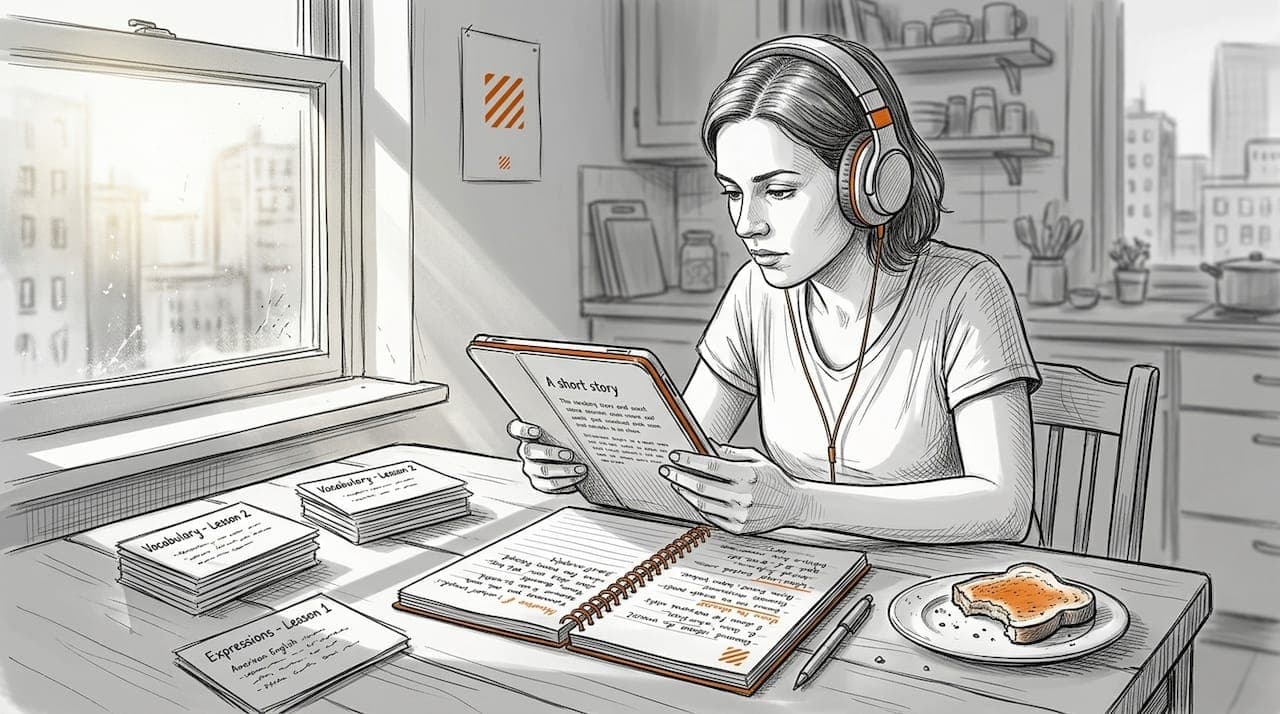
You've been studying French, Spanish, German, or another language for months. You know the basics, you've drilled vocabulary lists, and you've worked through grammar tables. Yet something feels stuck. Conversations still feel clunky, new words slip away overnight, and progress has slowed to a crawl. This is the intermediate plateau, and it's incredibly common. The fix isn't more drilling. It's switching to a story-based workflow that gives your brain the rich, contextual input it actually needs. Based on comprehensible input theory, stories pitched just above your current level trigger natural acquisition of vocabulary, grammar, and comprehension without forcing you to memorize rules.
Table of Contents
- Why story-based workflows accelerate language mastery
- What you need: Tools, apps, and story sources for every language
- Step-by-step workflow: From story input to confident output
- Common pitfalls and expert tips for maximizing your results
- How to track your progress and adjust for ongoing success
- Supercharge your language story journey with AktivLang
- Frequently asked questions
Key Takeaways
| Point | Details |
|---|---|
| Stories increase retention | Context-rich stories help you remember new words up to five times longer than rote memorization. |
| Follow a daily workflow | Short, regular practice using listen-read-speak cycles leads to the best progress for intermediates. |
| Balance input and output | Combine story input with speaking and writing to gain fluency and deep understanding. |
| Track and adjust | Check comprehension and recall regularly and move up in story complexity as you improve. |
Why story-based workflows accelerate language mastery
Stephen Krashen's input hypothesis introduced the concept of "i+1": language input that is slightly above your current level pushes you to grow without overwhelming you. Stories are the perfect vehicle for this. They wrap new words and grammar in meaningful context, so your brain connects meaning to usage rather than to a translation on a flashcard.
The results are striking. Vocabulary retention is 3-5x stronger through stories than through rote memorization. That's not a small edge. That's the difference between remembering 20 words from a list and remembering 60 to 100 from a single story session.
Stories also keep you engaged long enough for repetition to work. When a word appears three times in a gripping plot, your brain registers it differently than seeing it three times in a drill. Context creates memory hooks.
"The best language input is compelling, not just comprehensible. When you're absorbed in a story, acquisition happens almost automatically." — Stephen Krashen
Here's what story-based learning does that drills simply can't:
- Provides repeated exposure to vocabulary and grammar in natural, varied contexts
- Builds reading fluency by training your eye to process chunks of language, not individual words
- Activates emotional memory, making new words stick because they're tied to events and characters
- Models authentic sentence structure so grammar feels intuitive rather than mechanical
- Reduces anxiety by removing the pressure of explicit testing during input
You can also personalize language learning by choosing stories that match your interests, which makes the habit far easier to sustain. Platforms like MeloLingua offer AI-generated stories across multiple languages and levels, giving you a steady stream of fresh, leveled content.
Now that you see how stories can dramatically increase retention, let's explore what you need to set up an effective workflow.
What you need: Tools, apps, and story sources for every language
Not all story-based tools are created equal. The best ones combine leveled content, native audio, cultural relevance, and some form of interactive practice. Here's a quick comparison of the major options:
| Platform | Languages | Leveled stories | Native audio | Interactive exercises |
|---|---|---|---|---|
| AktivLang | FR, ES, DE, NL, IT, PT | Yes | Yes | 12+ types |
| StoryLearning | FR, ES, DE, IT, PT, and more | Yes | Yes | Limited |
| MeloLingua | FR, ES, DE, IT, PT | Yes | Yes | AI feedback |
| Dreame Reader | FR, ES | Partial | No | None |
StoryLearning and MeloLingua both support multiple languages and offer leveled story courses, making them solid starting points. For Dutch learners specifically, dedicated story programs are harder to find, so adapting French or German story methods with accessible Dutch texts is a practical workaround.
When choosing your story source, look for these criteria:
- i+1 level fit: You should understand roughly 70-95% of the content without a dictionary
- Cultural themes: Stories rooted in real culture teach idioms and context that textbooks miss
- Native audio: Hearing the language spoken naturally trains your ear and pronunciation simultaneously
- Tap-to-translate or glossary: Lets you look up unknown words without breaking your reading flow
- Output integration: The best tools push you to speak or write after reading, not just consume
Pro Tip: Browse French stories to see how leveled story content is structured. Even if French isn't your target language, the format gives you a clear model for what good story-based material looks like.
For supplementary tools, AI pronunciation feedback, shadowing apps, and writing journals all extend the value of each story session. Check out these top language learning tips for a broader toolkit that pairs well with story-based practice.
With the right resources in hand, you're ready to map out your workflow.

Step-by-step workflow: From story input to confident output
A story-based workflow isn't just "read a story and hope for the best." It follows a deliberate sequence: input, processing, output, and review. Here's the structure that works:
- Listen first (5 minutes): Play the native audio of your story without reading. Focus on rhythm, intonation, and any words you catch. This primes your ear before your eyes take over.
- Read along with audio (10 minutes): Follow the text while listening. Use tap-to-translate sparingly for words that block comprehension. Don't stop for every unknown word.
- Re-read silently (5 minutes): Go through the story again without audio. Notice how much more you understand the second time. This is your comprehension check.
- Speak it back (5 minutes): Summarize the story out loud in your target language. Don't translate. Just recall what happened using the words you absorbed. This is oral narration, and it's powerful.
- Write a short response (5 minutes): Write 3-5 sentences reacting to the story, predicting what happens next, or describing a character. Writing boosts fluency in ways that reading alone cannot.
- Review flagged vocabulary (5 minutes): Go back to the words you looked up and review them in context. Don't move them to a flashcard app. Keep them tied to the story.
This full cycle takes 30 to 35 minutes. If you only have 15 minutes, do steps 1 through 3 and save output for the next session.
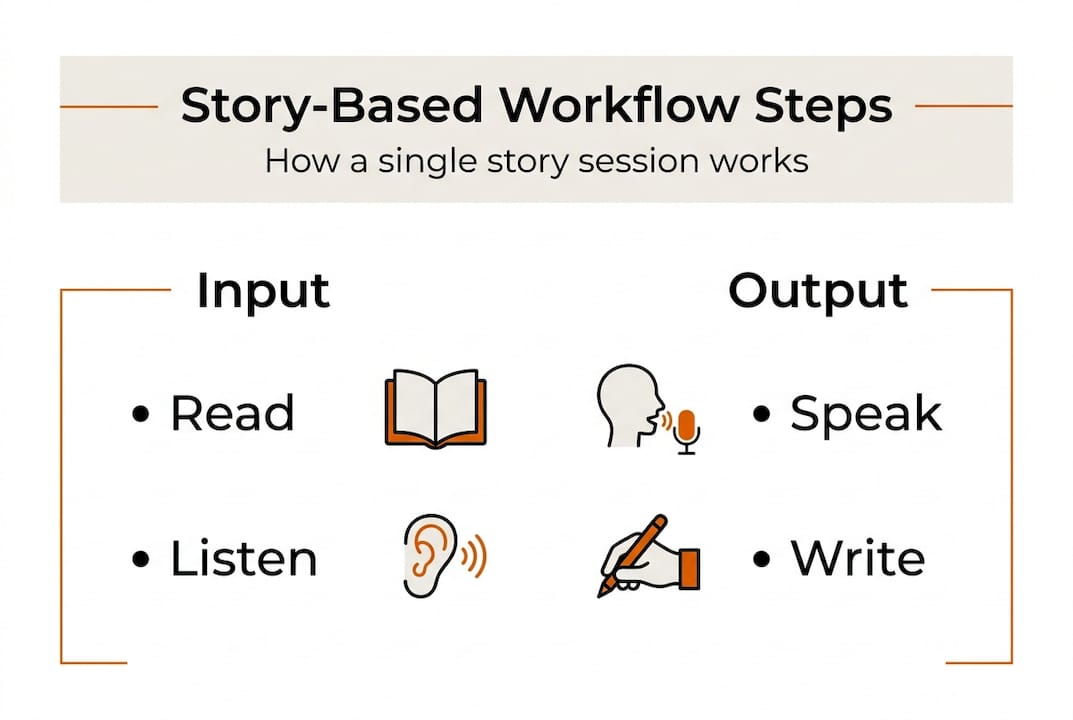
| Session length | Recommended steps | Focus |
|---|---|---|
| 15 minutes | Steps 1-3 | Input and comprehension |
| 25 minutes | Steps 1-4 | Input plus speaking |
| 35 minutes | Steps 1-6 | Full input-output cycle |
The daily story workflow research is clear: short daily sessions of 10 to 30 minutes outperform long irregular study marathons. Consistency beats intensity every time.
Pro Tip: Add conversation practice once or twice a week by discussing the story with a language partner or AI tutor. Talking about content you've already absorbed is far less intimidating than open-ended conversation.
You've got the structure. Next, let's tackle common pitfalls and ways to adjust your workflow for best results.
Common pitfalls and expert tips for maximizing your results
Even a solid workflow breaks down if you make a few key mistakes. Here's what to watch for:
- Choosing stories that are too hard: If you're looking up more than one word per sentence, the story is above your level. 70-95% comprehension is the sweet spot. Below 70%, frustration sets in and acquisition stalls.
- Skipping output entirely: Listening and reading are input. Speaking and writing are output. You need both. Input builds recognition; output builds production. Many learners stay stuck in input mode and wonder why they can't speak.
- Switching stories too fast: Spending two to three sessions with the same story deepens retention far more than racing through new content every day.
- Ignoring pronunciation during reading: Read aloud whenever possible, even quietly. Silent reading alone won't train your mouth or ear.
- Treating boredom as failure: If a story bores you, switch genres. Mythology, crime, travel, history, food culture. Find what pulls you in.
"The goal isn't to finish stories. The goal is to absorb them. Slow down, stay curious, and let the language wash over you."
Story-based learning research consistently shows that engagement is a core driver of acquisition. A story you love teaches more than a story you endure.
Pro Tip: Use creative writing prompts inspired by your stories to extend output practice. Write an alternate ending, a character's diary entry, or a scene from a different perspective. This forces active recall in a low-pressure way.
For speaking confidence, the advantages of speaking practice go beyond fluency. Regular spoken output reduces anxiety, sharpens pronunciation, and trains you to think in your target language rather than translating from English.
Implementing these tips sets you up for measurable progress. Here's how to know your workflow is paying off.
How to track your progress and adjust for ongoing success
Progress in language learning is notoriously hard to see in the short term. But with a story-based workflow, you have built-in checkpoints. Here's how to use them:
- Track comprehension percentage: After each story, estimate how much you understood without help. Aim for 80% or above before moving to harder material.
- Test story recall: Can you retell the story in your target language 24 hours later? If yes, the vocabulary and grammar are moving into long-term memory.
- Monitor output fluency: Record yourself summarizing a story once a week. Listen back. Are your sentences getting longer? Are you pausing less? That's real progress.
- Count new words retained: After two to three sessions with a story, how many new words can you use in a sentence without looking them up? Aim for 5 to 10 per story.
- Increase story complexity gradually: When you consistently hit 85-90% comprehension, move up one level. Don't wait until stories feel easy. That's a sign you've already outgrown them.
AI-generated input boosts oral proficiency and story-driven approaches increase both engagement and comprehension, according to recent empirical data. Pairing AI feedback tools with your workflow gives you objective data on pronunciation and fluency, not just a gut feeling.
Pro Tip: Use the master writing practice workflow to turn your story responses into structured writing practice. Over time, your written output becomes a portfolio of your progress.
If you're not seeing results after four to six weeks, the fix is usually one of three things: your stories are too hard, you're skipping output, or you're not being consistent. Adjust one variable at a time and reassess. Explore MeloLingua AI for adaptive story content that adjusts to your level automatically.
Supercharge your language story journey with AktivLang
If you're ready to put this workflow into action, AktivLang is built exactly for this. You read a story in French, Spanish, German, Dutch, Italian, or Portuguese, then immediately practice what you absorbed through 12+ exercise types covering vocabulary, comprehension, grammar, and speaking.
Every session connects input to output. Vocabulary exercises tie new words to the story context. Speaking exercises let you read sentences aloud and answer questions with AI scoring your fluency and accuracy. Comprehension exercises confirm you actually understood what you read, not just recognized words. Grammar exercises push you to produce correct structures from scratch. Weekly AI reflections show you exactly where you're improving and where to focus next. It's the story-based workflow described in this article, built into a single app.
Frequently asked questions
What makes story-based language learning more effective than grammar drills?
Stories provide context-rich input that creates memory hooks around new words and structures. Vocabulary retention is 3-5x stronger through stories than with rote memorization, making them far more efficient for long-term acquisition.
How much should I understand in an i+1 story for it to be effective?
Aim for 70-95% comprehension without a dictionary. Below 70%, the story is too hard and frustration blocks acquisition. Above 95%, you're not being challenged enough to grow.
How do I measure improvement with a story-based workflow?
Track comprehension percentage, your ability to retell stories in your target language, and fluency in spoken output tasks. AI-generated input tools can give you objective pronunciation and fluency scores to complement your self-assessment.
Are there good story-based programs for Dutch?
Most major platforms focus on French, Spanish, German, Italian, and Portuguese. StoryLearning covers several languages but Dutch options are limited. Your best approach is to adapt French or German story methods using accessible Dutch texts and native audio.
Is it important to combine speaking and writing with story listening?
Absolutely. Input builds recognition, but output builds production. Pairing story reading with spoken summaries and written responses leads to significantly better fluency and recall, as supported by ODST research on interactive story-driven learning.