

You've been studying your target language for months. You can read articles, follow podcasts, and recognize hundreds of words. Yet the moment someone speaks to you, your mind goes blank. Sound familiar? Many intermediate learners plateau despite consuming enormous amounts of input, because input alone doesn't activate the neural pathways you need for real conversation. This article explains the science behind why speaking accelerates fluency, how storytelling makes that practice more powerful, what pitfalls to avoid, and how to build a routine that actually moves the needle.
Table of Contents
- The science behind why speaking drives language progress
- Why storytelling makes speaking practice more powerful
- Potential pitfalls: Why speaking alone isn't enough
- How to optimize your speaking-led learning routine
- Practice smarter: Take the next step with AktivLang
- Frequently asked questions
Key Takeaways
| Point | Details |
|---|---|
| Speaking boosts fluency | Oral practice accelerates language progress faster than input alone for intermediate learners. |
| Storytelling reduces anxiety | Using stories for speaking practice increases confidence and improves retention. |
| Balance is essential | Combining 80% input with 20% targeted speaking prevents plateaus and fosters sustainable growth. |
| Self-assessment works best | Measuring your own speaking tasks leads to better proficiency and higher motivation than peer feedback. |
The science behind why speaking drives language progress
Having challenged the input-only myth, let's explore what science says about why speaking is so effective. Most learners treat language like a subject to study rather than a skill to perform. Reading and listening are receptive skills. Speaking is productive, and that distinction matters enormously.
When you speak, your brain must retrieve vocabulary, apply grammar rules, and monitor your output in real time. This process, often called the Output Hypothesis, forces you to notice gaps in your knowledge that passive input never reveals. Think of it like cooking from a recipe versus just reading one. You don't truly understand the steps until you're standing at the stove.
Speaking practice enhances oral fluency, accuracy, and self-efficacy for intermediate learners in measurable ways. Self-efficacy here means your belief in your own ability to succeed, and it's a powerful driver of continued effort. The conversation practice benefits for intermediate learners go well beyond just sounding smoother.
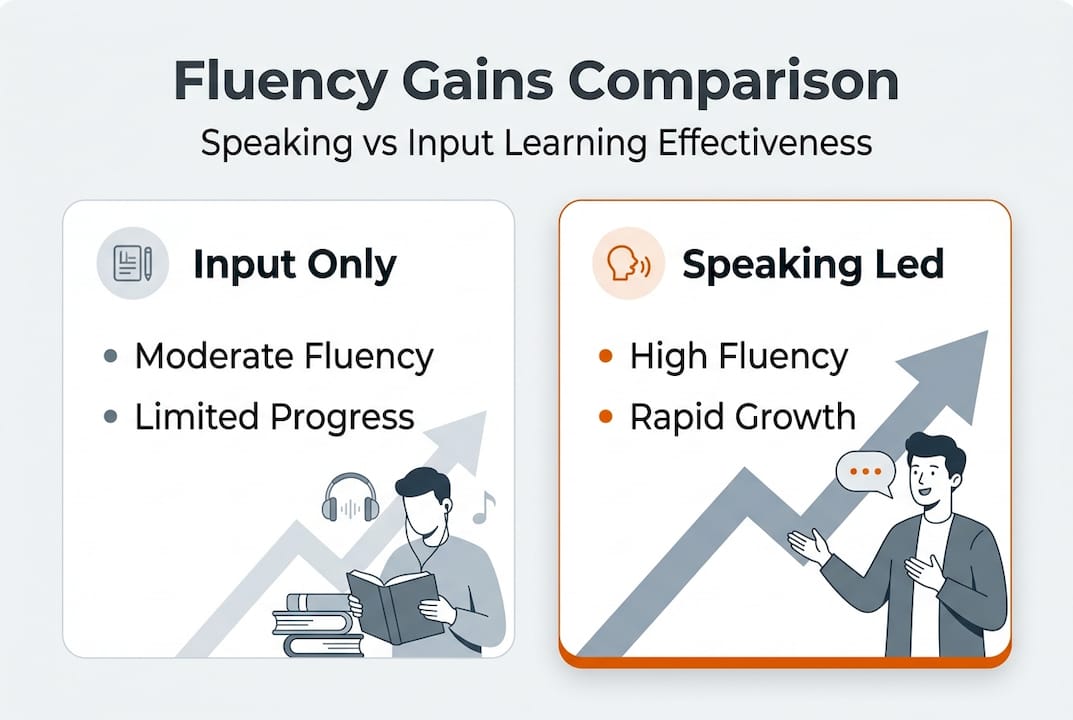
+33%: Learners who prioritized speaking practice showed fluency gains 33% higher than those using input-only methods.
| Outcome | Input-only learners | Speaking-led learners |
|---|---|---|
| Oral fluency improvement | Moderate | High (+33%) |
| Accuracy under pressure | Low | Significantly higher |
| Self-efficacy scores | Minimal growth | Strong growth |
| Vocabulary retention | Passive recognition | Active production |
| Motivation over time | Often declines | Stays consistent |
The psychological dimension is just as important as the linguistic one. Speaking requires risk-taking. You might make mistakes, and that vulnerability builds confidence faster than any amount of silent study.
Why storytelling makes speaking practice more powerful
With the science clear on speaking's value, let's go deeper. Why does speaking through stories especially accelerate progress?
Storytelling reduces the anxiety that often freezes intermediate learners mid-sentence. When you're retelling a story you've already read and understood, you have a cognitive scaffold to lean on. You're not generating ideas from scratch while simultaneously managing grammar and pronunciation. That reduced cognitive load frees up mental space for better language production.

Storytelling boosts speaking confidence, reduces anxiety, and enhances both fluency and vocabulary retention. These aren't small effects. Learners who practice speaking through narrative tasks consistently outperform those doing traditional drills.
Top effects of storytelling on language learning outcomes:
- Lowers speaking anxiety by providing familiar content to discuss
- Builds richer vocabulary through contextual repetition
- Improves narrative coherence and sentence linking
- Strengthens memory retention through emotional engagement
- Increases motivation for speaking practice by making sessions enjoyable
| Task type | Anxiety level | Vocabulary depth | Fluency gains |
|---|---|---|---|
| Traditional drills | High | Surface-level | Moderate |
| Storytelling-based tasks | Low | Contextual and deep | Strong |
| Free conversation | Variable | Unpredictable | Inconsistent |
| Story retelling | Low to moderate | Rich and retained | Consistently high |
Pro Tip: Choose stories that sit just above your current comfort level. You should understand roughly 80% of the content without help. That 20% stretch zone is where real acquisition happens, because you're motivated to fill the gap.
Potential pitfalls: Why speaking alone isn't enough
Storytelling makes practice effective, but speaking isn't a magic bullet. Balance is essential to avoid hitting a wall.
Here's a counterintuitive truth: speaking too much, too early, can actually slow your progress. When you speak before you've built sufficient vocabulary and grammar through input, you end up recycling the same limited structures over and over. Excessive early speaking means 95 to 98% of your output repeats words you already know, which is especially inefficient beyond the B1 and B2 levels.
This is called vocabulary redundancy, and it creates a fluency plateau. You feel like you're practicing, but you're not actually expanding your range. You're just getting faster at using a small toolkit.
Signs you need to rebalance your practice:
- You keep using the same 10 to 15 words in every conversation
- You struggle to express nuanced ideas or emotions
- Your speaking feels fluent but shallow
- You avoid topics outside your comfort zone
- You feel bored or unchallenged during speaking sessions
Research on fluency development also shows that task mode matters. Monologic speech (talking at someone) and dialogic speech (talking with someone) develop different skills. Relying on only one type limits your overall growth.
Pro Tip: Use an 80/20 rule as a starting framework. Spend roughly 80% of your weekly study time on rich input, including reading stories, listening, and building vocabulary, and 20% on targeted speaking output. As your level rises, you can gradually shift that ratio. Pairing writing prep for speaking with your output sessions also helps you organize thoughts before you speak them aloud. For more structured guidance, explore these language learning tips for intermediate learners.
How to optimize your speaking-led learning routine
So, what does a balanced, science-based practice look like for intermediate speakers? Let's break it down.
The goal isn't to speak more. It's to speak better, with more intention and more feedback. A well-designed weekly routine combines rich story-based input with focused speaking output and honest self-assessment.
Self-assessment via speaking tasks improves oral proficiency significantly (η²=0.32, meaning a large effect size) and self-efficacy (η²=0.13) more than peer-assessment alone. In plain terms: when you evaluate your own speaking, you learn faster and believe in yourself more. That's a powerful combination.
Essential components of an optimized speaking routine:
- Story-based input first: Read or listen to a story in your target language before each speaking session. This gives you vocabulary and ideas to work with.
- Retell and reflect: After reading, retell the story aloud in your own words. Record yourself if possible.
- Dialogic practice: Find a conversation partner or use AI-powered speaking tools to practice back-and-forth exchange, not just monologue.
- Writing tie-ins: Use writing and speaking together by jotting down key phrases before speaking. Writing activates the same retrieval processes as speaking.
- Self-assessment: Listen back to your recordings. Note where you hesitated, repeated yourself, or reached for a word you didn't have. These gaps are your next learning targets.
- Creative prompts: Use writing prompts for intermediates as speaking springboards. A prompt gives you a topic, a structure, and a reason to produce language.
- Track your wins: Celebrate small milestones. Used a new word naturally? Finished a story retell without stopping? These moments matter and keep motivation high.
Consistency beats intensity every time. Three focused 20-minute sessions per week will outperform one exhausting two-hour marathon. Build the habit first, then build the depth.
Practice smarter: Take the next step with AktivLang
Ready to put your new routine into action? AktivLang is built exactly for this kind of intentional, story-driven practice.
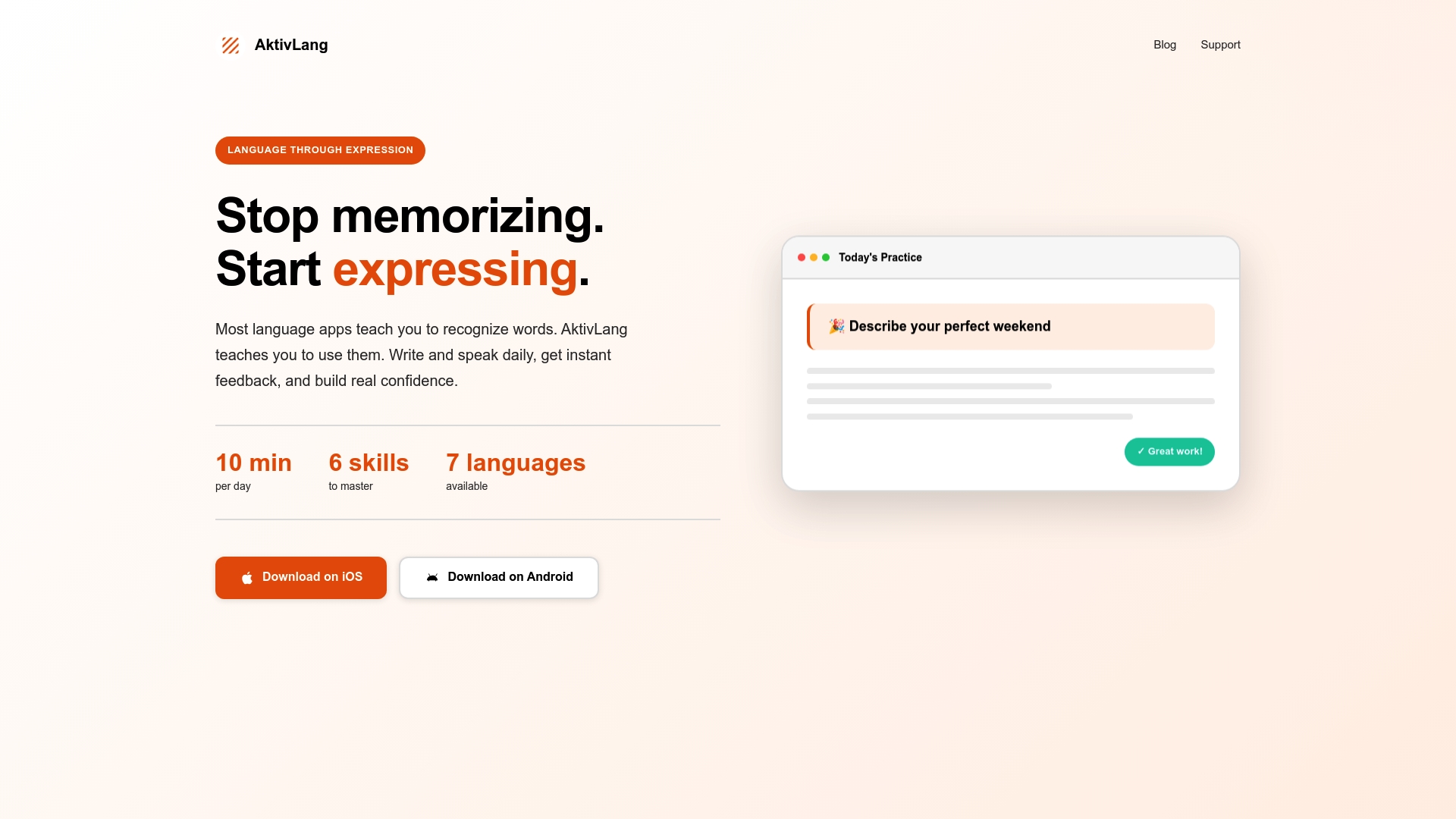
With AktivLang, you pick a theme you care about, read an engaging story in French, Spanish, German, Dutch, Italian, or Portuguese, and then immediately practice what you've learned through 12+ exercise types. Speaking exercises let you read sentences aloud, answer questions by speaking, and receive instant AI feedback on fluency and accuracy. Vocabulary exercises connect new words to the story context so they actually stick. You can track your progress weekly, review personalized AI insights, and see exactly where to focus next. It's the 80/20 routine built into a single app, so you spend less time wondering what to practice and more time actually improving.
Frequently asked questions
Does speaking practice really improve fluency faster than reading and listening?
Yes. Speaking-led learners gain 33% more fluency than those using input-only methods, making it the most effective approach for intermediate learners ready to move beyond recognition.
Isn't it enough to just speak as much as possible?
No. Excessive early speaking leads to 95 to 98% vocabulary redundancy, meaning you keep recycling words you already know. Balanced input and output is what drives real progress.
How does storytelling help with language anxiety?
Storytelling reduces anxiety by giving learners a familiar cognitive scaffold, so they can focus on language production rather than generating ideas under pressure, which directly boosts confidence and fluency.
What's the best way to measure speaking progress?
Self-assessment through speaking tasks produces the strongest gains in both oral proficiency and self-efficacy, outperforming peer-assessment as a tool for intermediate learners tracking their own growth.