

TL;DR:
- Story-based writing exercises help bridge the gap between passive knowledge and active fluency.
- Using storytelling frameworks like Freytag's Pyramid encourages complete and engaging narratives.
- Collaborative and reflective practices deepen understanding and accelerate language development.
You know the grammar rules. You've memorized hundreds of words. Yet when you sit down to write a paragraph in French, Spanish, German, Dutch, Italian, or Portuguese, something feels off. The sentences come out stiff, the ideas feel disconnected, and the fluency you hear in native speakers seems impossibly far away. This gap between passive knowledge and active expression is one of the most frustrating stages of language learning. Story-based writing exercises are one of the most effective ways to close it. This guide walks you through the tools, techniques, and strategies to help you write with more confidence and creativity in your target language.
Table of Contents
- Essential tools and prerequisites for improving writing skills
- Step-by-step story-based writing exercises
- Collaborative and metacognitive strategies to maximize progress
- Troubleshooting common mistakes and measuring your progress
- A fresh perspective: why story-based writing unlocks real fluency
- Continue your journey with AktivLang
- Frequently asked questions
Key Takeaways
| Point | Details |
|---|---|
| Story-based practice | Using stories and creative prompts accelerates vocabulary and grammar mastery for intermediate learners. |
| Collaborative strategies | Writing with peers and reflecting on your process produces deeper skills than solo drilling. |
| Measurable progress | Digital storytelling and rubric-based assessments allow you to track meaningful improvement in your writing. |
| Avoid common pitfalls | Focus on completing narrative arcs and using sensory language to overcome frequent writing mistakes. |
| AktivLang’s support | Apps like AktivLang offer guided story exercises for French, Spanish, German, Dutch, Italian, and Portuguese. |
Essential tools and prerequisites for improving writing skills
Now that you know what to expect, let's start with what you'll need to begin improving your writing skills.
The right tools make an enormous difference. Story-based learning works best when you have access to platforms that present language in meaningful context, not just isolated drills. The AktivLang app for A2+ learners is built specifically for intermediate learners who want to move beyond basics by reading engaging stories and then practicing vocabulary, grammar, and speaking through 12+ exercise types. It supports French, Spanish, German, Dutch, Italian, and Portuguese, making it a versatile choice regardless of your target language.
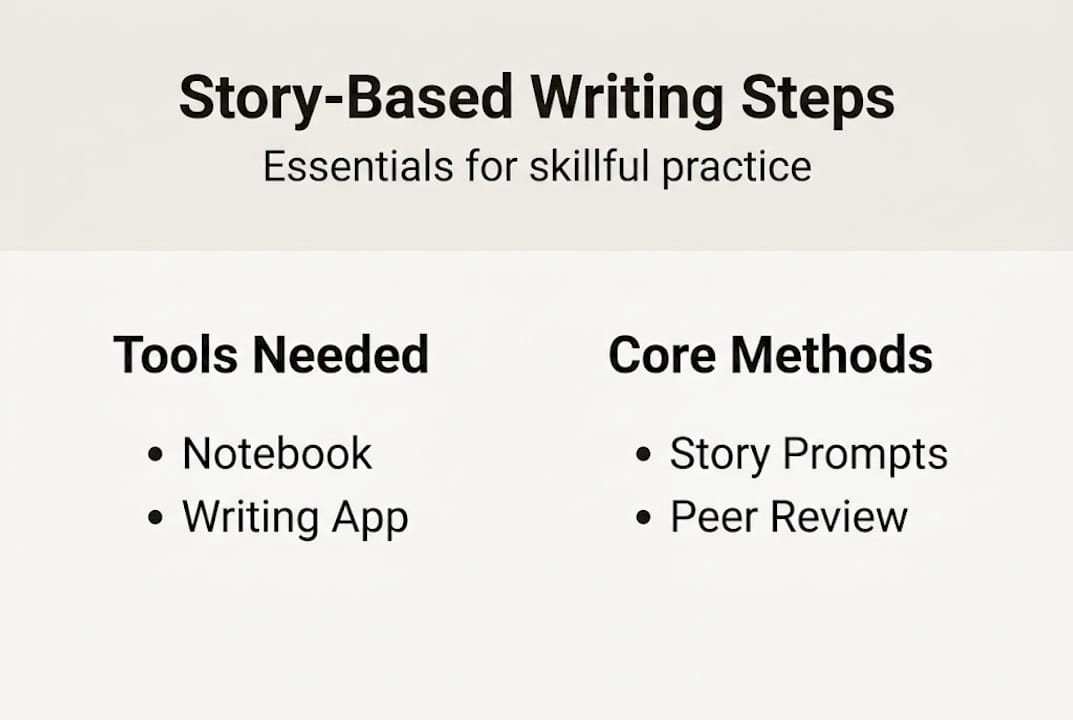
Beyond apps, interactive story-based writing exercises from platforms like BookWidgets offer creative formats that push you to produce language actively. Pair these digital tools with a physical notebook for handwriting practice, which research consistently links to stronger memory retention.
Your mindset matters just as much as your toolkit. Approach each exercise with curiosity rather than perfectionism. Willingness to experiment with sentence structures, vocabulary choices, and narrative angles will accelerate your growth faster than waiting until you feel "ready."
Here's a quick comparison of tools suited to each language:
| Language | App | Platform | Notebook use |
|---|---|---|---|
| French | AktivLang | BookWidgets | Daily journaling |
| Spanish | AktivLang | Story prompts | Dialogue writing |
| German | AktivLang | Digital exercises | Grammar logs |
| Dutch | AktivLang | Interactive tasks | Vocabulary notes |
| Italian | AktivLang | Creative platforms | Story drafts |
| Portuguese | AktivLang | Online exercises | Reflection entries |
To set yourself up for success, make sure you have:
- A story-based app like AktivLang for daily reading and exercise practice
- A dedicated notebook for handwritten drafts and vocabulary logs
- Access to writing prompts for intermediate learners that match your current level
- An interactive writing practice guide to structure your sessions
- A growth mindset: readiness to review, revise, and learn from mistakes
With these in place, you're set to move into structured practice.
Step-by-step story-based writing exercises
With your tools ready, here's how to put structured story-based exercises into practice.

Digital storytelling significantly improves EFL learners' writing across content, organization, vocabulary, and mechanics. The key is structure. One of the most reliable frameworks for narrative writing is Freytag's Pyramid, a five-stage story arc covering exposition, rising action, climax, falling action, and resolution. Freytag's Pyramid as a narrative methodology gives intermediate learners a clear scaffold to build stories without getting lost in blank-page anxiety.
Here's how to apply it step by step:
- Exposition: Introduce your character and setting in 2 to 3 sentences. Use sensory details: What does the place smell like? What sounds are present?
- Rising action: Add a problem or challenge. Write 3 to 4 sentences that build tension. Try using connectors like however, suddenly, or as a result.
- Climax: Write the turning point. This is your most emotionally charged moment. Keep it to 2 sentences for impact.
- Falling action: Show how the character begins to respond. One or two sentences work well here.
- Resolution: Wrap up the story. Reflect on what changed. Aim for a sentence that leaves the reader with a clear feeling.
Beyond Freytag's Pyramid, you can explore story exercises for intermediate learners like WhatsApp-style dialogues, emoji story prompts, and open paragraph completions. These formats feel playful but demand real linguistic choices.
| Exercise type | Format | Expected outcome |
|---|---|---|
| Emoji story | Write a story using 5 emojis as prompts | Creative vocabulary use |
| WhatsApp dialogue | Write a conversation between two characters | Natural, spoken-style fluency |
| Open paragraph | Complete a half-written story | Grammar and cohesion practice |
| Perspective swap | Rewrite a story from a different character's view | Deeper syntactic flexibility |
Pro Tip: When writing, deliberately include at least one sensory detail per paragraph. Describing what a character hears, smells, or feels forces you to reach beyond basic vocabulary and use language that writing boosts fluency in a lasting way.
Collaborative and metacognitive strategies to maximize progress
Once you've mastered basic story exercises, team up with peers and engage in self-reflection to deepen your skills.
Metacognitive instruction combined with collaborative story writing measurably enhances individual writing scores in second language learners. Metacognition, in plain terms, means thinking about your own thinking. When you analyze why you chose a particular word or how you structured a paragraph, you build the kind of self-awareness that accelerates improvement far beyond what solo drills can offer.
Collaborative writing adds another layer. When you write a story with a partner, you're forced to negotiate meaning, explain your choices, and adapt to another person's style. This negotiation is where real language learning happens. It mirrors the Output Hypothesis (the idea that producing language, not just receiving it, drives acquisition) in a social and dynamic context.
Imaginative strategies linking mental imagery to linguistic choices also improve writing quality. Before you write a scene, close your eyes and picture it fully. Then translate that image into words. This technique bridges the gap between what you imagine and what you can express.
Here are actionable strategies to integrate into your routine:
- Peer feedback sessions: Share a story draft with a language partner and ask for specific feedback on organization and word choice, not just grammar
- Self-assessment checklists: After writing, rate your own work on clarity, vocabulary range, and narrative completeness
- Reflective journaling: Keep a weekly log of what felt difficult and what improved, using your story-based learning workflow as a reference
- Timed rewrites: Take a story you've already written and rewrite it in half the time. Speed forces automaticity (the ability to produce language without conscious effort)
- Error analysis: Circle your most frequent mistakes and write three correct versions of each sentence
Pro Tip: After receiving peer feedback, don't just correct errors. Rewrite the entire paragraph from scratch using the feedback as a guide. This forces deeper processing than simple edits and aligns with reflection ideas for story-based learning that produce lasting improvement.
Troubleshooting common mistakes and measuring your progress
Even with the best strategies, learners encounter obstacles. Here's how to correct errors and measure your improvement.
One of the most common pitfalls in narrative writing is skipping key story elements. Intermediate ESL learners often omit the climax or resolution when working under strict word limits, which leaves stories feeling incomplete and flat. Other frequent issues include bland, repetitive language, inconsistent verb tenses, and weak transitions between scenes.
Always check your word count and confirm that your story includes all five narrative elements before submitting or sharing. A story without a climax or resolution is an exercise left half-finished.
Here's a numbered troubleshooting process to address the most common issues:
- Read your story aloud. Awkward phrasing becomes obvious when spoken. If you stumble, rewrite that sentence.
- Check for all five story elements. Use Freytag's Pyramid as a checklist. Mark each stage in your draft.
- Replace generic words. Swap out words like good, said, or went with more precise alternatives from your vocabulary log.
- Verify tense consistency. Pick one tense (past or present) and stick to it throughout. Inconsistency is one of the top grammar slip-ups at the intermediate level.
- Use a rubric. Score your own writing on content, organization, vocabulary, and mechanics before asking for feedback.
Story-based practice yields measurable gains across all four of those dimensions. Learners who practice digital storytelling regularly show statistically significant improvements in vocabulary use, language mechanics, and overall content quality compared to those using traditional drills. That's a compelling reason to stay consistent.
To track your progress over time, run a pre/post test: write a story at the start of a month, then write on the same prompt at the end. Compare the two drafts using a rubric. You can also use digital tools like AktivLang to monitor vocabulary growth and grammar accuracy. Explore daily story-based exercises and review the benefits of story learning to keep your motivation grounded in evidence.
A fresh perspective: why story-based writing unlocks real fluency
Most writing instruction at the intermediate level defaults to formulaic approaches: fill in the blanks, follow the template, match the model. These methods have their place, but they can quietly stunt your creative development. When you always follow a rigid structure, you never learn to make genuine linguistic choices. You learn to replicate, not to express.
Formulaic structures limit creativity compared to story-based and collaborative methods. Stories, by contrast, demand that you make decisions: Which word captures this emotion? How does this character speak? What detail makes this scene feel real? These decisions are where language acquisition actually deepens.
Fluency isn't about knowing more words. It's about trusting yourself to reach for the right one.
Collaborative and metacognitive approaches reinforce this. When you write with a partner and then reflect on your choices, you build self-regulation, the ability to monitor and adjust your own language use. That skill transfers directly to writing for real conversations and everyday communication. Story-based writing isn't a detour from fluency. It's the most direct path to it.
Continue your journey with AktivLang
Now that you've seen the power of story-based writing, discover more tools and support from AktivLang.
AktivLang is built for exactly this kind of learning. You read compelling stories in your target language, then practice what you've learned through vocabulary, grammar, speaking, and comprehension exercises, all with instant feedback. Whether you're working on French, Spanish, German, Dutch, Italian, or Portuguese, the app adapts to your level and interests. Visit AktivLang to explore the full experience, check the AktivLang support page for guidance, and review the AktivLang terms for subscription details. Your next story is waiting.
Frequently asked questions
How can I use story-based exercises to improve writing in multiple languages?
Story-based apps and prompts help you practice vocabulary, grammar, and creative expression in context. The AktivLang app for A2+ learners supports French, Spanish, German, Dutch, Italian, and Portuguese with structured exercises built around engaging stories.
Why does digital storytelling improve my writing skills faster than traditional drills?
Digital storytelling improves writing across content, organization, and vocabulary in a more engaging, immersive way than basic grammar drills, producing stronger and more lasting results.
How do strict word limits affect my narrative writing?
Strict word limits can push you to skip critical story elements. Intermediate learners often omit the climax or resolution, so prioritize building a complete arc before trimming for length.
What's the best way to track my progress with story-based writing exercises?
Use rubrics, pre/post story tests, and peer feedback to measure gains. Story-based practice yields measurable gains across vocabulary, organization, content, and mechanics.
Is collaborative writing really more effective than solo practice?
Metacognitive instruction and collaborative story writing enhance individual writing scores by building self-regulation and deeper linguistic awareness that solo practice alone rarely achieves.