

TL;DR:
- Structured daily story routines enhance comprehension, retention, and speaking confidence for intermediate learners.
- Combining input (reading/listening) with active output (speaking/writing) optimizes language progress.
- Consistency and engaging, context-rich stories are key to overcoming the intermediate plateau effectively.
You've moved past the basics. You can order food, introduce yourself, and follow simple conversations. But somewhere between beginner and fluent, progress slows to a crawl. Sound familiar? This is the intermediate plateau, and it's where most learners get stuck. The problem isn't effort. It's that daily practice becomes repetitive, passive, and disconnected from real speaking and understanding. Research confirms that story-based methods dramatically improve comprehension and engagement for language learners. This guide gives you a structured, story-driven daily process that works for French, Spanish, German, Dutch, Italian, and Portuguese learners ready to actually move forward.
Table of Contents
- Why daily repetition and story immersion work
- Essential ingredients for your daily routine
- Step-by-step: Your daily story-powered process
- Tracking progress and troubleshooting common challenges
- Why the best daily process blends stories and speaking
- Take your story-based routine further
- Frequently asked questions
Key Takeaways
| Point | Details |
|---|---|
| Spaced practice wins | Short, daily sessions boost retention 240% more than infrequent cramming. |
| Story input plus output | Combining story listening and reading with active speaking and writing produces faster, deeper results. |
| Customize for progress | Adjust story type, session length, and exercises to match your real-world goals and current challenges. |
| Track and adjust | Regularly monitor your progress and tweak your routine to stay motivated and improve further. |
Why daily repetition and story immersion work
Having addressed the challenge and opportunity, let's clarify why structured daily story-based routines are so effective.
Stories are not just entertaining. They activate multiple cognitive systems at once. When you read or listen to a story in your target language, your brain processes vocabulary in context, tracks grammar patterns naturally, and builds a mental model of how the language actually flows. This is fundamentally different from drilling isolated word lists. Context is what makes words stick.
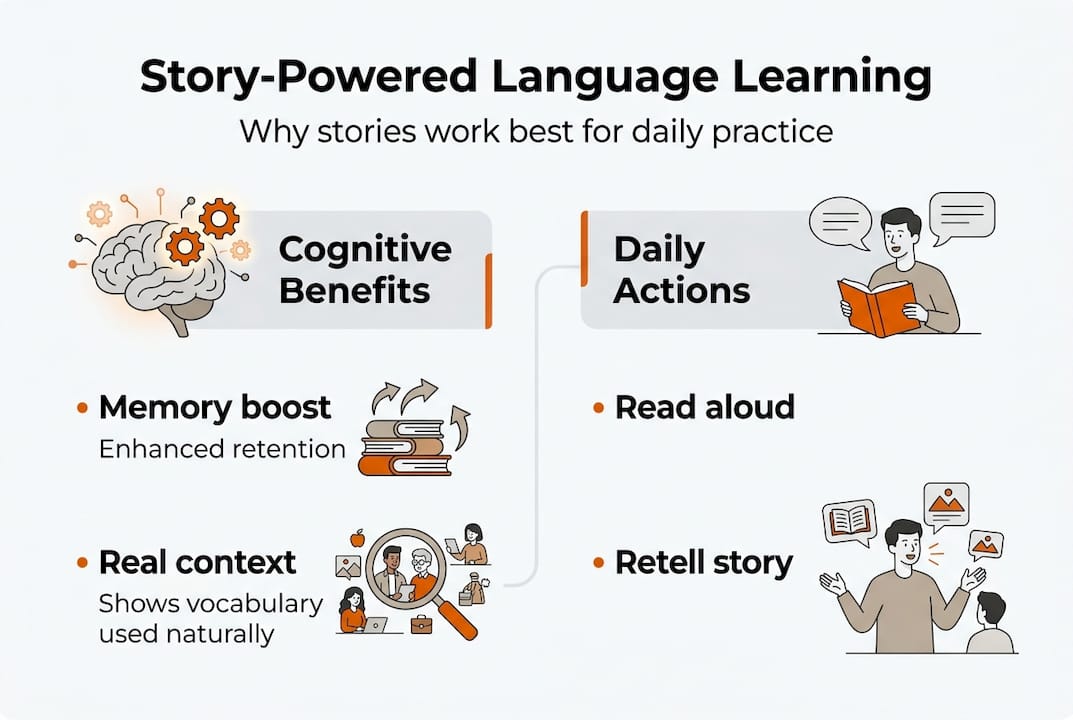
The story-based learning results speak for themselves. Learners who practice through stories consistently outperform those who rely on flashcards and grammar drills alone. Why? Because stories simulate real communication. You're not memorizing; you're experiencing.
Spacing matters just as much as method. Spaced practice yields 240% better retention than cramming the same material into one long session. Short, daily story sessions beat a two-hour weekend binge every time. Your brain consolidates language during rest, so consistency is the real engine of progress.
Humor and interesting contexts also play a measurable role. When a story makes you laugh or surprises you, emotional engagement increases, and emotional engagement deepens memory encoding. This is why choosing stories you actually find interesting matters more than picking whatever seems most "educational."
Both input and output are strengthened through stories. Reading and listening build your receptive skills. Summarizing, retelling, or writing about what you read builds productive skills. You need both.
"Story-based gamified reading boosts L2 achievement across comprehension, engagement, and self-efficacy measures."
Here's a quick look at how different practice routines compare for retention:
| Learning routine | Retention after 1 week | Engagement level | Skill coverage |
|---|---|---|---|
| Flashcard drilling | Low | Low | Vocabulary only |
| Grammar exercises | Moderate | Low | Grammar only |
| Story reading (passive) | Moderate | High | Vocabulary, comprehension |
| Story + active output | High | High | All four skills |
| Spaced daily story sessions | Very high | High | All four skills |
You can also explore how multiple languages with stories can be learned simultaneously using this same approach, which reinforces why the method scales so well.
Key benefits of daily story immersion include:
- Natural grammar acquisition through context rather than memorization
- Vocabulary retention through repeated, meaningful exposure
- Improved listening comprehension when audio accompanies the story
- Stronger speaking confidence because you internalize natural sentence structures
- Higher motivation because engaging content keeps you coming back
Essential ingredients for your daily routine
With the 'why' in place, next is knowing what you'll need and how to set up your routine.
You don't need a lot of tools. But you do need the right ones. A good daily story-based routine relies on a few core ingredients: quality story content at your level, a way to practice actively, and a simple system for tracking what you've learned.
Here's what to gather before you start:
- A story source at your proficiency level (app, podcast, leveled reader, or YouTube channel)
- A notebook or digital doc for vocabulary, phrases, and reflections
- A browser extension like a pop-up dictionary for reading online stories
- An audio component so you can listen and read simultaneously when possible
- A speaking tool with AI feedback for output practice
Not all story sources are equal. Gamified stories have been shown to boost reading self-efficacy, which means learners believe they can improve, and that belief drives sustained effort. Look for sources that include comprehension checks or interactive elements, not just passive reading.
Here's how common story sources compare:
| Source type | Interactivity | Level control | Audio included | Cost |
|---|---|---|---|---|
| Language learning app | High | Yes | Yes | Varies |
| Podcast with transcript | Low | Limited | Yes | Often free |
| YouTube (native content) | Low | No | Yes | Free |
| Leveled reader books | None | Yes | Sometimes | Low |
| Story-based app (e.g., AktivLang) | Very high | Yes | Yes | Subscription |
For format, prioritize dialogue-rich and humorous stories. These formats mirror real conversation patterns, which is exactly what intermediate learners need. Humor, in particular, forces you to understand nuance, timing, and cultural context. That's advanced comprehension disguised as fun.

Pro Tip: To quickly find appropriate stories, search for "[your language] graded readers B1" or "[your language] intermediate podcast transcript." If you understand 80-90% without help, the level is right. Below 70%? Go easier. Above 95%? Go harder.
You can find more ideas in writing-based learning tips and explore active learning methods that pair well with story reading for a complete daily practice.
Step-by-step: Your daily story-powered process
Armed with tools and structure, let's break down your ideal daily routine step by step.
A good daily session runs 20 to 30 minutes. That's enough to make real progress without burning out. Here's the sequence that works:
- Warm-up review (3 minutes). Quickly revisit 5 to 10 words or phrases from your previous session. Say them out loud. Don't just read them silently.
- Story listening or reading (8 minutes). Read or listen to a short story segment. Don't stop for every unknown word. Get the gist first.
- Active comprehension tasks (7 minutes). Summarize what happened in 3 to 5 sentences in your target language. Answer 2 to 3 questions about the story. Mimic a sentence or two from the text out loud.
- Output practice (7 minutes). Speak or write a short response. This could be your opinion on the story, a retelling from a character's perspective, or an answer to an open question. Writing for fluency is especially powerful here because it forces you to retrieve and produce language, not just recognize it.
- Reflect and record (5 minutes). Write down 3 to 5 new words or structures you want to remember. Note what felt hard. This reflection step is what most learners skip, and it's what separates consistent improvers from people who plateau.
Statistic callout: Spaced daily sessions produce 240% better retention than massed practice. Twenty minutes every day beats two hours once a week.
AI-graded reading has been shown to improve oral proficiency across learner levels, which means the speaking step in your routine isn't optional. It's where the gains get locked in.
Pro Tip: The biggest mistake intermediate learners make is stopping to look up every unknown word. Resist this. Finish the story segment first, then go back. Constant interruptions destroy comprehension flow and make reading feel harder than it is. Save deep vocabulary work for the reflection step.
For structured conversation practice steps and a deeper look at speaking advantages for intermediates, these resources expand on the output side of your daily routine.
Tracking progress and troubleshooting common challenges
With your daily actions defined, you need to know what progress looks like and how to adapt if you get stuck.
Progress in language learning is rarely linear. Some weeks you'll feel sharp. Others you'll wonder if you've forgotten everything. That's normal. What matters is having a system to measure real growth and adjust when things aren't working.
Use a simple experience log. After each session, write one sentence about what felt easier than last week. Over time, these notes reveal genuine improvement that you'd otherwise miss because daily gains are too small to notice in the moment.
Recognizing a plateau early saves weeks of frustration. Watch for these signs:
- Stories feel boring or too easy (time to increase difficulty)
- You're understanding everything but can't speak spontaneously (add more output tasks)
- Motivation is dropping (switch story themes or formats)
- Sessions feel mechanical (introduce a new exercise type or a humorous story)
Research shows that diverse story contexts boost higher-proficiency learners, while humor-based stories are especially effective for those still building confidence. Match your story type to your current state, not just your level.
"Consistency over intensity. A learner who practices 20 minutes daily for a month outperforms one who studies 3 hours on weekends every time."
Here's what to expect in your first month:
| Week | What to expect | What to adjust if stuck |
|---|---|---|
| Week 1 | Slow reading, frequent lookups | Accept it. Focus on gist. |
| Week 2 | Slightly faster reading, more recall | Add one more output task |
| Week 3 | Noticeably better comprehension | Increase story complexity |
| Week 4 | Speaking feels more natural | Start timed speaking responses |
For sustained motivation for speaking success, revisit your original reason for learning. Connecting daily practice to a real goal, like a trip, a job, or a conversation with a specific person, keeps the routine meaningful when novelty fades.
Why the best daily process blends stories and speaking
Now, let's step back and see how input and output blend for best results, going beyond what typical guides suggest.
Most language learning advice falls into one of two camps. Either it tells you to consume as much content as possible (podcasts, books, TV shows), or it pushes you to speak from day one regardless of how ready you feel. Both extremes miss something important.
Pure input without output creates what researchers call "passive competence." You understand the language but freeze when it's time to produce it. Pure output without sufficient input leads to fluent-sounding errors that become deeply ingrained habits.
The research is clear. Gamified stories boost engagement and self-efficacy far beyond traditional grammar instruction, but the real gains come when story input is paired with structured speaking and writing tasks. Stories build the mental model. Output practice forces you to use it under pressure.
This is why the daily routine outlined above insists on both. Read the story. Then speak about it. Write about it. Mimic it. The story is the fuel; the output tasks are the engine. Neither works as well alone.
Most learners fail not because they lack discipline but because they overweight one side. If you only read stories, you'll plateau in speaking. If you only speak, you'll run out of things to say. Blend both, and you build active speaking skills that hold up in real conversations.
Take your story-based routine further
Ready to build momentum? Here's how to keep progressing and get more support.
Building a daily story-based routine is one of the most effective moves you can make as an intermediate learner. But having the right platform behind you makes it significantly easier to stay consistent and keep improving.
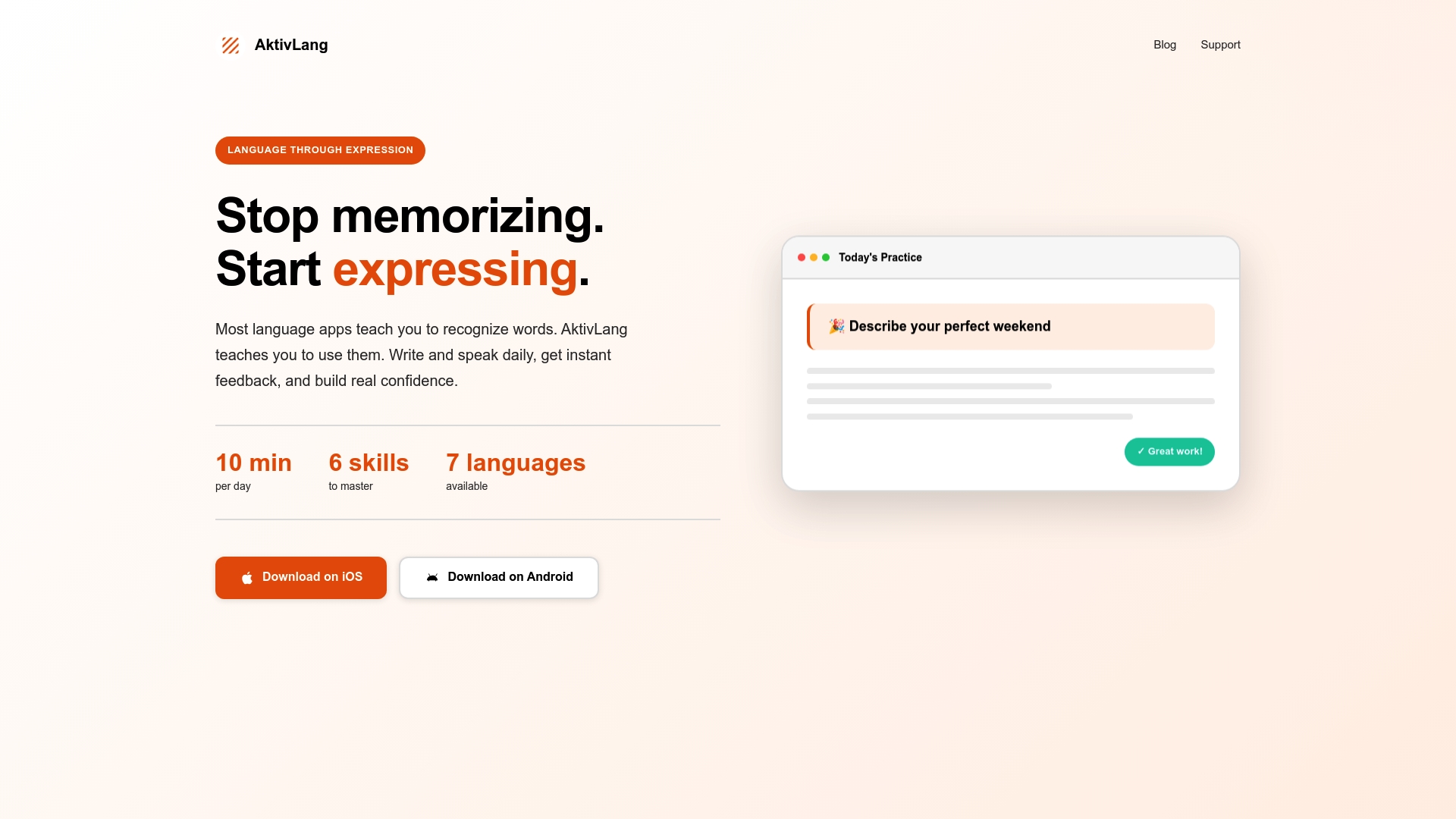
AktivLang is built exactly for this. You pick a theme you care about, read a story in French, Spanish, German, Dutch, Italian, or Portuguese, then practice through 12+ exercise types covering vocabulary, comprehension, grammar, and speaking with real AI feedback. Every session follows the same proven input-to-output structure this article describes. If you have questions or need guidance on getting started, the language learning support team is ready to help. Try it and feel the difference a structured story routine makes.
Frequently asked questions
How long should my daily story routine be?
Aim for 20 to 30 minutes daily. Short spaced sessions consistently outperform longer infrequent ones for long-term retention, so daily brevity beats occasional marathons.
What if I get stuck on unknown words while reading stories?
Keep going and use context clues to infer meaning. Only look up essential words after your first full read-through so you preserve comprehension flow.
Are some types of stories better for improving speaking?
Yes. Humorous and dialogue-rich stories are most effective for active speaking practice. Humor-based stories are especially valuable for building confidence at intermediate levels.
Should I focus more on listening, reading, or speaking?
Blend all three. AI-graded reading improves oral proficiency across learner levels, confirming that story-based input paired with speaking output drives the fastest overall growth.