

Most language learners hit a wall at the intermediate stage. You know enough to get by, but flashcards feel repetitive and grammar drills seem disconnected from real communication. Here's what the research actually shows: story-based methods combined with multilingual learning don't just speed up vocabulary acquisition, they reshape how your brain processes language entirely. Cognitive flexibility is one of the proven gains, and for intermediate learners of French, Spanish, German, Dutch, Italian, or Portuguese, that advantage compounds quickly when you pair it with the right learning approach.
Table of Contents
- Why learning multiple languages matters: cognitive and social gains
- The power of story-based, comprehensible input methods
- Story immersion mechanics: practical steps for French, Spanish, German, Dutch, Italian, and Portuguese
- Advanced benefits and edge cases: age, language combinations, and input/output nuances
- Next steps: practice your new languages with AktivLang
- Frequently asked questions
Key Takeaways
| Point | Details |
|---|---|
| Cognitive flexibility boost | Learning multiple languages enhances cognitive flexibility and protects against aging. |
| Story-based methods win | Story immersion results in significantly better vocabulary retention and grammar acquisition than drills. |
| Practical mechanics matter | Applying Listen-Read-Speak cycles with AI feedback accelerates pronunciation and proficiency gains. |
| Age and language combos | Older learners and those studying dissimilar languages see amplified benefits from multilingualism. |
| App choices accelerate learning | MeloLingua, StoryLearning, Lingopie, and Babbel provide effective story-based experiences for French, Spanish, German, Dutch, Italian, and Portuguese. |
Why learning multiple languages matters: cognitive and social gains
The evidence against isolated learning is stronger than most people realize. Learning more than one language doesn't split your attention, it actually sharpens it. Research confirms that multilingual cognitive benefits include perspective-taking, cognitive flexibility, and measurable protection against cognitive aging, with an odds ratio of OR=0.46 and a relative risk of RR=0.70 for age-related decline among multilinguals compared to monolinguals.
Think about what that means practically. When you learn French alongside German, your brain builds stronger neural pathways for switching between rule systems. That flexibility makes each new language easier to absorb. It also improves your ability to read social cues and understand different viewpoints, which directly strengthens communication skills in every language you speak.
For intermediate learning tips, the social dimension matters just as much. Multilingual learners consistently show higher empathy scores and better cross-cultural communication. These aren't soft benefits. They translate into real-world fluency.
Comparing outcomes by language background:
| Learner type | Cognitive flexibility | Aging protection | Communication empathy |
|---|---|---|---|
| Monolingual | Baseline | Baseline | Baseline |
| Bilingual | Moderate gain | Moderate gain | Moderate gain |
| Multilingual | High gain | Strong gain (OR=0.46) | High gain |
Here's a quick breakdown of what language learning and cognition research shows across learner types:
- Monolinguals build deep fluency in one system but show fewer executive function advantages
- Bilinguals gain measurable cognitive flexibility and stronger working memory
- Multilinguals show the highest gains in mental switching speed, perspective-taking, and long-term cognitive resilience
"The cognitive advantages of multilingualism are not limited to language tasks. They extend to general problem-solving, attention control, and social cognition."
The takeaway is clear. Learning multiple languages isn't a distraction from mastering one. It's a force multiplier.
The power of story-based, comprehensible input methods
Building on those cognitive advantages, let's look at why story-based methods are especially impactful for intermediate learners. The key concept here is comprehensible input, a term from linguist Stephen Krashen. His i+1 theory states that you acquire language most efficiently when the input is just slightly above your current level. Stories are the ideal vehicle for this.
When you read or listen to a story in your target language, you encounter vocabulary and grammar in context. That context is everything. Story-based vocabulary retention lasts 3 to 5 times longer than vocabulary learned through flashcards, and intermediate learners using story methods show measurable ACTFL proficiency gains. ACTFL stands for the American Council on the Teaching of Foreign Languages, the standard benchmark for language proficiency in the United States.

Why does context make such a difference? Because your brain stores words alongside the emotions, images, and narrative events connected to them. A word you encounter in a gripping story about a Roman gladiator sticks far better than the same word on a flashcard. That's not a metaphor. It's how memory consolidation works.
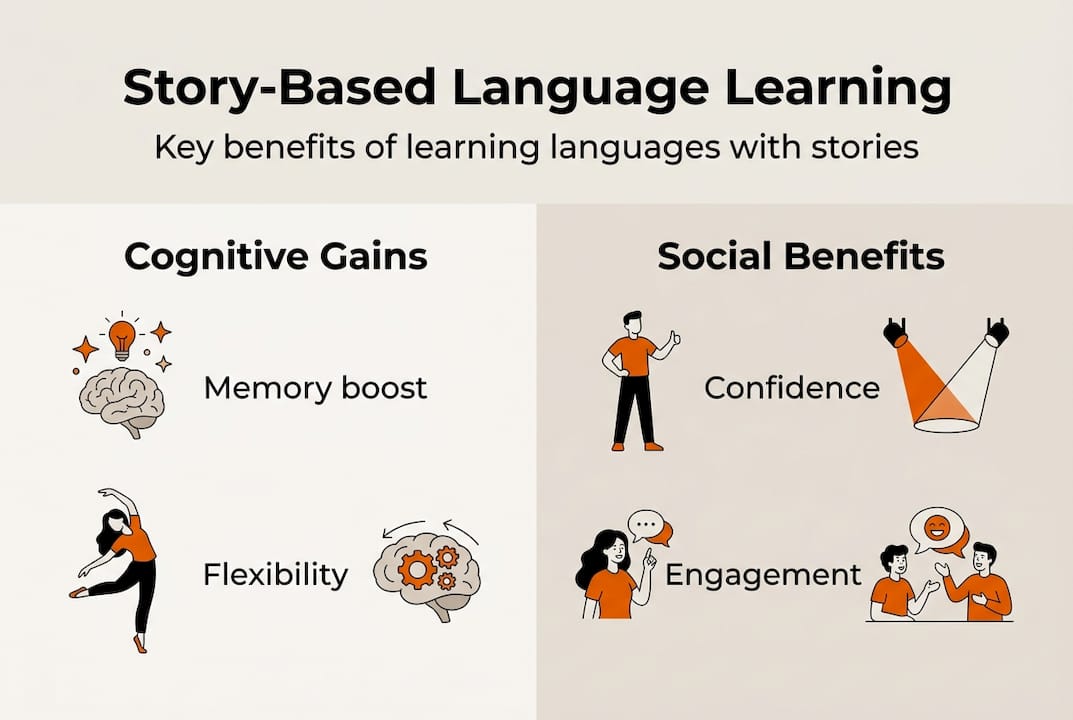
Here's a direct comparison:
| Method | Retention duration | Grammar in context | Pronunciation support | Engagement level |
|---|---|---|---|---|
| Flashcards/drills | Short-term | Minimal | None | Low |
| Story-based learning | 3-5x longer | Natural | High (audio + text) | High |
For story-based workflow results, the data consistently favors immersive narrative input over rote repetition. And for pronunciation specifically, hearing native speakers narrate stories while reading synchronized text trains your ear and mouth simultaneously.
The storytelling approach to language learning also supports grammar acquisition naturally. You internalize sentence structures by seeing them used repeatedly in meaningful situations, not by memorizing rules in isolation.
- Choose a story at roughly your current level, with about 10 to 15 percent new vocabulary
- Read and listen simultaneously to connect written and spoken forms
- Note new words in context, not as isolated items
- Retell or summarize the story in your own words to activate recall
- Review grammar patterns you noticed, then find them in a second story
Pro Tip: Target 15 to 30 minutes of i+1 story input daily. Consistency at this level produces faster retention gains than longer, irregular sessions. For creative writing prompts that reinforce what you read, short writing exercises after each story session dramatically boost retention.
Story immersion mechanics: practical steps for French, Spanish, German, Dutch, Italian, and Portuguese
With the evidence favoring story-based methods, here's how intermediates can implement these strategies for their chosen languages. The most effective framework is the Listen-Read-Speak cycle.
How the Listen-Read-Speak cycle works:
- Listen to a native-speaker audio story in your target language without reading first. Focus on rhythm and tone.
- Read the synchronized text while listening again. Tap or click unfamiliar words for instant translations.
- Speak by repeating sentences aloud, then answering comprehension questions verbally. Use AI feedback to check pronunciation accuracy.
This cycle targets the three core skill areas simultaneously. Listening builds phonological awareness (your brain's map of how the language sounds). Reading reinforces spelling and grammar patterns. Speaking forces active production, which is where real fluency develops.
Personalized AI stories and Listen-Read-Speak cycles are specifically designed to target key challenges in pronunciation and grammar for intermediate learners. The AI feedback component is particularly valuable because it gives you objective data on your fluency and accuracy scores, not just a feeling that you're improving.
Here are some top apps built around story immersion for your target languages:
- MeloLingua: AI-generated personalized stories with Listen-Read-Speak cycles and pronunciation scoring
- StoryLearning: Narrative-first approach for Spanish, French, German, Italian, and Portuguese
- Lingopie: TV shows and films as story input, with interactive subtitles for vocabulary building
- Babbel: Structured story dialogues with grammar integration, strong for German and Dutch
For conversation practice techniques that go beyond passive listening, cultural roleplay adds another layer. When you act out a scene set in a Parisian café or a Berlin market, you absorb cultural nuance alongside vocabulary. That context makes the language feel real, not academic.
Pro Tip: Choose stories where you understand 80 to 90 percent of the content. Below 80 percent, frustration slows acquisition. Above 90 percent, there's not enough new material to push your level forward. That sweet spot is where growth happens fastest. Explore methods for fluency that combine story input with structured output for the best results.
For French story-learning specifically, audio-synchronized texts with cultural context outperform translation-heavy methods. And for German, roleplay scenarios that simulate real-life situations accelerate both grammar accuracy and speaking confidence.
Advanced benefits and edge cases: age, language combinations, and input/output nuances
After learning the mechanics, consider the research-backed nuances that can optimize your multilingual journey. Not all language combinations are equal, and age plays a more interesting role than most people expect.
First, language combinations. Choosing dissimilar languages, such as French and German rather than French and Spanish, actually minimizes linguistic interference. When two languages share too many features, learners sometimes mix them up. Dissimilar languages activate different cognitive systems, which strengthens both and reduces confusion.
Here are the key edge cases to consider:
- Age: Cognitive protection strengthens with age for multilingual learners. Adults who continue adding languages show stronger executive function gains than those who stop at two.
- Reading input: Structured reading input alone has produced upward proficiency shifts, even without dedicated speaking practice. This is encouraging for learners who feel self-conscious about speaking early.
- Grammar apps: Structured grammar review complements story immersion. Stories build intuition; grammar apps build precision. You need both.
- Output practice: Speaking and writing (output) force you to notice gaps in your knowledge that input alone won't reveal.
"Balancing story immersion with targeted grammar review is not a compromise. It's the most efficient path to fluency. Stories give you the feel of the language; structured practice gives you the rules to explain what you already sense."
For speaking practice advantages at the intermediate level, the research is clear: output practice accelerates the transition from passive recognition to active production. You can recognize a word in a story and still struggle to use it in conversation. Speaking exercises close that gap.
The comprehensible input approach works best when paired with regular output. Think of it like cooking from a recipe. Reading the recipe (input) teaches you the ingredients and steps. Actually cooking the dish (output) is where you develop real skill. Both are necessary.
Pro Tip: Mix story immersion with one targeted grammar review session per week. Focus the grammar session on patterns you noticed but couldn't fully explain during your story reading. This combination of intuition and analysis accelerates fluency faster than either approach alone. For deeper strategy, language practice and fluency resources can help you structure your weekly sessions effectively.
Next steps: practice your new languages with AktivLang
You've explored the science and strategies. Now it's time to put them into practice. AktivLang is built specifically for intermediate learners who want to move beyond basics and start using their language with confidence.
Practice the language you want through story-based exercises covering French, Spanish, German, Dutch, Italian, and Portuguese. Each story is followed by 12+ exercise types including vocabulary matching, speaking practice with AI pronunciation feedback, grammar correction, and comprehension checks. You get instant feedback on every exercise, so you always know exactly what to improve. For learning tips for intermediates that complement your story sessions, the AktivLang blog covers strategies for every stage of your journey. And if you want to see how the story-based workflow translates into measurable progress, story-based workflow insights break down the results in detail. The research is clear. Stories work. Now it's your turn to use them.
Frequently asked questions
How do story-based methods improve vocabulary retention?
Vocabulary retention is 3 to 5 times higher with story-based methods because narrative context creates stronger memory associations than isolated flashcard repetition.
Is it harder to learn multiple languages at the same time?
Not necessarily. Learning French and German simultaneously actually minimizes interference because dissimilar languages activate different cognitive systems, which enhances overall learning efficiency.
Do cognitive benefits increase with age?
Yes. Cognitive protection strengthens as you get older, meaning adult multilingual learners gain more executive function benefits over time compared to those who stop at one or two languages.
Which apps are best for story-based learning in French, Spanish, German, Dutch, Italian, or Portuguese?
Top-rated apps for story immersion include MeloLingua, StoryLearning, Lingopie, and Babbel, each offering different strengths in vocabulary, grammar, and speaking practice.
Can reading alone improve oral proficiency?
Research shows that reading input alone has produced measurable upward proficiency shifts, even without dedicated speaking practice, making it a strong foundation for oral skill development.