

Grammar drills feel productive. You fill in blanks, conjugate verbs, and tick boxes. But when you sit down to write a real paragraph, the words don't come. That gap between drill performance and actual writing ability is one of the most frustrating walls intermediate learners hit. Story-based writing exercises significantly improve syntactic complexity, narrative structure, and overall writing proficiency beyond what traditional drills ever deliver. This guide breaks down exactly why that happens, how to use story-based and active recall methods in your own practice, and what pitfalls to avoid as you move from intermediate to confident writer.
Table of Contents
- Why writing exercises matter: More than just practice
- How story-based exercises build real writing skill
- Integrating active recall for memory and fluency
- Designing effective writing exercises: Methods, models, and pitfalls
- A fresh perspective: Creativity overshadows formula in real writing success
- Practice your way: Turn research-backed writing exercises into real-world skill
- Frequently asked questions
Key Takeaways
| Point | Details |
|---|---|
| Story-based tasks win | Writing exercises grounded in stories boost complexity, narrative skill, and language retention far more than standard drills. |
| Active recall maximizes memory | Writing from memory or retelling stories raises retention rates dramatically compared to passive review. |
| Design matters | Structured, scaffolded, and personalized exercises avoid common pitfalls and make intermediate learning much more effective. |
| Creativity fuels fluency | Open-ended, imaginative writing encourages deeper engagement and produces more confident, practical language skills. |
Why writing exercises matter: More than just practice
Most language learners treat writing as a side activity, something to do after the "real" studying. That's a mistake. Writing is where language knowledge becomes language skill. It forces you to produce, not just recognize, and that production gap is exactly where intermediate learners stall.
Traditional drills ask you to fill in a missing verb or choose between two options. You're reacting, not creating. Context-rich writing exercises, especially those built around stories and real tasks, require you to pull vocabulary from memory, apply grammar rules in motion, and organize ideas with purpose. That's a completely different cognitive load, and it's the kind that actually builds fluency.
Intermediate learners benefit especially from writing practice that integrates story, context, and reflection. At this stage, you already have a foundation. What you need is a way to activate it. Story-based tasks do that by giving you a meaningful frame to work within, which is why writing boosts your fluency in ways that isolated grammar work simply can't match.
Research on methodologies for writing tasks confirms that task-based, story-focused exercises increase both syntactic and lexical complexity far more than rote drills. The gains aren't marginal. They're structural.
"Task-based, story-focused exercises increase syntactic and lexical complexity and narrative structure awareness more than rote drills."
| Feature | Traditional drills | Story-based exercises |
|---|---|---|
| Context | Isolated sentences | Rich narrative context |
| Cognitive demand | Recognition and recall | Active production and creation |
| Vocabulary gains | Surface-level | Deep, contextual retention |
| Grammar application | Rule-following | Integrated, flexible use |
| Motivation | Often low | Higher due to engagement |
Here's what learners consistently gain from story-based writing practice:
- Syntactic complexity: Longer, more varied sentence structures
- Lexical diversity: Wider, more precise word choices
- Narrative structure awareness: Understanding how stories are organized
- Overall writing quality: More coherent, purposeful paragraphs
- Retention: Vocabulary and grammar that actually sticks
How story-based exercises build real writing skill
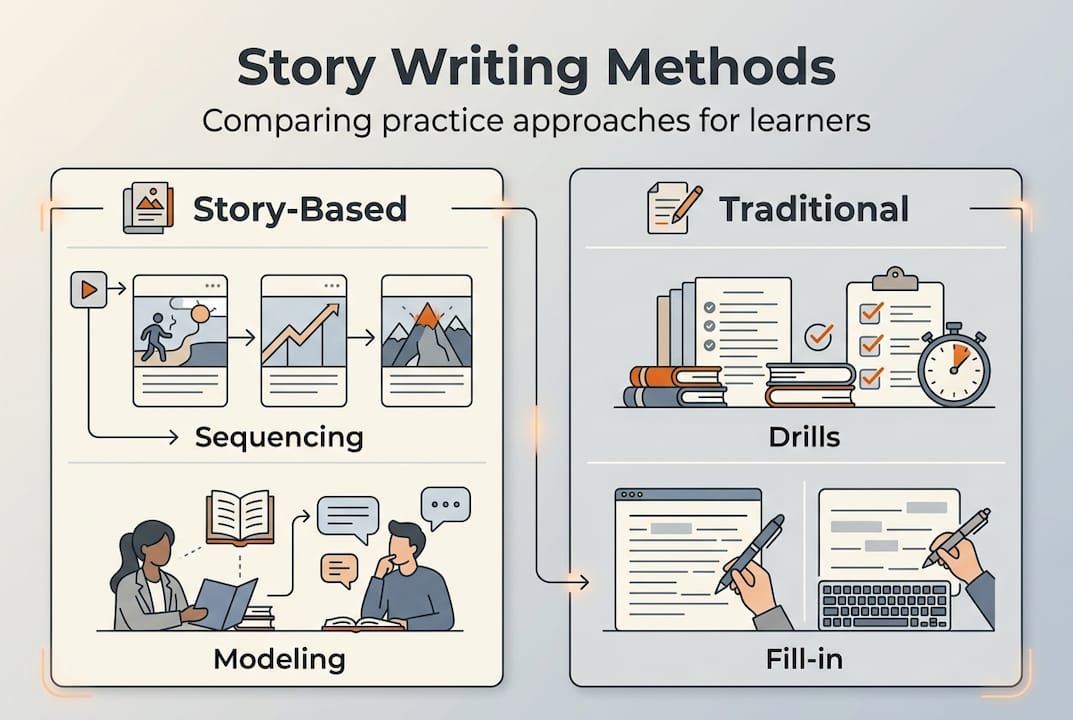
Understanding the difference in writing exercise types sets the stage for exploring how story-based methods build practical, lasting skill. Three methodologies stand out in the research: task sequencing (TS), text modeling (TM), and story retelling (TR).
Task sequencing means structuring exercises in a deliberate order, from comprehension to production. You read a story, answer questions about it, then retell or rewrite it. Each step builds on the last. Text modeling gives you a strong example to analyze and imitate, which teaches narrative structure through exposure. Story retelling asks you to reconstruct a story from memory, which activates recall and forces you to internalize vocabulary and structure.

The data is clear. Task sequencing and text modeling deliver the largest documented gains in writing complexity and story structure for intermediate learners, with task sequencing edging out text modeling in most measures. Story retelling is still effective but works best as a complement, not a standalone method.
| Method | Complexity gains | Structure awareness | Fluency impact |
|---|---|---|---|
| Task sequencing (TS) | Highest | Strong | High |
| Text modeling (TM) | High | Strongest | Moderate |
| Story retelling (TR) | Moderate | Moderate | Moderate |
Explicit story grammar instruction, such as Freytag's Pyramid (exposition, rising action, climax, falling action, resolution), also produces significant post-test gains in writing quality. When you understand how a story is built, you can build one yourself.
Here's a simple process you can follow:
- Pre-read: Scan the story for key vocabulary and predict the plot
- Read actively: Note sentence structures and narrative turns
- Retell: Write a summary from memory without looking back
- Elaborate: Expand the story with your own ending or a new scene
- Review: Compare your version to the original and note differences
Pro Tip: Use creative writing prompts tied to the same story theme across multiple sessions. Thematic repetition builds a vocabulary cluster you can actually use, rather than a scattered list of unrelated words. Check out story-based workflow results to see how this process plays out in practice.
Integrating active recall for memory and fluency
While story-based practice builds a strong foundation, integrating memory-focused strategies takes your writing to the next level. Active recall is the practice of retrieving information from memory rather than passively reviewing it. In writing, this looks like retelling a story without notes, writing a summary from scratch, or expanding a scene using only what you remember.
The retention difference is striking. Active recall produces 80% retention versus just 36% for rereading. That's not a small edge. It's the difference between vocabulary that fades in a week and vocabulary that becomes part of how you think in your target language.
Why does it work so well? When you force yourself to retrieve a word or structure, your brain strengthens the neural pathway to that item. Rereading feels easier, but it creates an illusion of knowing. Active recall is harder, and that difficulty is exactly what makes it effective.
Here are the main forms active recall takes in writing practice:
- Story retelling: Write what happened in a story without looking at the source
- Memory summaries: Summarize a passage in your own words after a short delay
- Creative expansions: Add a new scene or character using vocabulary from the story
- Self-testing: Write answers to comprehension questions before checking
- Vocabulary reconstruction: Use key words from a story in new sentences
Pro Tip: Space your recall sessions. Write your first retelling right after reading, then revisit the same story 48 hours later and write again. The gap forces deeper retrieval and dramatically improves long-term retention. This is the core idea behind spaced repetition, applied directly to writing practice.
The payoff is faster, more reliable writing fluency that builds fast. When you've actively recalled a structure multiple times, it stops being something you look up and becomes something you just use.
Designing effective writing exercises: Methods, models, and pitfalls
With the power of story-based and active recall approaches in mind, it's essential to learn how to structure and implement these exercises for consistent improvement. Good exercise design isn't complicated, but it does require intentionality.
For intermediate (B1/B2) learners, scaffolding matters. That means providing a clear structure, explicit goals, and vocabulary support before asking for independent production. Don't throw a blank page at yourself and hope for the best. Start with a story, a model, or a prompt that gives you something to work with.
Scaffolding with comprehensible input, pre- and post-story tasks, and explicit story grammar instruction are all empirically linked to strong writing gains. These aren't optional extras. They're the architecture of effective practice.
Common mistakes to avoid:
- Over-focusing on grammar correctness at the expense of creative expression
- Using the same exercise format every session without variation
- Ignoring word count guidance which can prevent you from fully developing ideas
- Skipping the review step where you compare your writing to a model
- Practicing in isolation without connecting exercises to real communication goals
Here's a reliable design process for your own exercises:
- Choose a story or text at your level with rich, varied vocabulary
- Set a clear goal (e.g., retell the climax, write an alternate ending)
- Provide vocabulary support upfront if needed
- Write without stopping to check every word
- Review against the original and note structural differences
- Repeat the task a few days later with less support
Research warns that word limits, L1 interference, and limited vocabulary can reduce the effectiveness of certain tasks, especially at the resolution and climax stages of narrative writing. Design around these constraints by building vocabulary before asking for production.
Personalize your tasks. Write about topics you actually care about. Monitor your progress by saving your writing and comparing it across weeks. Growth becomes visible, and that visibility keeps you motivated. Explore the interactive writing practice guide for structured templates you can use right away.
A fresh perspective: Creativity overshadows formula in real writing success
Here's something most language programs still get wrong: they treat writing as a correctness problem rather than a communication opportunity. Templates and formulas have their place, but over-reliance on rigid structures stifles the very thing that makes writing powerful, which is your voice.
The data supports creativity. Imaginative, story-based practice produces more confident, flexible communication than formulaic drills. When you write a story with a character you invented, you're emotionally invested. That investment drives deeper processing, better retention, and more natural language use.
Approaching writing as an act of creation rather than a correctness exercise changes everything. You stop asking "Is this right?" and start asking "Does this work?" That shift is where real fluency lives. It's also where motivation stops being a struggle.
Pro Tip: Once a week, replace one structured drill with an open-ended story challenge. Pick a theme, write freely for 15 minutes, then review. You'll notice quicker, more meaningful progress than any grammar worksheet delivers. Check out this practice workflow for real conversations to see how creative writing connects to speaking confidence.
Practice your way: Turn research-backed writing exercises into real-world skill
You now have the research, the methods, and the design principles. The next step is putting them into practice with tools that actually support this kind of learning.
AktivLang is built around exactly this approach. You read engaging stories in your target language, then practice through 12+ exercise types that include writing, speaking, vocabulary, and grammar tasks, all with instant feedback. Every exercise is grounded in the story you just read, so active recall happens naturally. Explore the story-based language benefits to understand why this method outperforms isolated drilling. If you're ready to move beyond basics and write with real confidence, AktivLang gives you the structure and the creative challenge to get there.
Frequently asked questions
What kinds of writing exercises help intermediate learners most?
Story-based and task-sequenced exercises, especially those focused on retelling, modeling, and narrative structure, deliver the biggest improvement in complexity and retention. Task sequencing and text modeling consistently show the largest gains in writing quality for intermediate learners.
How does active recall improve language learning through writing?
Active recall through retelling or summarizing from memory boosts retention to 80% compared to just 36% for rereading, making it far more effective for long-term vocabulary and grammar retention.
What are the most common mistakes with intermediate writing exercises?
Common pitfalls include focusing too much on grammar at the expense of creativity, using overly formulaic tasks, and failing to repeat or space practice sessions. Word limits, L1 interference, and limited vocabulary are also documented factors that reduce exercise effectiveness.
How often should I practice writing with story-based exercises?
Ideal results come from frequent, spaced practice. Practicing 2 to 4 times weekly with varied story challenges works best, since spaced, repeated practice of story-based writing leads to stronger long-term gains than massed sessions.