

TL;DR:
- Modern AI language prompts are structured tools acting like personalized tutors to enhance language skills.
- Effective prompts define roles, constraints, output formats, and progression rules to maximize learning.
- Story-based, active production prompts significantly improve vocabulary retention and speaking fluency.
Most intermediate learners assume a language learning prompt is just a question like "How was your day?" or "Describe your hometown." That assumption costs real progress. Modern AI-driven prompts are far more sophisticated. They are structured, context-rich tools that act like personalized tutors, adapting to your skill level, correcting your grammar, and pushing you to produce language rather than just recognize it. This guide breaks down exactly what language learning prompts are, how their mechanics work, what the science says about why they succeed, and how you can build and use them today to accelerate your vocabulary, grammar, and speaking skills.
Table of Contents
- Defining language learning prompts: More than simple questions
- Key components and mechanics of effective prompts
- Prompt engineering and language acquisition: The science behind the scenes
- Creating and applying prompts: Practical templates and story-based examples
- Our perspective: The real impact and future potential of language learning prompts
- Get started with adaptive language learning prompts
- Frequently asked questions
Key Takeaways
| Point | Details |
|---|---|
| Prompts are structured inputs | Language learning prompts are carefully designed inputs for AI or tutors to create personalized practice. |
| Output-focused practice is critical | The best prompts encourage learners to produce, interact, and speak for real skill improvement. |
| Story-based prompts boost engagement | Prompts built around real-world scenarios and stories drive deeper retention and conversation fluency. |
| Design and clarity matter | Effective prompts rely on clear formatting, role assignment, and specificity to maximize learning gains. |
Defining language learning prompts: More than simple questions
So what exactly is a language learning prompt? The short answer: it is a lot more than a conversation starter. Language learning prompts are structured text inputs designed for AI language models to generate customized, interactive exercises for practicing vocabulary, grammar, speaking, and other skills. Think of them as instructions you give an AI to transform it into a tutor built specifically for your needs.
Traditional prompts, like the ones you find in old textbooks, are static. They ask you to fill in a blank or answer a fixed question. AI-driven prompts are dynamic. You can tell the AI to act as a Spanish conversation partner, to correct only your verb tense errors, to use B1-level vocabulary, and to end every session with a five-sentence summary challenge. That is a completely different experience.
For intermediate learners, this distinction matters enormously. You are past the basics. You already know common words and simple sentence structures. What you need now is context-rich practice that forces you to retrieve vocabulary, apply grammar rules under pressure, and produce real sentences. That is exactly what well-designed prompts enable.
Here is what separates effective AI prompts from weak ones:
- Role definition: Telling the AI who it is (your tutor, a native speaker, a story narrator)
- Skill constraints: Specifying vocabulary level, grammar focus, or topic domain
- Corrective feedback rules: Instructing the AI when and how to correct your errors
- Output format: Requesting responses as dialogues, stories, quizzes, or structured exercises
- Session progression: Building in difficulty increases across a conversation
The stakes are real. Research shows a up to 45% performance gap between well-phrased and poorly phrased prompts. That gap directly affects the quality of practice you get. Weak prompts produce generic, unhelpful responses. Strong prompts produce targeted, adaptive exercises that push your skills forward.
This is why personalized language learning is no longer a luxury. It is a necessity for anyone serious about moving from intermediate to fluent. And adaptive learning for faster fluency starts with knowing how to design prompts that actually work.
Key components and mechanics of effective prompts
Knowing why prompts matter, let's explore how their mechanics shape language learning outcomes.
Key mechanics include role prompting, constraints, formatting, and session progression rules. Each element plays a specific role in turning a generic AI chat into a focused practice session.
Role prompting is the foundation. When you open a session with "You are my French language tutor. You will only respond in French. You will correct my grammar after each response," you set the entire context for the interaction. The AI shifts from a general assistant to a dedicated language coach. This single step dramatically improves the relevance and quality of every exchange that follows.
Constraints are where you fine-tune the experience. You can limit vocabulary to your current level, restrict topics to areas you are studying, or specify that corrections should focus only on one grammar point at a time. This mirrors how skilled human tutors operate: they do not overwhelm you with every error at once.

Here is a quick comparison of prompt types and their learning impact:
| Prompt type | Best for | Learning gain |
|---|---|---|
| Role prompt | Setting tutor behavior | High: consistent context |
| Constraint prompt | Targeting skill gaps | High: focused feedback |
| Output format prompt | Structuring practice | Medium: clarity and review |
| Session progression | Building difficulty | High: prevents plateau |
To build an effective prompt, follow this sequence:
- Define the role ("You are my Italian tutor")
- Set the language rules ("Respond only in Italian")
- Add constraints ("Use B1 vocabulary, correct verb tenses only")
- Specify the output format ("End each turn with a comprehension question")
- Include progression rules ("Increase complexity after five correct responses")
Using active learning methods within your prompts, like asking for story retelling or guided speaking exercises, pushes you to produce language rather than just read it. You can also combine prompts with creative writing prompts to practice narrative construction in your target language.
Pro Tip: Save your best-performing prompt templates as reusable scripts. Paste the same role and constraint setup at the start of every session. This gives you consistent, repeatable practice without having to rebuild the context each time.
Prompt engineering and language acquisition: The science behind the scenes
Once we grasp prompt construction, it is key to understand the scientific principles that unlock their real learning power.
Methodologies draw from prompt engineering and language acquisition theories like Krashen's comprehensible input, emphasizing contextual, engaging practice over rote memorization. Three prompt engineering approaches are especially relevant for language learners.
Zero-shot prompting asks the AI to perform a task with no examples. "Translate this sentence and explain the grammar." It works for simple tasks but can produce inconsistent results at higher levels.
Few-shot prompting gives the AI two or three examples before the main task. "Here are three sentences I wrote. Correct them and explain each error. Now correct this new sentence." This approach dramatically improves accuracy and relevance.
Chain-of-thought prompting asks the AI to reason step by step. "First identify the grammar rule, then explain the error, then show the corrected version." This mirrors how a skilled tutor breaks down feedback, making it far easier to learn from.
These methods connect directly to modern language acquisition theories. Krashen's comprehensible input theory (often written as i+1) argues that you acquire language best when the input is slightly above your current level. AI prompts can be calibrated exactly to that zone.
But here is where the science gets interesting. Critics of pure input models argue that passive reading and listening are not enough:
- Output forces you to notice gaps in your knowledge
- Interaction creates real communicative pressure
- Ecological affordances (real-world context) make language meaningful
"Force production and output over consumption for real skill gains." This is the core lesson that separates learners who plateau from those who keep improving.
Contrasting viewpoints emphasize the need for output, interaction, and ecological affordances beyond passive input. The best prompts honor both sides: they provide rich, comprehensible input through stories and then immediately demand output through speaking, writing, or structured response tasks. You can explore how interactive writing practice fits into this framework to round out your sessions.
Creating and applying prompts: Practical templates and story-based examples
With theory in hand, let's shift to actionable steps for creating prompts and injecting them into your daily practice.
Prompts transform AI into adaptive tutors via templates like a language tutor contract for intermediate story practice, balancing input with targeted output. Here is a step-by-step template you can use right now:
- Set the role: "You are my German language tutor. You speak only German during our sessions."
- Define the task: "Today we will practice story retelling. I will read a short paragraph and retell it in my own words."
- Add constraints: "Correct only my word order and verb conjugation errors. Use B1 vocabulary in your responses."
- Request output format: "After my retelling, give me a score out of 10 for accuracy and fluency, then show me two improved sentences."
- Build in progression: "If I score above 8, increase the story complexity in the next round."
Story retelling is one of the most powerful prompt-based methods available to you. It forces active recall, vocabulary production, and grammar application all at once. You are not just reading. You are reconstructing meaning in your target language.
Hybrid prompts combine input and output for the best results:
- Read a story segment (input)
- Retell it aloud or in writing (output)
- Receive targeted corrective feedback (interaction)
- Answer a follow-up comprehension question (output again)
Input plus output hybrid approaches yield the best gains compared to either method alone. This mirrors what we know about the importance of speaking practice and why conversation practice tips consistently emphasize active production over passive review.
Pro Tip: If your AI session starts drifting into off-topic or overly simple responses, your prompt is too vague. Add one specific constraint, like "respond only with sentences relevant to the story we are practicing," and the quality will improve immediately.
Our perspective: The real impact and future potential of language learning prompts
Before concluding, let's step back for an honest perspective on what really sets effective prompts apart.
Generic prompts fail. That is not an opinion. It is a pattern we see consistently. Learners open an AI chat, type "help me practice Spanish," and wonder why the session feels aimless. The AI is not the problem. The prompt is.
The hard-won lesson is this: output and interaction are everything. Passive input, even comprehensible input, builds recognition. It does not build production. You can read a thousand stories and still freeze when someone asks you a question in your target language. Language learning motivation stays high when you see real progress, and real progress comes from being pushed to speak and write, not just to read.
A 45% performance gap from prompt phrasing is not a minor detail. It is the difference between a session that moves you forward and one that wastes your time. The future of language learning prompts is adaptive, story-driven, and skills-focused. Prioritize real-world scenarios. Build prompts that demand production. That is where measurable gains live.
Get started with adaptive language learning prompts
Now that you understand the mechanics and benefits of prompts, here is how to continue your language journey.
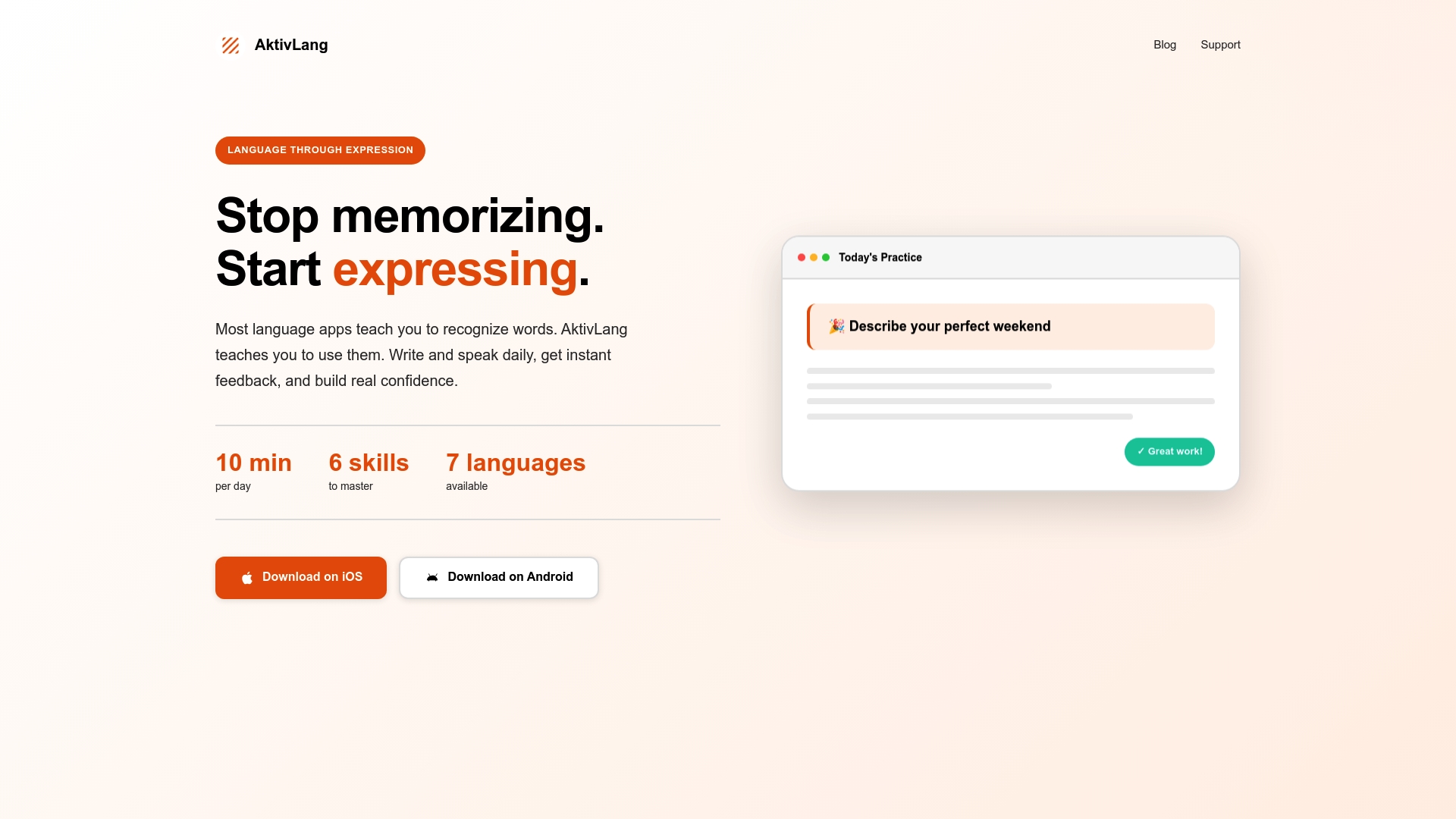
If you want prompt-driven practice without the setup work, AktivLang is built exactly for that. Every story on the platform is paired with 12+ exercise types covering vocabulary, grammar, speaking, and comprehension. You read an engaging story in French, Spanish, German, Dutch, Italian, or Portuguese, then immediately practice what you learned through structured exercises with instant AI feedback. No vague prompts. No aimless chats. Just focused, story-based practice that forces production at every step. Explore adaptive language learning and see how structured, story-driven exercises can accelerate your progress from intermediate to confident.
Frequently asked questions
What is a language learning prompt?
A language learning prompt is a structured input used by AI or tutors to generate custom exercises for practicing vocabulary, grammar, and speaking skills. It goes far beyond a simple question by defining roles, constraints, and output formats.
How do prompts help improve speaking skills?
Prompts transform AI into adaptive tutors through structured templates that push you to retell stories, answer questions aloud, and receive targeted pronunciation and fluency feedback in real time.
What common mistakes should I avoid when designing prompts?
Avoid vague or overly broad prompts. A 45% performance gap exists between well-phrased and poorly phrased prompts, so always define a clear role, add specific constraints, and state the exact output format you want.
Are story-based prompts more effective than traditional exercises?
Yes. Contextual, engaging practice through story-based prompts leads to stronger vocabulary retention and more natural conversation skills than isolated drills or static fill-in-the-blank exercises.