

TL;DR:
- Natural language acquisition involves subconscious learning through meaningful exposure and comprehensible input.
- Combining input with active production and genuine curiosity accelerates language fluency.
- Using content slightly above your level (i+1) and engaging in practice helps overcome intermediate challenges.
Grammar drills, flashcard marathons, conjugation tables memorized at midnight. Sound familiar? Many intermediate learners spend years studying a language yet still freeze up in real conversations. The frustrating truth is that traditional study methods often build recognition without building fluency. Natural language acquisition offers a different path, one that mirrors how you learned your first language: subconsciously, through meaningful exposure, and without the pressure of constant testing. This article breaks down exactly how natural acquisition works, what the research says about input versus output, and how you can apply these principles today to move past the intermediate plateau faster.
Table of Contents
- What is natural language acquisition?
- The stages and mechanics of acquiring a new language naturally
- Why input trumps output (but intermediates need both)
- Common challenges and special cases in natural acquisition
- Our take: what most articles miss about language acquisition
- How AktivLang helps you master languages naturally
- Frequently asked questions
Key Takeaways
| Point | Details |
|---|---|
| Subconscious learning works | You can acquire a new language naturally by immersing yourself in meaningful input, not just grammar drills. |
| Input is essential | Consistent exposure to language slightly above your level fuels rapid progress and long-term fluency. |
| Output accelerates growth | Practicing speaking or writing helps you notice gaps and move from intermediate to advanced skills. |
| Challenge is normal | Mastering tricky grammar features takes time, but focused input and practice help you break through plateaus. |
What is natural language acquisition?
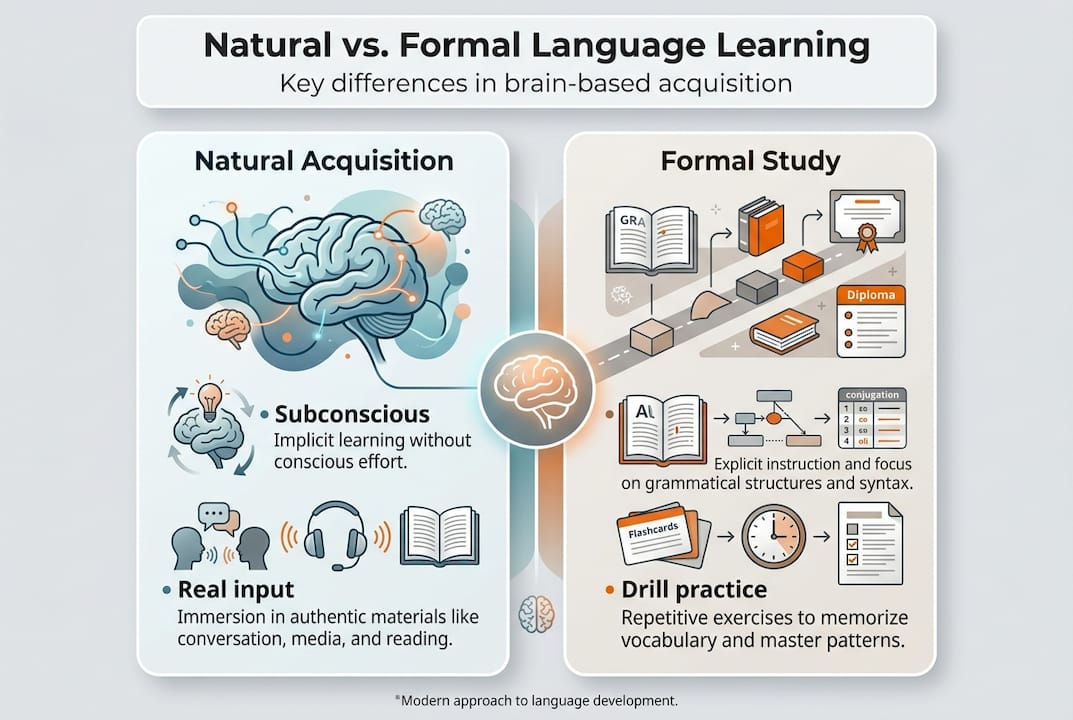
Natural language acquisition is not just a teaching philosophy. It is a description of how the human brain actually absorbs language when conditions are right. Natural language acquisition refers to the subconscious process of acquiring a second language through meaningful exposure to comprehensible input, mimicking first language acquisition, as opposed to formal language learning.
The key word here is subconscious. You are not consciously memorizing rules. Instead, your brain is detecting patterns, building intuitions, and internalizing structures through repeated, meaningful exposure. Think of it like learning to ride a bike. You can read every manual ever written about balance and momentum, but real mastery only comes from actually riding.
Linguists Stephen Krashen and Tracy Terrell formalized this idea into what they called the Natural Approach. Their model rests on a few critical features:
- Comprehensible input: Language input that is just slightly above your current level, labeled i+1
- Low affective filter: A relaxed, low-stress environment where you feel safe making mistakes
- No forced speech: You are not pressured to produce language before you are ready
"Acquisition requires meaningful interaction in the target language, not explicit knowledge of its rules." — Stephen Krashen
This stands in sharp contrast to formal learning, which prioritizes grammar instruction, drills, and explicit rule memorization. Here is how the two approaches compare:
| Feature | Natural acquisition | Formal learning |
|---|---|---|
| Grammar focus | Implicit, through exposure | Explicit rules and drills |
| Input type | Meaningful, contextual | Structured, often decontextualized |
| Speech pressure | Low, no forced output | High, frequent testing |
| Affective filter | Low stress encouraged | Often high stress |
| Vocabulary learning | In context | Lists and flashcards |
For intermediate learners, this distinction matters enormously. You have already built a foundation. Now the question is whether to keep drilling or to start acquiring. Active language learning methods that blend input with meaningful practice tend to produce the best results at this stage.
The stages and mechanics of acquiring a new language naturally
Understanding what natural acquisition is, let us map out the key stages and how learners progress. The natural approach identifies three core stages: preproduction, early production, and speech emergence. Each stage has its own mechanics and its own ideal activities.
- Preproduction (the silent period): At this stage, you absorb input without producing much language. Your brain is building an internal model. Listening to podcasts, watching shows, and reading stories in your target language are ideal here.
- Early production: You start responding with single words, short phrases, and yes/no answers. Comprehensible input remains central, but simple conversations and story-based exercises begin to reinforce what you have absorbed.
- Speech emergence: Sentences become longer and more flexible. You can express ideas, ask questions, and engage in real dialogue. Grammar errors still happen, but communication flows.
The engine driving all three stages is comprehensible input, specifically the i+1 principle. If input is too easy, your brain does not need to stretch. If it is too hard, comprehension collapses and acquisition stalls. The sweet spot is material that challenges you just enough to keep the brain engaged and learning.
For intermediate learners, this means seeking out content that is slightly above your comfort zone. A story where you understand 90% of the words but have to infer the remaining 10% from context is perfect i+1 material.

Pro Tip: Build an input-rich environment by surrounding yourself with your target language throughout the day. Set your phone to French, listen to a Spanish podcast during your commute, or read a short Italian news story with your morning coffee. Consistency beats intensity every time.
Activities that match each stage:
- Preproduction: Audiobooks, native-speaker podcasts, graded readers, subtitled films
- Early production: Story-based exercises, simple Q&A, vocabulary matching with audio
- Speech emergence: Conversation exchanges, shadowing, retelling stories aloud
Why input trumps output (but intermediates need both)
Having explained the stages, it is time to tackle an often-debated question: input or output? The answer is more nuanced than most articles admit.
Research comparing different instructional methods shows that Processing Instruction (PI) and output-based methods both develop explicit and implicit knowledge equally, while input-based approaches tend to enhance comprehension more directly. In plain terms: input builds the foundation, but output solidifies the structure.
For intermediate learners specifically, output becomes increasingly important. When you try to speak or write in your target language, you notice gaps you did not know existed. This is sometimes called pushed output, and it forces your brain to search for the right form, not just recognize it. That search is where real learning happens.
Here is a breakdown of methods and what each one develops:
| Method | Explicit knowledge | Implicit knowledge | Comprehension |
|---|---|---|---|
| Processing Instruction (PI) | High | Moderate | High |
| Traditional Instruction (TI) | High | Low | Moderate |
| Meaning-Oriented Instruction (MOI) | Moderate | High | High |
Activities that balance input and output effectively:
- Listening to stories, then retelling them in your own words
- Conversation practice with a native speaker or language partner
- Shadowing: listening to a sentence and repeating it immediately
- Writing short texts like journal entries or story summaries
- Reading aloud to build the connection between written and spoken forms
The input hypothesis remains a cornerstone of acquisition theory, but the practical takeaway for you as an intermediate learner is this: consume rich input daily, and then push yourself to produce. Both matter. Neither alone is enough.
Common challenges and special cases in natural acquisition
It is also important to recognize natural acquisition is not a cure-all. Special cases and common obstacles do exist, and being aware of them helps you adjust your approach.
The critical period hypothesis suggests that certain aspects of language, particularly accent and complex grammar, are harder to master after childhood. Critical period effects on grammar and pronunciation mastery are well-documented, though adults consistently outperform children in vocabulary acquisition speed. So while your accent in French or German may never be indistinguishable from a native speaker's, your ability to build a rich vocabulary and communicate fluently is absolutely within reach.
Another challenge is L1 transfer, where your first language bleeds into your second. Interestingly, cross-linguistic research shows that naturalistic learners show minimal L1 transfer in syntax (sentence structure), but morphology, meaning verb endings, noun forms, and case markers, remains stubbornly difficult regardless of method.
Here is what that looks like across popular European languages:
- French and Italian: Gender agreement and noun forms trip up most intermediate learners
- German and Dutch: Case endings (nominative, accusative, dative) require heavy exposure and active practice
- Spanish and Portuguese: Verb conjugation across tenses, especially the subjunctive, demands repeated meaningful use
Pro Tip: For persistent morphology challenges, do not just read more. Engage with speaking practice that forces you to produce the exact forms you struggle with. Retelling a story you read is far more effective than drilling a conjugation table in isolation.
Individual differences also play a big role. Motivation, learning environment, and prior language experience all affect how quickly you move through the acquisition stages. Story-based learning is particularly effective because it keeps motivation high while delivering rich, contextualized input.
Our take: what most articles miss about language acquisition
Having covered both the research and practical nuances, here is our experience-driven view on what truly moves the needle.
Most articles frame the debate as input versus output, or natural acquisition versus formal study. That framing misses the point entirely. The learners who progress fastest are not the ones who choose a side. They are the ones who stay engaged with the language in ways that feel meaningful to them.
Passive input alone creates a comfortable illusion of progress. You understand more, but you cannot yet produce. Grammar study alone builds rules you cannot apply under pressure. The real accelerant is reflective engagement: reading a story, noticing a structure you did not expect, trying to use it in conversation, and then noticing whether it worked.
Cultural curiosity amplifies everything. When you genuinely care about what you are reading or hearing, your brain encodes it more deeply. That is not a metaphor. It is how memory consolidation works. For motivation and speaking confidence, the single biggest factor we see is whether learners are engaging with content they actually find interesting, not content assigned to them.
Combine input, meaningful output, and genuine curiosity, and you have a system that works.
How AktivLang helps you master languages naturally
Ready to take what you have learned and apply it to your own language journey? Here is how our tools can support you.
AktivLang is built around exactly the principles covered in this article. You read engaging stories in French, Spanish, German, Dutch, Italian, or Portuguese, stories about mythology, history, culture, and real-world topics, and then practice through 12+ exercise types covering vocabulary, comprehension, speaking, and grammar. Every exercise gives you instant feedback, so you always know what to improve. The AktivLang blog also offers practical strategies, learner tips, and research-backed guidance to keep you moving forward. Whether you are building toward fluency for work, travel, or personal growth, AktivLang gives you the input-rich, output-driven environment that natural acquisition actually requires.
Frequently asked questions
How is natural language acquisition different from traditional study?
Natural acquisition happens subconsciously through exposure to meaningful input, while traditional study relies on explicit grammar rules and memorization. One builds intuition; the other builds rule knowledge.
Can adults achieve fluency with natural language acquisition?
Yes, adults can reach strong fluency, though critical period effects mean accent and certain grammar features may be harder to perfect after childhood. Vocabulary and communication skills remain highly achievable.
What is comprehensible input and why does it matter?
Comprehensible input is language pitched just above your current level, labeled i+1, and it drives subconscious acquisition by keeping your brain engaged without overwhelming it.
Are grammar drills needed for mastering languages like French or German?
Not necessarily. Research shows learners can make strong gains without explicit drills by focusing on input and context, though targeted practice helps with stubborn morphology features.
What is the biggest challenge for intermediates using this approach?
Tackling specific morphology, like verb endings and case markers, often requires extra exposure and active production practice beyond passive input alone.