

TL;DR:
- Adaptive language systems personalize learning by adjusting content based on individual performance.
- They reduce time to proficiency by 30 to 50 percent and improve retention through spaced repetition.
- Combining adaptive story-based apps with real conversation practice yields the best language learning results.
Adaptive language systems can cut the time to reach proficiency by 30 to 50 percent, yet most intermediate learners keep grinding through the same static drills and flashcard decks. That gap between what the research shows and what most people actually do is striking. If you are learning French, Spanish, German, Dutch, Italian, or Portuguese, understanding how adaptive learning works could be the single biggest shift you make this year. This guide breaks down what adaptive language learning is, why the evidence behind it is compelling, how it plays out in real apps and story-based tools, and what the experts say about doing it right.
Table of Contents
- What is adaptive language learning?
- How adaptive language systems accelerate progress
- Adaptive learning in real-life: Stories, apps, and human feedback
- Limitations, challenges, and expert insights on adaptive language learning
- Our take: Why story-driven adaptivity plus real communication wins
- Ready to boost your adaptive language journey?
- Frequently asked questions
Key Takeaways
| Point | Details |
|---|---|
| Faster, smarter learning | Adaptive systems can cut your language learning time in half compared to old-school methods. |
| Not all apps are equal | Story-driven, feedback-rich adaptive apps offer the best mix for vocabulary, grammar, and speaking gains. |
| Balance tech and people | Combining adaptive tools with conversation and feedback produces the strongest results. |
| Know the limits | Over-reliance on AI risks missed context—embrace stories, social learning, and expert advice. |
What is adaptive language learning?
To understand adaptive methods, let's first clarify what the term actually means and how it flips the script from one-size-fits-all lessons.
Adaptive language learning is a technology-driven approach where the system adjusts what you study, how difficult it is, and how often you review it, all in real time, based on your performance. Think of it like a personal trainer who watches every rep and immediately changes the weight, speed, or exercise based on how you are doing. Traditional language courses hand everyone the same textbook. Adaptive systems hand you a lesson built around your specific gaps.
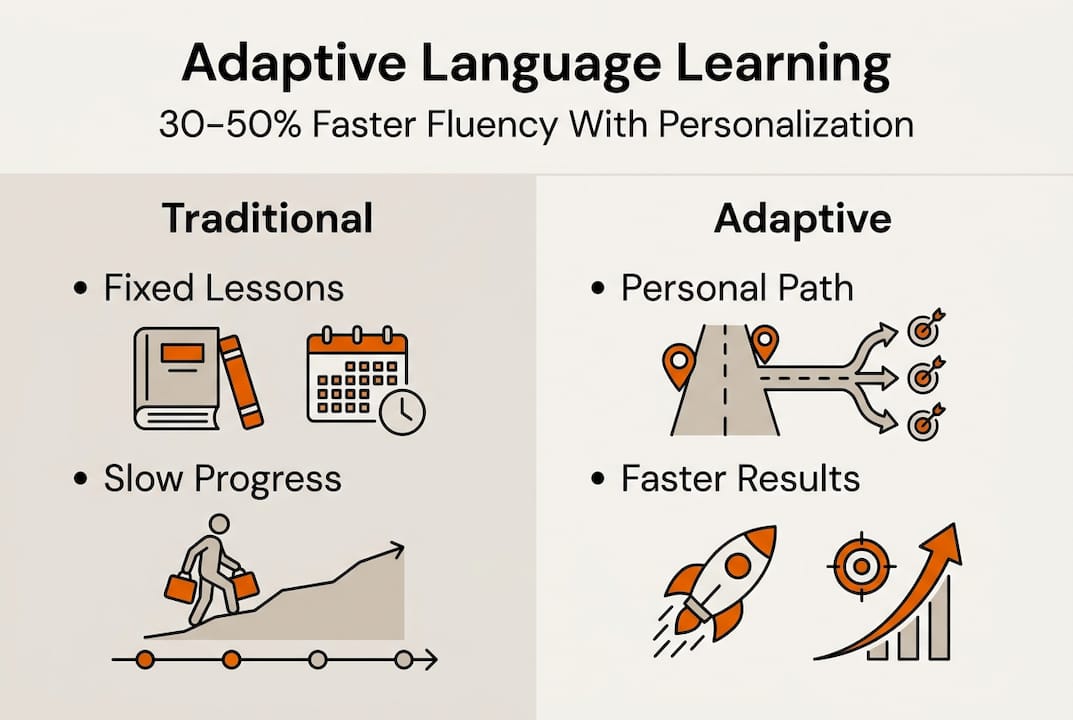
The core engine behind most adaptive platforms is machine learning, a type of artificial intelligence that identifies patterns in your errors and predicts which words or grammar rules you are most likely to forget. Pair that with spaced repetition, a technique where material is reviewed at increasing intervals right before you would naturally forget it, and you get a system that is genuinely calibrated to your brain.
Common adaptive features you will find across modern platforms include:
- Error targeting: The app notices you keep confusing the Spanish subjunctive and pushes more exercises on that exact point.
- Story-based content: Vocabulary and grammar appear inside meaningful narratives rather than isolated drills, so context does the heavy lifting.
- Community and human feedback: Some platforms layer in peer corrections or tutor reviews to catch what the algorithm misses.
- Difficulty scaling: Lessons get harder or easier based on your recent scores, keeping you in the productive zone just above your comfort level.
Apps like Duolingo, Babbel, and others use adaptive learning features to varying degrees, but the quality and depth of adaptivity differ significantly between them. Some only adjust vocabulary frequency. Others adapt grammar pathways, story difficulty, and speaking prompts simultaneously.
Where adaptive learning really separates itself is in how it helps you personalize language learning rather than forcing you through a predetermined sequence. You stop wasting time on things you already know and spend more energy on what actually holds you back.
Pro Tip: When evaluating any adaptive app, check specifically for spaced repetition in the vocabulary section. That single feature, when implemented well, can dramatically improve how much you retain between sessions.
How adaptive language systems accelerate progress
Now that the basics are clear, let's dig into the evidence. Why do adaptive techniques actually work better for language acquisition?

The numbers are hard to ignore. Adaptive systems reduce time to proficiency by 30 to 50 percent compared to traditional instruction, while spaced repetition alone pushes retention rates to 80 to 90 percent. Duolingo users studying consistently improved all measured language skills across a 12-week period, with listening and speaking scores rising by 3.9 to 4.5 points on standardized scales.
Here is a side-by-side look at how adaptive and traditional approaches compare:
| Metric | Traditional methods | Adaptive methods |
|---|---|---|
| Time to proficiency | Baseline | 30–50% faster |
| Vocabulary retention | 40–60% after 1 week | 80–90% with spaced repetition |
| Speaking improvement (12 weeks) | Minimal without practice | Up to 4.5 points |
| Personalization | None | Real-time adjustment |
| Learner dropout rate | High | Lower with gamification |
These methods boost fluency because they force active recall, which means retrieving information from memory rather than just recognizing it on a page. Recognition is passive. Retrieval is what actually builds lasting knowledge.
Here is how a well-designed adaptive system personalizes your journey step by step:
- Initial placement: You complete a diagnostic that maps your current level across vocabulary, grammar, and listening.
- Error analysis: The system tracks every mistake and builds a profile of your weak points.
- Content selection: Future lessons prioritize the exact gaps identified, pulling from a library of stories, dialogues, and exercises.
- Review scheduling: Spaced repetition algorithms schedule reviews at the optimal moment, just before forgetting occurs.
- Progress recalibration: As you improve, the system raises difficulty and shifts focus to new weak areas.
This loop is why language practice boosts retention so effectively when it is adaptive. You are never coasting on what you already know, and you are never overwhelmed by content that is too far ahead of your current level.
Adaptive learning in real-life: Stories, apps, and human feedback
But what does this look like day-to-day? Let's examine popular adaptive platforms, how they use stories, and where human interaction still matters.
Different apps take very different approaches to adaptivity. Here is a practical comparison:
| App | Adaptivity level | Story elements | Human feedback |
|---|---|---|---|
| Duolingo | Moderate | Minimal | None built-in |
| Babbel | Moderate | Some dialogue | Limited |
| Talkpal | High (AI chat) | Roleplay scenarios | AI-simulated |
| Busuu | High | Cultural stories | Peer corrections |
| AktivLang | High | Full story-based | AI speaking feedback |
Apps like Duolingo, Babbel, Talkpal, and others each offer different balances of gamification, adaptive AI, and story-based content. The right choice depends on how much you value narrative immersion versus gamified drills.
Story-based adaptive experiences tend to show up in a few distinct formats:
- Interactive dialogues: You read or listen to a conversation between characters, then answer questions or fill in missing lines based on what you understood.
- Roleplay scenarios: The app places you in a simulated situation, like ordering food in Italian or navigating a German train station, and adapts the difficulty based on your responses.
- Contextual vocabulary building: New words appear inside a story first, so you encounter them with full meaning before you ever see a flashcard.
- Progressive narrative arcs: Stories continue across sessions, so you stay motivated to return and find out what happens next.
This story-based workflow is particularly effective because it mirrors how children acquire language: through meaningful, emotionally engaging context rather than rote memorization. The benefits of learning with stories extend beyond vocabulary to grammar intuition and cultural understanding.
Pro Tip: Combine adaptive story apps with at least one weekly session of peer or tutor feedback. The app catches your grammar errors; a human catches the awkward phrasing that sounds technically correct but would confuse a native speaker.
Limitations, challenges, and expert insights on adaptive language learning
No method is perfect. What are the real-world pitfalls, and how do experts suggest we maximize adaptive language learning?
Adaptive tools are powerful, but they carry genuine risks when used in isolation. The most common limitations include:
- Context blindness: Algorithms can identify that you got a question wrong, but they cannot always understand why. A misclick looks the same as a knowledge gap.
- Over-gamification: Points, streaks, and badges can shift your motivation from learning the language to maintaining a streak. These are not the same goal.
- Solo learning risk: Spending all your time with an app means you are never practicing the unpredictable, messy, real-time nature of actual conversation.
- Grammar and context gaps: Some adaptive apps excel at vocabulary but handle nuanced grammar or cultural context poorly.
Research published in Frontiers in Psychology makes the point clearly: adaptive methods must go beyond static input and account for interaction, context, and cognitive development to produce lasting gains. An app that only adjusts vocabulary frequency is not truly adaptive in the full sense.
"The most effective adaptive interventions do not just respond to errors. They build metacognitive awareness, helping learners understand their own learning process and take ownership of it."
Gamified adaptive apps can risk social isolation and may create dependency without building the real-world communication skills learners actually need. Cognitive load is also a factor. When an app throws too many new words, grammar rules, and story elements at once, working memory gets overwhelmed and retention drops.
The solution is balance. Use adaptive tools to build your foundation in French, Spanish, German, Dutch, Italian, or Portuguese. Then stress-test that foundation with speaking practice advantages that no algorithm can replicate. Motivation for speaking success also matters here. Staying connected to real people keeps your reasons for learning alive in a way that a leaderboard simply cannot.
Our take: Why story-driven adaptivity plus real communication wins
Here is what most adaptive language learning guides miss entirely: the technology is only half the equation.
Many learners treat app adaptivity as the destination. They optimize their streaks, hit their daily targets, and wonder why they still freeze up when a native speaker talks to them at normal speed. The app adapted to their mistakes. It never adapted to the chaos of real conversation.
Speaking is key to closing that gap. Story-based adaptive learning is genuinely superior to static drills because it builds vocabulary in context and keeps you emotionally engaged. But stories are input. Real communication is output. And output is where language actually gets locked in.
Our view is that the best learners use adaptive story apps as their daily foundation and then hold themselves accountable through partners, tutors, or language groups. The app tells you what you got wrong. The conversation tells you whether you can actually communicate. Both signals are necessary. Neither one alone is enough.
Pro Tip: Set a weekly speaking goal that exists completely outside your app. Even a 15-minute conversation with a language partner will surface gaps that months of adaptive drilling might never catch.
Ready to boost your adaptive language journey?
If you have been relying on static drills or isolated flashcards, the research is clear: adaptive, story-based learning is a faster and more effective path to fluency in French, Spanish, German, Dutch, Italian, and Portuguese.
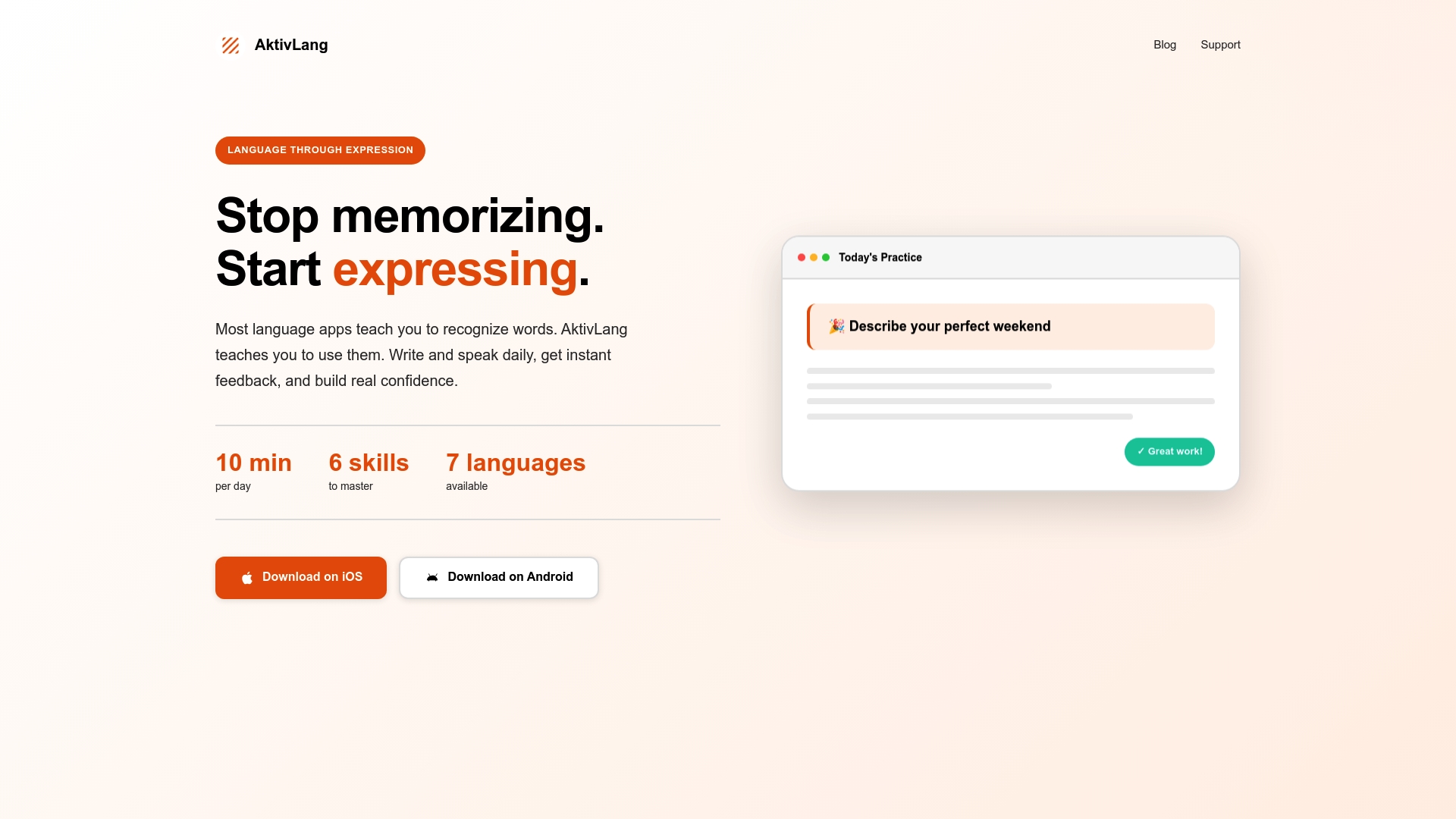
AktivLang is built around exactly this approach. You read compelling stories in your target language, then practice what you learned through 12+ exercise types covering vocabulary, grammar, comprehension, and speaking, all with instant AI feedback. It is the kind of adaptive story-driven experience that puts context and active recall at the center of every session. Explore language learning tips to complement your practice, and start building the fluency that actually holds up in real conversations.
Frequently asked questions
How fast can I progress with adaptive language learning?
Adaptive systems reduce time to proficiency by 30 to 50 percent compared to traditional methods, making it one of the most efficient approaches available to intermediate learners.
Do adaptive apps work for speaking practice?
Adaptive apps can improve speaking skills, with Duolingo users gaining up to 4.5 points in speaking over 12 weeks, but experts consistently recommend combining them with real human conversation for the best results.
Are there risks in relying only on adaptive AI for language learning?
Yes. Risks include isolation and potential over-reliance on gamification, which can erode motivation and leave real-world communication skills underdeveloped.
Which languages benefit most from adaptive story-based methods?
French, Spanish, German, Dutch, Italian, and Portuguese all show strong results, with story-based and adaptive features available across major apps for all six languages at the intermediate level.
How should I track my progress using adaptive tools?
Use your app's built-in benchmarks as a starting point, then add empirical progress tracking through regular self-tests or tutor feedback sessions to get a complete and honest picture of your advancement.