

TL;DR:
- Intermediate French (B1-B2) involves developing fluency in complex topics and advanced comprehension.
- Combining story-based input with active speaking and writing accelerates progress and overcomes plateaus.
- Engaging content and deliberate practice are key to transforming intermediate learners into fluent speakers.
Most intermediate French learners hit a wall and assume the answer is more grammar drills or bigger flashcard decks. It isn't. The real issue is that beginner tools simply stop working once you cross into B1 territory, and no one tells you what to replace them with. This guide cuts through that confusion. You'll discover what intermediate French actually requires, why story-based methods accelerate progress faster than isolated vocab practice, and how to use interactive exercises to build real speaking confidence. Whether you're chasing fluency for travel, work, or personal growth, the strategies here will move you forward.
Table of Contents
- What does 'intermediate French' really mean?
- Break the plateau: Core strategies for intermediate French
- Make it engaging: How to use stories and cultural icons for faster learning
- Practical exercises for vocabulary, comprehension, and speaking
- Expert advice: Overcoming common obstacles and maximizing results
- A fresh perspective: Why intermediate French is your true launchpad
- Take your French to the next level with AktivLang
- Frequently asked questions
Key Takeaways
| Point | Details |
|---|---|
| Benchmark your progress | Mastering intermediate French means increasing speaking, comprehension, and vocabulary, with clear hour-based milestones. |
| Embrace stories for input | Use engaging stories and cultural icons to boost motivation and accelerate vocabulary and comprehension. |
| Balance input with action | Blend listening, reading, and active speaking or writing exercises for steady progress. |
| Level up your practice | Move beyond beginner apps—integrate task-based, interactive exercises and challenge yourself with advanced content. |
| Consistency beats cramming | Daily micro-study sessions (15–30 minutes) deliver better long-term results at the intermediate stage. |
What does 'intermediate French' really mean?
With the misconception addressed, let's define what 'intermediate' really covers for French learners.
The Common European Framework of Reference for Languages, known as CEFR, is the standard benchmark for measuring language proficiency. For French, the intermediate range spans B1 (lower intermediate) and B2 (upper intermediate). These aren't just labels; they represent real, measurable abilities.
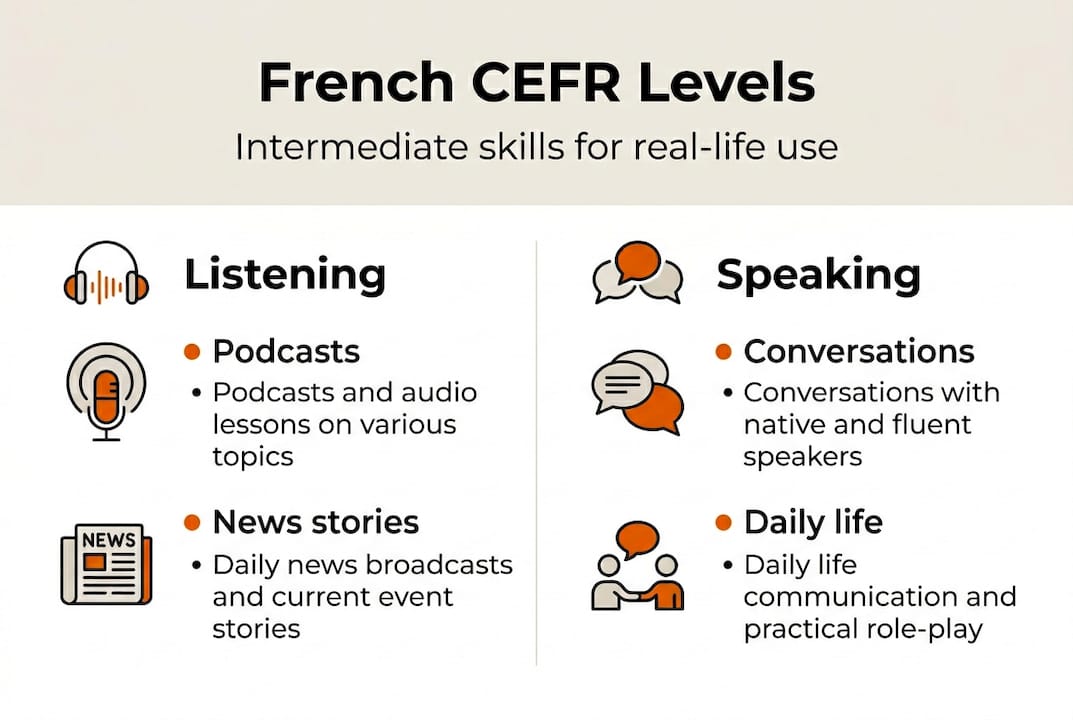
At B1, you can handle familiar topics in conversation, follow the main points of a podcast or news story, and write simple connected text. At B2, you can interact fluently with native speakers, understand complex arguments, and express yourself with enough precision to hold your own in professional or academic settings.
The time investment is significant. According to cumulative hour estimates, reaching B1 requires 350 to 400 total hours of study from beginner, while B2 demands 550 to 800 hours. That means moving from B1 to B2 alone can take 200 to 250 additional hours of focused practice.
Here's a quick breakdown of what each level looks like in practice:
| Skill | B1 | B2 |
|---|---|---|
| Speaking | Handles familiar topics | Fluent with native speakers |
| Comprehension | Follows clear, standard speech | Understands complex arguments |
| Vocabulary | ~2,000 words active | ~4,000 words active |
| Writing | Simple connected text | Clear, detailed text on many topics |
Common challenges at this stage include:
- The plateau effect: progress slows sharply after early wins
- The comprehension-production gap: you understand more than you can say
- Outgrowing beginner tools: apps designed for A1-A2 learners no longer push you
Success at the intermediate stage looks like following a French podcast without losing the thread, holding a real conversation without freezing, and reading a story or article with genuine comprehension. If you want intermediate French tips that map to these goals specifically, focusing on context-rich input and active output is the proven path. Exploring learning methods for B1/B2 can also help you understand which approaches deliver the best return on your study time.
Break the plateau: Core strategies for intermediate French
Armed with a definition of intermediate, here's how you can keep moving forward and avoid getting stuck.
The two main learning approaches at this level are input-focused and output-focused methods. Neither works best in isolation. Here's how they compare:
| Method type | Examples | Pros | Cons |
|---|---|---|---|
| Input-focused | Stories, podcasts, reading | Builds natural comprehension | Can delay speaking confidence |
| Output-focused | Shadowing, speaking tasks | Builds production and fluency | Requires more cognitive effort |
Shadowing means listening to a native speaker and repeating what you hear in real time, almost like an echo. It trains your mouth and ears simultaneously. Spaced repetition systems (SRS), like Anki, schedule vocabulary reviews at optimal intervals so words move into long-term memory. Retrieval practice means actively recalling information rather than passively rereading it.
Here are four core activities to build into your routine:
- Story listening and reading with pauses to summarize what you heard
- Shadowing short dialogues or podcast segments to improve pronunciation and rhythm
- SRS flashcard review using cards built from words you encountered in stories
- Task-based speaking such as recording a 60-second summary of a story you just read
The key mechanics of effective intermediate practice, including comprehensible input and retrieval practice, are well supported by research on how adults acquire languages fastest.
Pro Tip: Daily micro-doses of 15 to 30 minutes outperform occasional long sessions. Consistency beats intensity at this stage, especially for retention.
For a structured approach to story-based language practice, the key is pairing every story you read or hear with at least one output task. And if you want to sharpen your production skills specifically, dedicated intermediate speaking exercises are a powerful complement. You can also explore output-focused techniques to find approaches that suit your schedule and goals.
Make it engaging: How to use stories and cultural icons for faster learning
Beyond methods alone, let's see how adding engaging content changes the way you learn.
One of the biggest mistakes intermediate learners make is treating content as a chore. When you read or listen to something genuinely interesting, vocabulary sticks without brute-force memorization. That's the power of story-based learning. Context creates memory.
As ExploreFrench's intermediate modules highlight, prioritizing comprehensible input through engaging stories paired with interactive exercises produces measurable gains in speaking, vocabulary, and comprehension. The combination of narrative engagement and active practice is hard to beat.
Top resources for intermediate learners include:
- InnerFrench: A podcast designed specifically for B1-B2 learners, using slow, clear speech on cultural and social topics
- TV5Monde: Authentic French television with interactive subtitles and comprehension activities
- Coffee Break French: Structured audio lessons that blend grammar explanation with real conversation examples
- ExploreFrench: Story-based skill modules with built-in exercises for each level
- McGill University resources: Curated practice materials covering grammar, listening, and reading
You can also explore a French storybook with fairytales at the B1-B2 level, which gives you cultural richness alongside familiar narratives that help comprehension.
To turn any story into active practice, use this approach: read or listen once for general understanding, then go back and note five to ten new words. Write a three-sentence summary from memory. Then either record yourself retelling it or write a short continuation of the story.
Pro Tip: Use characters from a story you enjoyed as role-play prompts. Ask yourself, "What would this character say if...?" and answer out loud. It sounds playful, but it forces real-time production.
For ideas on how to build story-based writing exercises into your study routine, this kind of creative application is one of the fastest ways to move vocabulary from passive recognition to active use.
Practical exercises for vocabulary, comprehension, and speaking
Here's how to apply these resources and strategies with ready-to-use practice ideas.

You don't need a complex study plan. You need repeatable exercises that target each core skill. Here's a simple framework:
Vocabulary
- Read a short French story (250 to 400 words at your level)
- Highlight unknown words in context, not in isolation
- Create SRS cards using the full sentence as context, not just the word alone
- Review cards daily, pronouncing each word aloud
Comprehension
- Listen to or read a story once without stopping
- Without looking back, write or say five key facts from memory
- Check your recall against the original text
- Identify one sentence you misunderstood and analyze why
Speaking
- Choose a dialogue or story excerpt (3 to 5 sentences)
- Shadow it three times, focusing on rhythm and intonation
- Record yourself answering a question about the story in French
- Listen back and note one thing to improve
Sample practice prompts you can use immediately:
- Summarize a story you read in three sentences, spoken aloud
- Role-play a conversation between two characters from the story
- Describe a scene from the story to an imaginary listener who hasn't read it
- Write a different ending for the story in 100 words
Resources like ExploreFrench, TV5Monde, and InnerFrench all provide story and exercise pairings you can slot directly into this framework. For grammar and listening support, McGill's practice resources are worth bookmarking.
For more ideas on building speaking habits, conversation practice tips offer structured approaches you can use even without a speaking partner. And if writing is a focus, creative French writing prompts give you a ready-made bank of story-based tasks.
Expert advice: Overcoming common obstacles and maximizing results
While practice is crucial, expert advice can help you sidestep common pitfalls and level up faster.
Even motivated learners fall into patterns that slow progress. Here are the most common obstacles and how to move past them:
- Sticking with beginner apps: Tools built for A1-A2 learners don't challenge you enough. You need content at or slightly above your level.
- Avoiding speaking: Many intermediate learners focus on listening and reading because speaking feels hard. But output is where fluency is actually built.
- Passive consumption: Watching French TV without any active task (note-taking, summarizing, shadowing) produces minimal language gains.
- Irregular practice: Skipping days breaks the retrieval cycle. Even 15 minutes daily is more effective than two hours once a week.
- Perfection paralysis: Waiting until you feel ready to speak delays the very practice that builds readiness.
Research on optimized study habits suggests that allocating around 35 to 40% of your time to input and 20 to 25% to shadowing and speaking produces the strongest progress at the intermediate stage.
Experts consistently advise that at the intermediate level, avoiding beginner apps and using story-based, just-in-time tools delivers far better results. "Just-in-time grammar" means looking up rules as real questions arise during speaking or writing, rather than studying grammar abstractly in advance.
Pro Tip: Deliberately challenge yourself with content that's slightly above your level. Discomfort signals growth. If everything feels easy, you've stopped stretching.
For a deeper look at speaking strategies for intermediates, consistent output practice combined with story-based input is the combination that breaks most plateaus. And if you want perspective on time investment guidance, it helps to know that quality of practice matters at least as much as quantity.
A fresh perspective: Why intermediate French is your true launchpad
Let's zoom out to see why this part of your French journey is so transformative and what most guides don't tell you.
Most learners dread the intermediate stage. They call it a plateau, a slog, a grind. We'd argue they're looking at it wrong. Intermediate French isn't where progress slows. It's where real language acquisition begins.
At the beginner stage, you were building scaffolding. Now you have enough structure to actually live inside the language. Stories become comprehensible. Conversations become possible. The complexity you feel isn't a sign you're stuck. It's a signal that you're ready for immersive, challenging content.
The learners who break through fastest are not the ones who study more grammar. They are the ones who consume rich, interesting stories and then produce language from them, speaking, writing, and creating. This is where story-based skill growth becomes a true differentiator.
The blend of story-driven input, consistent output, and deliberate challenge isn't a shortcut. It's the actual path. Most guides won't say that clearly enough, so we will: intermediate French is not a problem to survive. It's a launchpad to use.
Take your French to the next level with AktivLang
Ready to start applying all this? Discover how AktivLang can make the difference.
AktivLang is built specifically for learners at the B1-B2 stage who are ready to move beyond basics and start using their French. Every session starts with a compelling story on a topic you choose, from history and mythology to culture and travel. Then you practice what you read through 12+ exercise types covering vocabulary, comprehension, speaking, and grammar.
You don't just recognize words. You produce them. Speaking exercises give you AI-powered pronunciation feedback and fluency scores, so you always know exactly what to improve. Personalized weekly insights track your growth across every skill. If you're ready to make in-depth story exercises a daily habit, AktivLang is where intermediate French learners go to finally feel the progress they've been working toward.
Frequently asked questions
How long does it take to go from intermediate (B1) to upper intermediate (B2) in French?
For most learners, progressing from B1 to B2 typically takes 200 to 250 hours of focused study and practice. The exact timeline depends on how consistently you practice and whether you prioritize active output alongside listening and reading.
What are the best resources to improve intermediate French comprehension?
Top resources include InnerFrench, TV5Monde, ExploreFrench, and McGill practice materials. Each combines authentic content with structured comprehension activities suited to B1-B2 learners.
How can I overcome the intermediate plateau in French?
Switch to extensive reading and story immersion combined with real speaking practice slightly above your current level. Passive consumption alone will not break the plateau.
Should I still use beginner language apps at the intermediate level?
No. Intermediate learners benefit more from story-based, just-in-time tools than from beginner app formats. Apps designed for A1-A2 learners don't challenge you at the level needed for B1-B2 growth.
How much should I focus on speaking versus listening at the intermediate stage?
Aim for roughly 35 to 40% listening and 20 to 25% speaking through shadowing and conversation. This input-output balance consistently delivers the strongest results for intermediate learners.