

TL;DR:
- Intermediate learners often hit a speaking plateau despite knowing vocabulary and grammar.
- Structured practice with tools and specific goals accelerates fluency and confidence.
- Consistent, imperfect speaking activities are key to long-term language mastery.
You know the vocabulary. You understand the grammar rules. But the moment someone asks you a question in French, Spanish, or German, your mind goes blank. This is the speaking plateau, and almost every intermediate learner hits it. The good news? It is not a sign that you lack talent. It is a sign that you need a different kind of practice. This guide gives you a clear, step-by-step roadmap to break through that wall. You will find practical tools, structured methods, motivation strategies, and a way to track real progress, so you can start speaking with confidence sooner than you think.
Table of Contents
- What you'll need to improve your speaking practice
- Step-by-step methods to practice speaking effectively
- Staying motivated and overcoming common speaking obstacles
- Tracking your progress and measuring improvement
- Why mastering speaking is more achievable than you think
- Next steps: practice speaking with expert guidance
- Frequently asked questions
Key Takeaways
| Point | Details |
|---|---|
| Gather the right tools | A few focused resources make speaking practice easier and more effective. |
| Use varied practice methods | Mix solo exercises and real conversations to challenge and improve your skills. |
| Track your progress | Regularly recording and reviewing your practice sessions ensures steady improvement. |
| Stay consistent and motivated | Small, daily efforts and a positive mindset are crucial to breaking through speaking plateaus. |
What you'll need to improve your speaking practice
Setting yourself up correctly before you open your mouth makes a real difference. Gathering the right resources can double the effectiveness of your practice, so it pays to prepare. Think of it like cooking: even a skilled chef produces better results with sharp knives and fresh ingredients.
Here are the essential tools to have ready:
- Online dictionary or translator (WordReference, DeepL) for quick lookups without breaking your flow
- Pronunciation app or AI feedback tool to catch sounds you are producing incorrectly
- A conversation partner found through platforms like Tandem or HelloTalk
- A recording device such as your phone's voice memo app
- Language prompt cards with topics, questions, or scenarios to spark spontaneous speech
Beyond tools, your environment matters. A quiet, distraction-free space signals to your brain that it is time to produce language, not consume it. Even 15 minutes of focused speaking practice in a calm room beats an hour of half-attention.
| Tool | Purpose | Free option |
|---|---|---|
| Voice recorder | Playback and self-review | Phone memo app |
| Pronunciation app | Accent and clarity feedback | AI speaking tools |
| Prompt cards | Spark spontaneous speech | DIY index cards |
| Language partner | Real conversation practice | Tandem, HelloTalk |
| Online dictionary | Instant word lookup | WordReference |
Finally, set a micro-goal for each session. Instead of "I want to speak better," try "Today I will describe three photos without stopping." Specific goals keep you focused and give you something to measure. For more language learning tips tailored to your level, it helps to explore resources designed specifically for intermediate learners.
Pro Tip: Record every session, even the messy ones. Listening back after a week reveals patterns in your mistakes that you simply cannot notice in the moment.
Step-by-step methods to practice speaking effectively
With your preparation in place, here is how to structure your speaking practice for real improvement. A good session has three phases: warm-up, guided exercises, and spontaneous conversation.
Phase 1: Warm-up (5 minutes). Read a short paragraph aloud from a story or article in your target language. This activates your pronunciation muscles and gets your brain into "output mode" before the harder work begins.
Phase 2: Guided exercises (15 minutes). Guided speaking exercises accelerate improvement because they give you a clear task with measurable results. Try these methods:
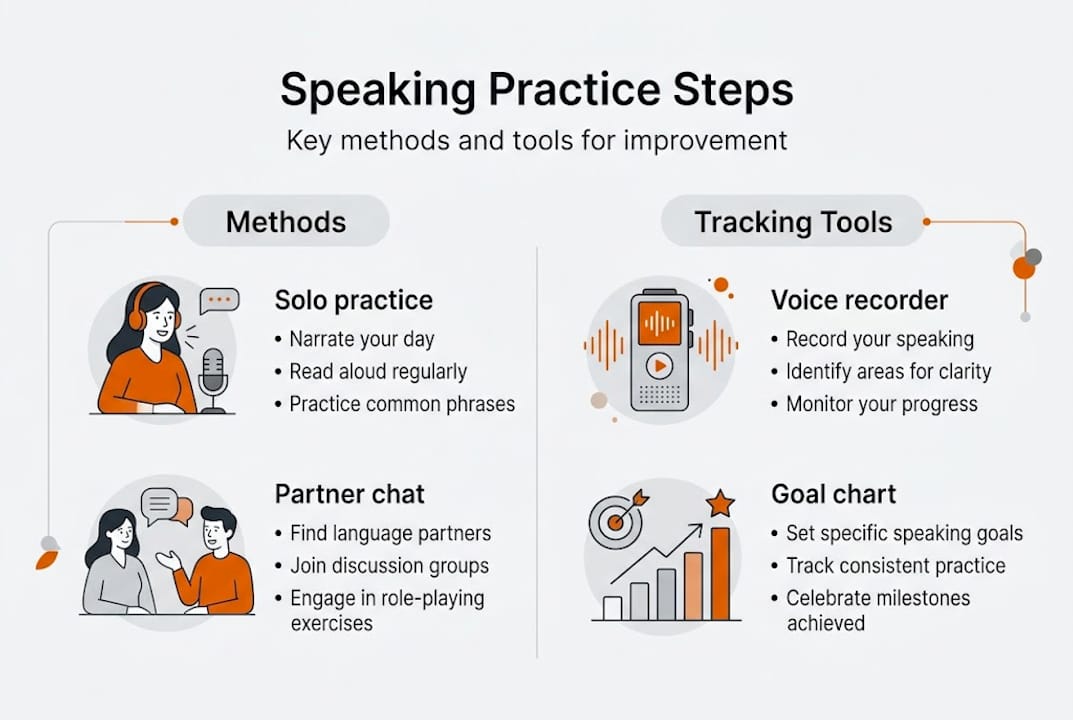
- Shadowing — Listen to a native speaker, then repeat immediately, matching rhythm and intonation
- Repetition drilling — Take a sentence you got wrong and say it correctly five times in a row
- Q&A practice — Answer questions aloud, either from a prompt card or a language app
- Picture description — Describe an image in detail for 60 seconds without stopping
- Story retelling — Summarize something you read or watched in your target language
Phase 3: Spontaneous conversation (10 minutes). This is where speaking practice boosts confidence and fluency most. Talk with a partner, use a language exchange app, or simply speak aloud to yourself about your day.

| Practice type | Key benefit | Best challenge | Ideal for |
|---|---|---|---|
| Solo practice | Available anytime | Staying motivated alone | Pronunciation, fluency drills |
| Partner practice | Real-time feedback | Finding a reliable partner | Conversation, listening |
For a wider range of speaking exercise ideas, mixing solo and partner formats gives you the best of both worlds.
Pro Tip: Use a timer for each phase. Knowing you only have 60 seconds to describe a picture removes the temptation to overthink and forces natural speech.
Staying motivated and overcoming common speaking obstacles
Once you have started practicing, staying motivated and tackling obstacles is crucial. Most learners do not quit because the language is too hard. They quit because the obstacles feel personal.
Here are the most common roadblocks and how to fix them:
- Fear of making mistakes. Mistakes are not failures; they are data. Every error tells you exactly what to practice next. Shift your mindset from "I must sound correct" to "I must produce output."
- No conversation partner available. Use online exchange platforms, join language learning communities on Reddit or Discord, or practice with AI conversation tools.
- Forgetting words mid-sentence. Keep a small vocabulary log after each session. Write down words you blanked on and review them before the next session.
- Feeling like progress is too slow. Compare recordings from four weeks apart, not day to day. Slow progress is still progress, and it compounds faster than you expect.
"Consistency beats intensity every time. Ten minutes of speaking practice every day will outperform a two-hour session once a week. Show up, speak up, and trust the process."
Motivation and consistency are the real keys to speaking success, not talent or perfect grammar. Understanding why speaking is key to overall language success can also reframe how you think about every session.
Pro Tip: Create a simple "streak calendar" where you mark each day you practiced speaking. Seeing a visual chain of days builds momentum and makes you reluctant to break it.
Tracking your progress and measuring improvement
To avoid stagnating and ensure results, tracking your practice is essential. Without measurement, you are guessing. With it, you can make smart adjustments.
Follow these steps to build a reliable tracking habit:
- Record yourself weekly. Use your phone to capture a 2-minute speaking sample on the same topic each week. Over time, the difference becomes obvious and motivating.
- Keep a progress journal. After each session, write two or three sentences: what felt easier, what you struggled with, and one word or phrase you want to reinforce.
- Use a session checklist. Before you finish, confirm you completed your warm-up, guided exercise, and spontaneous speaking phases.
Regular self-assessment is vital for measurable results because it forces you to engage actively with your own output rather than just moving through exercises on autopilot. Meanwhile, reflecting on your successes boosts long-term motivation by reminding you how far you have already come.
| Session date | Practice method | Difficulties noted | New achievements |
|---|---|---|---|
| Example: Week 1 | Shadowing + Q&A | Verb tenses, speed | Completed 60-sec description |
| Example: Week 2 | Picture description | Adjective agreement | Fewer pauses than last week |
| Example: Week 3 | Story retelling | Linking words | Finished without stopping |
When you notice the same difficulty appearing three sessions in a row, that is your signal to adjust. Spend more time on that specific area, find a targeted exercise, or ask a partner to focus feedback there. Tracking turns vague frustration into a clear action plan.
Why mastering speaking is more achievable than you think
Here is something most language guides will not tell you: waiting until you feel ready to speak is the single biggest mistake intermediate learners make. Confidence does not come before speaking. It comes from speaking, repeatedly, imperfectly, and out loud.
The myth that fluency requires years of study or a "perfect" foundation keeps learners stuck in passive consumption mode. They read, they listen, they review flashcards. But they rarely produce. The output hypothesis in language acquisition research tells us that producing language, not just receiving it, forces your brain to notice gaps and fill them. Active learning methods that emphasize production consistently outperform passive review.
The learners who improve fastest are not the most talented. They are the ones willing to sound awkward in week two so they can sound natural by week twelve. Rough conversations are not a detour on the path to fluency. They are the path.
So stop waiting for the right moment and start treating every imperfect sentence as a deposit in your fluency account. Small, consistent actions accumulate. One honest conversation today is worth more than ten "almost ready" sessions that never happen.
Next steps: practice speaking with expert guidance
You now have a complete framework for improving your speaking skills. But having a framework and having the right practice environment are two different things.
AktivLang is built specifically for intermediate learners who are ready to move beyond passive study. You read engaging stories in French, Spanish, German, Dutch, Italian, or Portuguese, and then practice speaking directly from that context with AI-powered feedback. You get fluency scores, pronunciation analysis, and personalized insights every week. No guesswork, no generic drills. Just targeted practice that matches your level and your interests. If you are ready to stop hesitating and start speaking, AktivLang gives you the structure and feedback to make it happen.
Frequently asked questions
What is the fastest way to improve my speaking in a new language?
The fastest way is through daily practice with guided speaking exercises and real conversations, even if only for 10 to 15 minutes each day. Consistency and active output matter far more than session length.
How do I practice speaking alone if I have no partner?
You can use shadowing, describe your surroundings aloud, or record yourself to review pronunciation and fluency. Solo speaking exercises build confidence even without a conversation partner.
How can I measure my speaking progress?
Track your sessions, listen to recordings over time, and set specific goals to see tangible improvement. Tracking and reflection also sustain long-term motivation by making your growth visible.
What do I do if I keep forgetting words while speaking?
Stay calm, use synonyms to keep the conversation moving, and keep a vocabulary log to reinforce new words after each session. Practicing with prompts and checklists helps words stick in context rather than in isolation.
How can I stay motivated to practice speaking?
Set achievable milestones, reward small wins, and remember that every session builds on the last. Motivation and consistency are the foundation of real speaking improvement at the intermediate level.