

TL;DR:
- Story-based practice helps intermediate learners build context, intuition, and subconscious language acquisition.
- Consistent reading, listening, reflection, and conversation pairing accelerate fluency and vocabulary retention.
- Choosing stories at 80-95% comprehensibility ensures effective learning and progress tracking.
You've moved past the basics. You can order food, introduce yourself, and follow simple conversations. Yet real fluency still feels frustratingly out of reach. This is the intermediate plateau, and it stops more learners than any grammar rule ever could. The good news? Story-based practice is one of the most evidence-backed ways to break through it. This guide explains exactly why intermediate learners stall, what the research says about narrative-driven learning, and how you can build a practical, story-centered routine that produces measurable gains in vocabulary, grammar, and speaking confidence.
Table of Contents
- Why intermediate learners plateau and how stories help
- What you need to start story-based language practice
- Step-by-step process: Story-driven skill building
- How to assess progress and maximize story impact
- Our take: The real secret to language mastery beyond stories
- Next steps: Deepen your language learning with AktivLang
- Frequently asked questions
Key Takeaways
| Point | Details |
|---|---|
| Plateau solution | Story-based practice helps break through the intermediate language learning plateau with engaging, context-rich input. |
| Comprehensible input | Reading or listening to stories at the i+1 level (80-95% understood) is proven to accelerate proficiency and retention. |
| Balanced approach | Combining storytelling immersion with conversation and reflection drives deeper fluency gains than drills alone. |
| Actionable process | With the right tools and daily routines, intermediate learners can see measurable improvement in as little as six months. |
| Platform support | Platforms like AktivLang make it easier to access high-quality story content and organize your learning workflow. |
Why intermediate learners plateau and how stories help
The intermediate plateau is real, and it has a clear cause. At the beginner stage, every new word and rule produces visible progress. At the intermediate stage, the easy wins disappear. You already know the 500 most common words. What you need now is context, nuance, and exposure to language as it actually flows in real communication. Most apps and textbooks are not built for that.
This is where comprehensible input (CI) theory becomes essential. Linguist Stephen Krashen proposed that we acquire language most effectively when we understand messages that are slightly above our current level. He called this the i+1 principle: your current level (i) plus one step up. You grasp enough to follow the meaning, but you're still reaching for new structures and vocabulary. Stories are the ideal vehicle for this because they provide context, repetition, and emotional engagement all at once.
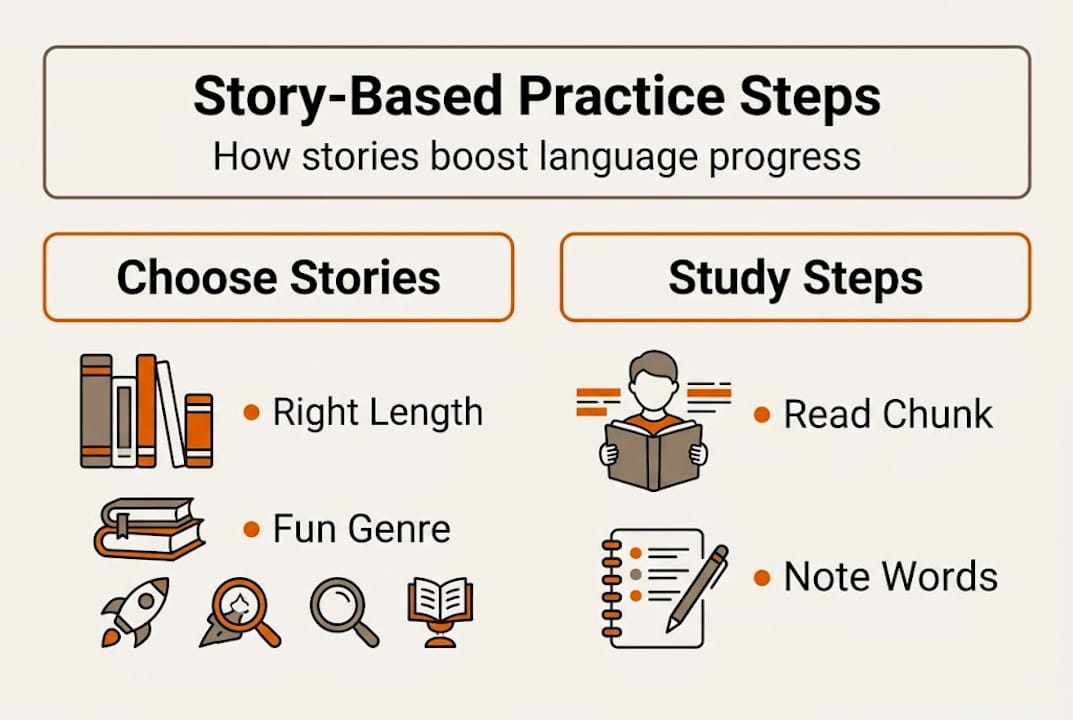
Story-based language learning for intermediate learners uses CI methodology at the i+1 level, where narratives are 80 to 95% comprehensible, enabling subconscious acquisition through context rather than explicit drills. That last phrase matters: subconscious acquisition. You're not memorizing rules. You're absorbing patterns the same way a child absorbs language, through repeated, meaningful exposure.
The data backs this up strongly. Narrative interventions improve fluency with a measured effect size of g=0.425 across fluency, grammar, and lexis, and CI reading has been shown to boost oral proficiency even without dedicated speaking practice.
"Vocabulary learned in context through stories is retained significantly longer than vocabulary learned through isolated drills. The narrative gives the word a home."
Here's a quick look at how story-based learning compares to traditional methods:
| Method | Vocabulary retention | Grammar acquisition | Engagement |
|---|---|---|---|
| Flashcard drilling | Low (isolated) | Minimal | Low |
| Grammar textbooks | Moderate | High (explicit) | Low |
| Story-based CI | High (contextual) | High (implicit) | High |
For a deeper look at how this plays out in practice, the story learning workflow and tips for intermediate learners are worth exploring before you build your routine.
Building on why intermediate learners struggle, we'll clarify what you need to set up a successful story-based study routine.
What you need to start story-based language practice
Getting started with story-based practice doesn't require expensive materials or a complete schedule overhaul. What it does require is the right combination of resources and a clear understanding of your current level.
Essential materials to gather:
- Graded readers or short stories in your target language (French, Spanish, German, Dutch, Italian, or Portuguese)
- An audio version of the same text when possible, for listening alongside reading
- A vocabulary notebook or digital tool for logging unfamiliar words in context
- A practice app that supports story-based exercises with feedback
One of the most common questions is: which app should I use? Duolingo review research shows that gamified apps build habits and basic vocabulary effectively, but they plateau at the intermediate stage because they lack the immersive context and fluency-building that story-based tools provide.
| Feature | Duolingo | Story-based apps (e.g., LingQ, AktivLang) |
|---|---|---|
| Habit building | Excellent | Good |
| Vocabulary in context | Limited | Strong |
| Grammar depth | Basic | Intermediate to advanced |
| Speaking practice | Minimal | Integrated |
| Immersion quality | Low | High |
The most important boundary to set before you begin is your CI threshold. You want stories where you understand 80 to 95% of the language without stopping to translate every sentence. Below 80%, frustration sets in. Above 95%, you're not being challenged enough to grow.
When choosing narratives, think about genre, length, and your personal interests. A 500-word mystery story in Spanish will hold your attention far better than a dry grammar passage. Short wins matter at this stage.

Pro Tip: Before committing to a full story, read the first two paragraphs and count how many words you don't recognize. If it's more than one in five, it's too difficult for CI practice right now. Save it for later and find something slightly easier.
For daily story-based exercises that fit your schedule, and creative writing prompts to extend your practice, both resources offer practical starting points.
With the prerequisites set, let's move into an actionable, step-by-step framework for deepening your skills using stories.
Step-by-step process: Story-driven skill building
A structured approach makes the difference between casual reading and real language growth. Here's a proven process you can follow consistently.
-
Set a reading schedule. Aim for at least 20 to 30 minutes of story reading four to five times per week. Consistency matters more than session length. Short, regular sessions outperform long, infrequent ones.
-
Read first without stopping. Go through the story once for overall meaning. Resist the urge to look up every unknown word. Let context carry you. This builds tolerance for ambiguity, a critical skill for real-world fluency.
-
Annotate on the second pass. Read again and note words or phrases you couldn't infer from context. Look them up, write them down with the sentence they appeared in, and say them aloud.
-
Listen to the audio version. If available, listen while reading or immediately after. Hearing the rhythm and pronunciation reinforces what you've read and builds listening comprehension in parallel.
-
Apply active reflection. Write a three to five sentence summary of the story in your target language. This forces you to produce language, not just recognize it. You can also find interactive writing practice exercises that extend this step effectively.
-
Do targeted exercises. Answer comprehension questions, fill in vocabulary gaps, or rewrite key sentences. These active methods for fluency transform passive reading into active skill building.
Pro Tip: Chunk longer stories into 200 to 300 word sections. Completing a chunk feels like a win, and wins keep motivation high. Treat each chunk as a mini-lesson with its own vocabulary focus.
The results of this kind of structured CI practice are striking. AI-generated CI reading boosts proficiency significantly over six months, with learners advancing from Novice High to Intermediate Mid on standardized scales, and vocabulary retention running three to five times higher in story contexts versus rote learning. Additional CI study outcomes confirm these patterns across multiple languages and learner profiles.
Now that you know the practical steps, let's discuss how to verify progress and adjust your story strategy for maximum results.
How to assess progress and maximize story impact
Progress in language learning can feel invisible if you don't measure it intentionally. The good news is that story-based practice creates natural checkpoints.
Ways to track real skill gains:
- Re-read a story you found difficult three months ago. Notice how much more you understand now.
- Record yourself summarizing a story in your target language, then compare recordings month to month.
- Use ACTFL (American Council on the Teaching of Foreign Languages) or CEFR (Common European Framework of Reference) benchmarks to self-assess your current level every six to eight weeks.
- Track new vocabulary you've logged from stories and test yourself on words from six weeks ago.
Narrative benchmarking research confirms that narrative interventions produce measurable improvements in fluency, grammar, and lexical range, with an effect size of g=0.425 across studies. That's a meaningful, real-world difference.
"Progress feels slow day to day and dramatic month to month. Measure over longer windows to see what story-based practice is actually doing for your skills."
Stories alone, however, are not the complete picture. Blending narrative reading with conversation practice accelerates growth. Conversation practice tips and advantages of speaking practice both show that producing language in real interactions reinforces what stories teach passively.
Here's a summary of what to focus on at each stage:
| Stage | Primary focus | Supporting practice |
|---|---|---|
| Early intermediate | CI reading, vocabulary in context | Listening, basic writing |
| Mid intermediate | Story reflection, writing summaries | Conversation, grammar review |
| Upper intermediate | Complex narratives, speaking output | Live conversation, exam prep |
When you hit a plateau within your story practice, the solution is usually to adjust the difficulty level or switch genres. If you've been reading history stories in German, try a short mystery or a travel narrative. Fresh content reactivates engagement. You can also explore apps for intermediate learners to supplement your story practice with structured exercises. And reflection for story learning offers concrete techniques for turning what you've read into lasting knowledge.
Having explored how to maximize story-driven progress, let's consider a fresh perspective that challenges conventional wisdom and offers practical guidance.
Our take: The real secret to language mastery beyond stories
Here's something most language learning content won't tell you: stories are a springboard, not a destination. We've seen intermediate learners read hundreds of stories and still freeze when a native speaker talks to them at full speed. Why? Because passive input, even excellent CI input, doesn't automatically become active output.
True fluency at the intermediate level requires three things working together: narrative immersion, live interaction, and reflective practice. Stories build your internal vocabulary and grammar intuition. Conversation forces you to retrieve and produce that knowledge under pressure. Reflection, writing summaries or analyzing what confused you, builds the metalinguistic awareness (your ability to think about how language works) that accelerates long-term growth.
Best apps for intermediate research consistently favors immersion over drills for this stage, but the most successful learners pair immersive reading with conversation tools for balance. Stories give you the raw material. Conversation and reflection turn that material into real fluency. For practical speaking practice strategies that complement your story routine, the combination is genuinely powerful.
Next steps: Deepen your language learning with AktivLang
If you're ready to put this approach into practice, AktivLang is built exactly for this stage of your journey.
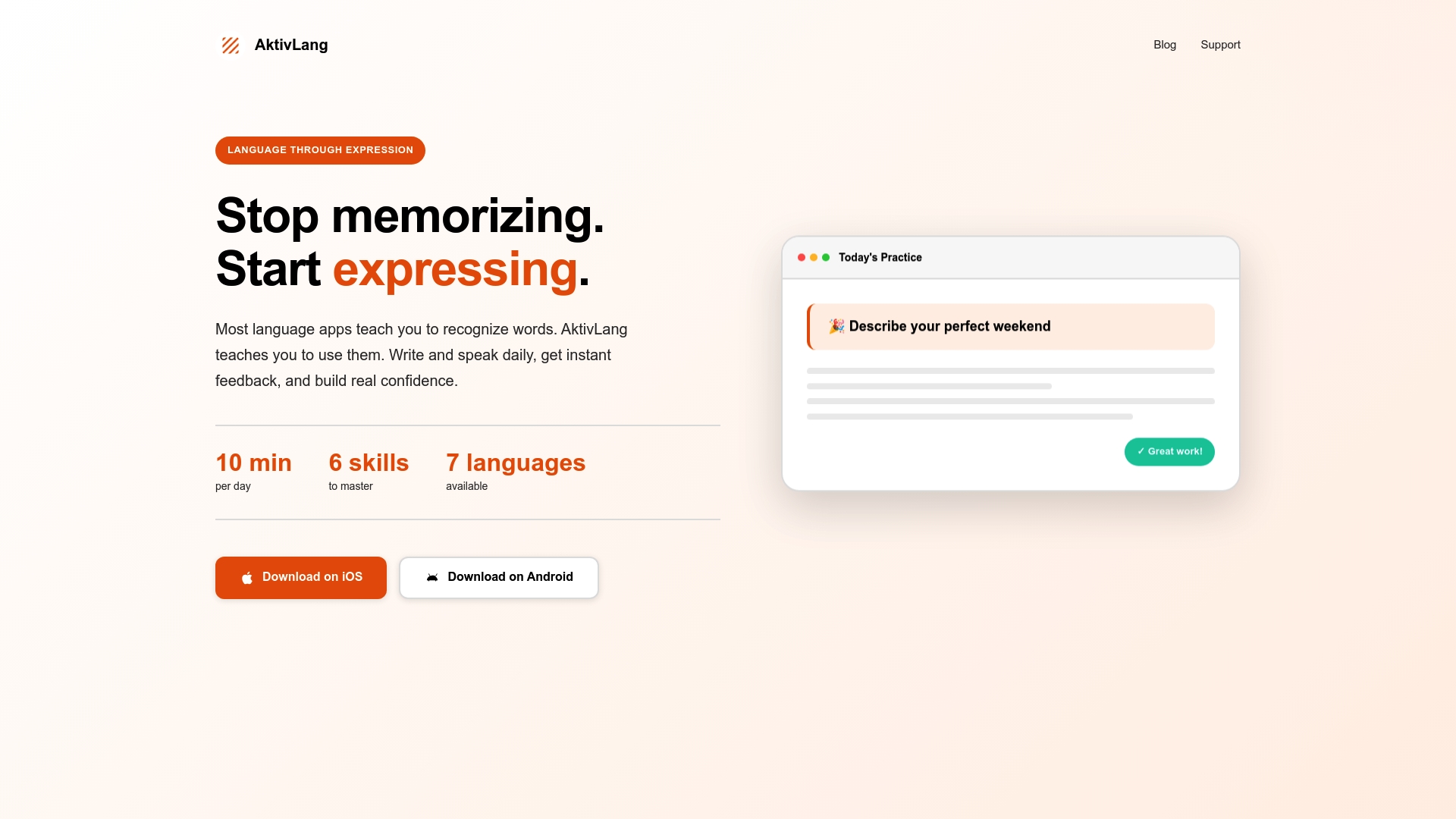
AktivLang for learners gives you access to engaging stories across themes like mythology, history, culture, travel, and science in French, Spanish, German, Dutch, Italian, and Portuguese. After each story, you practice with 12+ exercise types covering vocabulary, comprehension, grammar, and speaking, with AI feedback on your pronunciation and fluency. It's the complete story-based practice loop in one place. Whether you're preparing for an exam, building skills for work, or simply chasing real fluency, AktivLang adapts to your level and keeps you moving forward.
Frequently asked questions
What is comprehensible input and why is it effective for language learners?
Comprehensible input is language pitched just above your current level, around 80 to 95% understandable, so your brain can acquire new patterns naturally through context. Story-based language learning for intermediate learners shows this approach leads to subconscious acquisition that sticks far better than isolated drills.
How can I tell if a story is at the right level for my language skills?
The 80 to 95% rule is your guide: if you can grasp the main ideas and only encounter a handful of unknown words per page, the story is at the right CI level. Story-based language learning for intermediate learners confirms that comprehensible input works best within this understanding range.
Should story-based practice replace grammar drills?
At the intermediate stage, story-based practice should be your primary method, since immersion builds grammar intuition more effectively than isolated exercises. You can layer in targeted grammar work when a specific structure keeps tripping you up, as best apps for intermediate research supports immersion as the core approach.
Does story-based learning work for languages besides English?
Absolutely. The evidence applies across French, Spanish, German, Dutch, Italian, and Portuguese at the intermediate stage. Narrative interventions improve fluency in multiple languages, with consistent gains in fluency, grammar, and vocabulary documented across studies.