

TL;DR:
- Interactive and task-based methods promote active use and real-world application of language skills.
- Combining input, interaction, and memory techniques accelerates intermediate language development.
- Personalizing methods based on goals and interests maximizes learning efficiency and motivation.
You've moved past the basics. You can order coffee, introduce yourself, and follow simple conversations. But somewhere between beginner and fluent, progress slows to a crawl. Sound familiar? The intermediate plateau is real, and it catches nearly every learner off guard. Traditional drills and grammar tables got you this far, but they rarely push you into genuine fluency. The good news: six proven methods can break that stall. Each one shifts your focus from passive recognition to active, meaningful language use, which is exactly what intermediate learners need to keep moving forward.
Table of Contents
- Task-based learning: Real-world language in action
- Communicative methods: From drills to meaningful interaction
- Story-based and extensive reading: Contextual input for fluency
- Retrieval practice and spaced repetition: Optimizing memory
- Interactive apps: Gamified exercises for French, Spanish, and more
- Why hybrids and personalization are the new frontier
- Supercharge your language journey with AktivLang
- Frequently asked questions
Key Takeaways
| Point | Details |
|---|---|
| Task-based learning | Real-world tasks create purposeful practice and enhance speaking confidence. |
| Communicative interaction | Pair work, role-plays, and problem-solving accelerate fluency over basic drills. |
| Contextual input | Story-driven and extensive reading methods naturally build vocabulary and motivation. |
| Retention techniques | Spaced repetition and mnemonics optimize memory, especially for tricky vocabulary. |
| App-powered practice | Interactive apps personalize exercises and make learning engaging for French, Spanish, German, and more. |
Task-based learning: Real-world language in action
Task-Based Learning, or TBL, is built around a simple idea: you learn a language best when you use it to accomplish something real. Instead of drilling verb conjugations in isolation, you complete a task that requires those verbs naturally. The process follows a clear cycle: receive the task, plan your approach, perform it, then report back on what you did and how.
TBL engages learners in real-world tasks that promote active communication, with mechanics built around task creation, performance, planning, reporting, and a language focus woven throughout. This structure forces you to produce language, not just recognize it.
What does this look like in practice? Here are some examples tailored to specific languages:
- French: Simulate ordering at a Parisian café, including asking about ingredients and handling the bill
- Spanish: Plan a weekend trip by researching destinations, comparing prices, and writing an itinerary
- German: Role-play a business meeting where you must solve a scheduling conflict
- Italian: Cook a recipe using only Italian instructions and explain each step aloud
- Dutch or Portuguese: Navigate a public transit system using only target-language resources
The reason TBL works so well is engagement. When a task mirrors your real life, motivation stays high. You're not practicing for a test. You're practicing for a situation you'll actually face. Pair TBL with active learning methods to maximize communicative output. Research on contextualized learning confirms that tying language to real scenarios deepens retention significantly.
Pro Tip: Choose tasks that mirror your actual life. If you work in tech, simulate a German client call. If you love food, plan a Spanish market visit. Relevance is the engine that drives retention.
Communicative methods: From drills to meaningful interaction
Communicative Language Teaching, or CLT, flips the traditional classroom model. Instead of memorizing rules and hoping they transfer to conversation, CLT puts interaction first. You learn grammar and vocabulary by using them in context, not before you use them.
CLT prioritizes interaction over rote memorization and includes pair discussions, role-plays, and problem-solving exercises that mirror authentic communication. The shift is significant. You stop performing language for a teacher and start using it for a purpose.
Here are the core CLT techniques that work especially well for intermediates:
- Role-playing: Act out practical scenarios like renting an apartment in Paris or negotiating a price in Madrid
- Pair conversations: Set up a structured exchange where each partner has information the other needs, forcing genuine communication
- Problem-solving tasks: Work through a scenario with a gap, such as planning a group trip where each person has different constraints
"CLT shifts language from memorized drills to natural conversation, producing measurably better outcomes for real-world communication."
The story-based workflow pairs naturally with CLT because stories give you rich context before you step into a communicative exercise. You already know the vocabulary and setting, so the interaction feels grounded rather than forced. For deeper personalization, explore why personalizing your learning accelerates progress. The language tips for intermediates section of our blog also covers how to structure CLT sessions on your own.
Story-based and extensive reading: Contextual input for fluency
Once you've adopted interactive practices, input quality becomes your next lever. Extensive Reading, often called ER, means reading large amounts of text slightly below your maximum ability level. The goal is fluency and enjoyment, not word-by-word analysis.
The research is clear. Extensive Reading shows small to medium effect sizes (d=0.4 to 0.88) on reading ability, vocabulary growth, fluency, and motivation. Crucially, those effects grow larger when learners have limited choice and built-in accountability.
Stat callout: Accountability structures in extensive reading programs consistently boost outcomes for intermediate learners, pushing effect sizes toward the higher end of the range.
Here's how story-based learning compares to standard drills:
| Method | Effect on vocabulary | Effect on motivation | Context provided |
|---|---|---|---|
| Extensive Reading | Medium to high | High | Rich narrative context |
| Standard drills | Low to medium | Low | Minimal or none |
| Story-based apps | Medium to high | High | Structured + interactive |
Story-based apps combine the input benefits of ER with the accountability of structured exercises. That combination is powerful. The story-based workflow shows exactly how to build this into a daily routine.
Here's how to integrate story-based learning into your schedule:
- Pick a theme that genuinely interests you (mythology, history, travel, food)
- Read a short story in your target language without stopping to look up every word
- Complete comprehension exercises immediately after to lock in meaning
- Review flagged vocabulary with context sentences, not isolated definitions
- Explore topic selection strategies to keep your reading varied and motivating
The contextualized input approach supported by research makes story-based learning one of the most efficient methods available for intermediates. You can also explore story-based writing skills to extend this method into productive output.
Retrieval practice and spaced repetition: Optimizing memory
Strong input is only half the equation. You also need to retain what you learn. That's where retrieval practice and spaced repetition come in. These techniques are grounded in cognitive science and consistently outperform passive review.

Spaced repetition works by showing you a word again just before you're likely to forget it. Each successful recall pushes the next review further into the future. Over time, you build durable long-term memory rather than short-term familiarity. Adaptive algorithms yield significantly better recall, with learners remembering 27 out of 80 words after one week compared to far fewer with manual review.
Mnemonics add another layer. Linking a tricky German word to a vivid image or a Spanish phrase to a personal memory makes retrieval faster and more reliable.
Here's how to set up an effective spaced repetition system:
- Choose an app with an adaptive algorithm (not a fixed schedule)
- Add words in context sentences, not isolated translations
- Review daily, even for just 10 minutes
- Flag difficult words for more frequent review
- Track your retention rate weekly to spot patterns
| Method | Retention after 1 week | Setup time | Adaptability |
|---|---|---|---|
| Spaced repetition app | High | Low | High |
| Manual flashcard review | Low to medium | Medium | None |
| Passive re-reading | Low | None | None |
Pro Tip: Use an app with an adaptive algorithm rather than a fixed review schedule. Adaptive systems adjust to your personal forgetting curve, making every session more efficient. Explore retrieval practice strategies and adaptive learning methods to build this into your routine. The science of language teaching confirms retrieval practice as one of the top research-backed techniques available.
Interactive apps: Gamified exercises for French, Spanish, and more
Technology has made interactive language practice more accessible than ever. But not all apps are created equal. Understanding what each platform offers helps you choose the right tool for your goals.
Apps like Babbel, Lingopie, and Duolingo offer interactive exercises and dialogues across multiple languages, with Babbel standing out for grammar depth and real-world context. Each platform takes a different approach:
| App | Structure | Context | Languages | Best for |
|---|---|---|---|---|
| Duolingo | Gamified, bite-sized | Low | Many | Daily habit building |
| Babbel | Lesson-based | Medium to high | 14 languages | Grammar and conversation |
| Lingopie | Video-based | High | Several | Listening and vocabulary |
| AktivLang | Story + exercises | Very high | FR/ES/DE/NL/IT/PT | Intermediates seeking depth |
Here's a quick breakdown of pros and cons:
- Duolingo: Highly engaging and free, but limited depth for intermediates
- Babbel: Strong grammar scaffolding and practical scenarios, subscription required
- Lingopie: Excellent for listening comprehension through authentic video, less structured for grammar
- AktivLang: Combines story-based input with 12+ exercise types including speaking and writing, built specifically for intermediates
Speech recognition is a standout feature to look for. Apps that analyze your pronunciation and give fluency scores push you toward production, not just recognition. Pair app use with AI language prompts for speaking practice and personalization strategies to tailor your app routine to your goals.
Why hybrids and personalization are the new frontier
Here's an uncomfortable truth: no single method is enough. Grammar-translation gave learners a foundation, but it rarely produced speakers. Communicative methods improved interaction but sometimes left learners without the structural knowledge to self-correct. The real breakthrough comes when you combine approaches deliberately.
The most effective learners in 2026 aren't loyal to one method. They blend story-based input with retrieval practice, layer communicative tasks on top of extensive reading, and use AI-powered tools to fill the gaps. The caveat is intentionality. Mixing methods randomly produces noise, not progress.
Personalization in learning means selecting methods based on your specific context: your target language, your goals, your schedule, and your weak points. A German learner preparing for a work visa interview needs more TBL and CLT. An Italian learner building reading fluency needs more ER and retrieval. There's no universal answer, only the right combination for you right now. The learners who progress fastest are those who treat method selection as an ongoing decision, not a one-time choice.
Supercharge your language journey with AktivLang
Ready to move past the intermediate plateau? AktivLang was built for exactly this moment in your learning journey. You get engaging stories in French, Spanish, German, Dutch, Italian, or Portuguese, followed by 12+ exercise types that cover vocabulary, comprehension, grammar, speaking, and writing. Every session gives you instant feedback so you always know what to work on next.
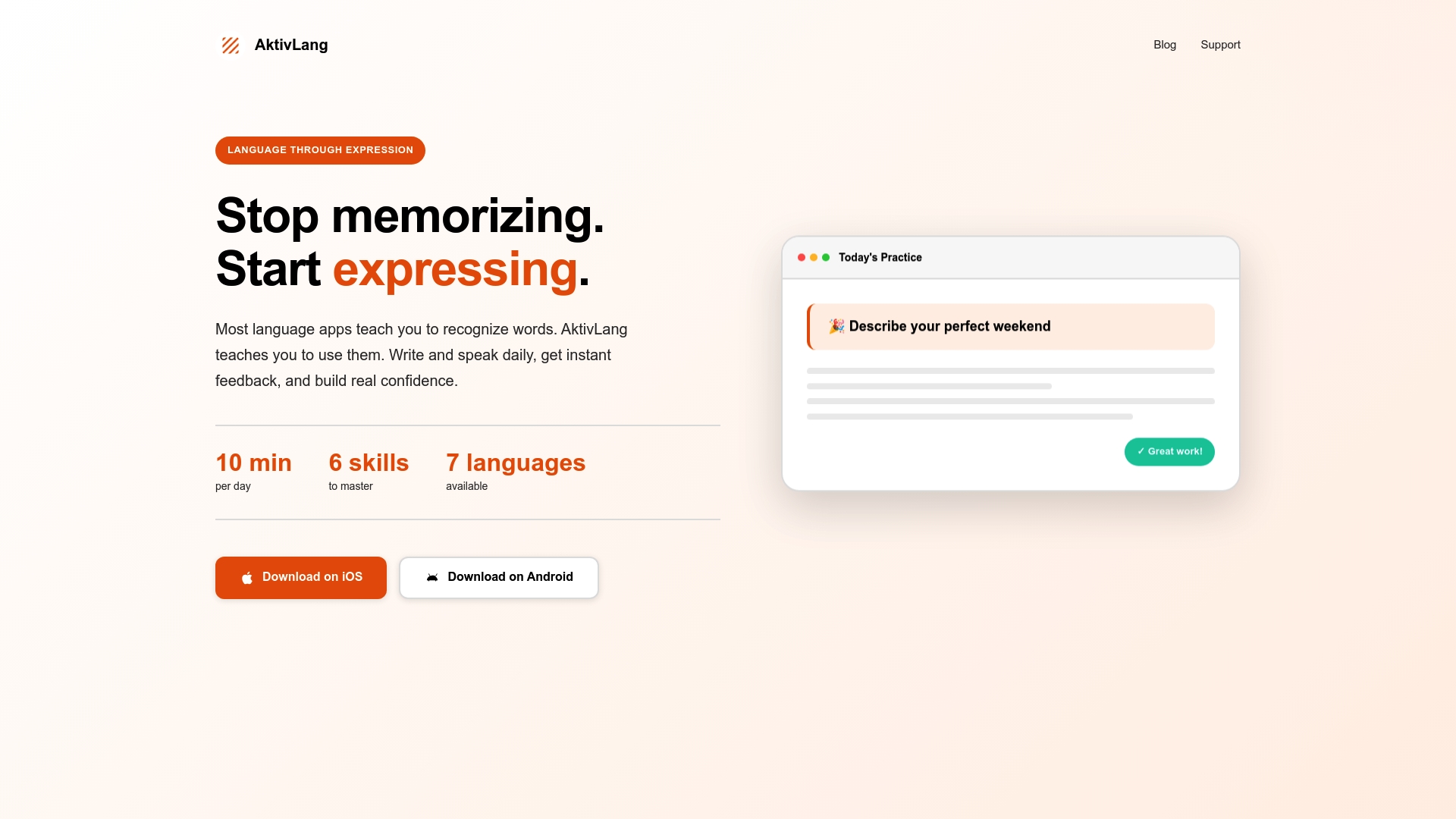
AktivLang combines the story-based input, communicative practice, and retrieval methods covered in this article into one structured experience. AI-powered speaking analysis gives you fluency and accuracy scores. Weekly reflections show you exactly how your language is improving. Whether you're learning for work, travel, or personal growth, AktivLang adapts to your level and interests. Start your story today.
Frequently asked questions
Which language learning method is best for French and Spanish intermediate learners?
Story-based contextual methods combined with task-based and communicative approaches offer the strongest results for intermediates in French and Spanish, tying vocabulary and grammar to meaningful narratives.
How does spaced repetition improve vocabulary retention?
Adaptive spaced repetition algorithms boost memory by timing reviews just before forgetting occurs, helping learners recall significantly more words after a week than traditional review methods allow.
Are interactive apps effective for intermediate learners?
Yes. Apps like Duolingo and Babbel provide gamified practice, speech recognition, and real-world scenarios that help intermediates move from passive recognition to active language production.
What's the advantage of combining different learning methods?
Combining TBL, CLT, and retrieval blends input, interaction, and memory optimization, producing faster progress and higher motivation than any single method can deliver on its own.
How do I choose the right method for German or Italian?
Base your choice on your goals: task-based and communicative methods for real-world fluency, story-based reading for contextual input, and spaced retrieval for durable vocabulary memory across German, Italian, and all other supported languages.