
TL;DR:
- Intermediate Spanish requires practicing spontaneous speaking and real-time language use.
- Story-based learning enhances vocabulary retention and natural grammar understanding through context.
- Combining active output with authentic input and feedback accelerates fluency beyond passive study.
Grammar drills feel productive. You conjugate verbs, memorize lists, and ace every written exercise. Yet the moment a native speaker fires off a quick sentence, your mind goes blank. Sound familiar? That gap between knowing Spanish and using it is exactly where most intermediate learners get stuck. Intermediate Spanish corresponds to CEFR B1-B2 levels, where you can handle travel situations, discuss familiar topics, and produce detailed text. But reaching true conversational fluency requires more than grammar knowledge. This article walks you through what intermediate Spanish really demands, which core skills to build, and how story-based learning and interactive exercises can finally close that gap.
Table of Contents
- What does it mean to be intermediate in Spanish?
- Core skills: Conversation, comprehension, and spontaneous use
- Story-based learning and interactive exercises
- Practical strategies: Building habits for real fluency
- The biggest mistake most intermediate Spanish learners make
- Take your Spanish to the next level
- Frequently asked questions
Key Takeaways
| Point | Details |
|---|---|
| Intermediate defined | B1/B2 Spanish means you can handle most real conversations and begin expressing detailed ideas. |
| Focus on stories | Story-based methods and interactive exercises build true understanding and fluency faster. |
| Balanced skills | Develop both comprehension (input) and speaking/writing (output) for progress past the plateau. |
| Build consistent routines | Regular practice with stories, speaking, and writing habits leads to steady improvement. |
| Apps are supplemental | Apps can help but should be combined with conversation and real practice for results. |
What does it mean to be intermediate in Spanish?
Being "intermediate" sounds vague, but the CEFR framework gives it real shape. B1-B2 levels mean you can handle most travel situations, discuss familiar topics fluently with native speakers, and produce detailed written text. That is a wide range of ability, and it matters to know where you sit within it.
At B1, you can hold a conversation about everyday topics, understand the main points of clear speech, and write simple connected text. At B2, you can interact spontaneously and fluently with native speakers without much accommodation on their part, discuss abstract ideas, and produce detailed, well-structured writing.
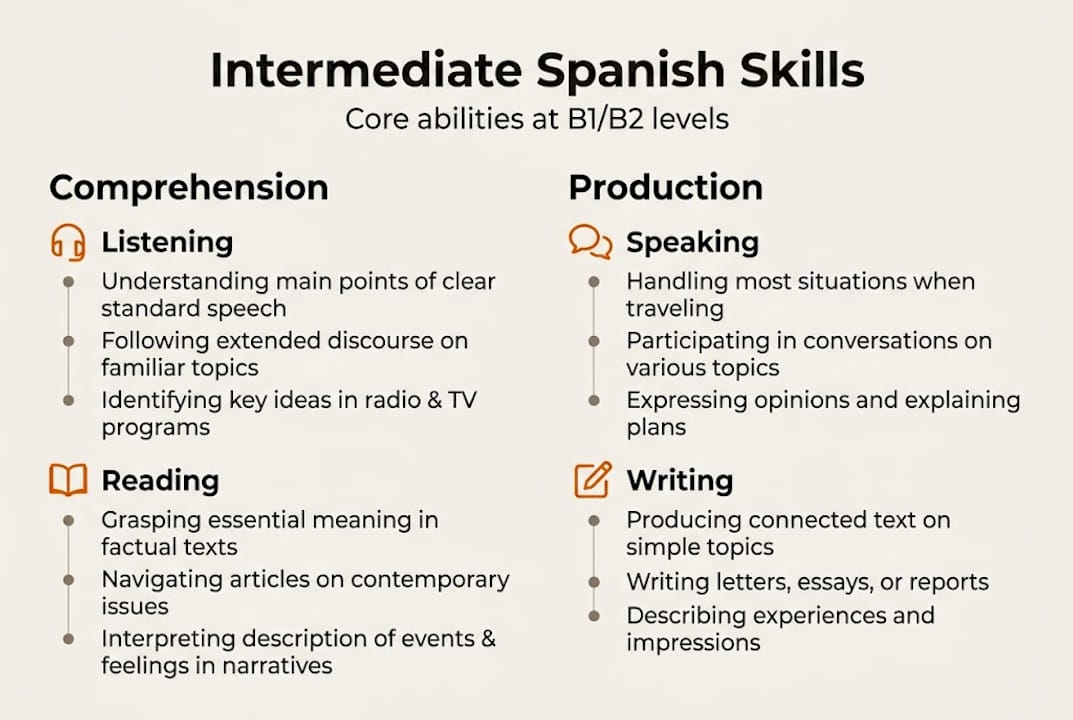
Here is a quick comparison of what each level looks like in practice:
| Skill area | B1 | B2 |
|---|---|---|
| Speaking | Handles familiar situations | Speaks spontaneously with natives |
| Listening | Understands clear, standard speech | Follows complex discussions |
| Reading | Reads straightforward texts | Reads articles and longer narratives |
| Writing | Writes simple connected text | Writes detailed, structured essays |
Most learners at this stage can do the following:
- Describe experiences, events, and plans in some detail
- Understand the main points of TV news and current affairs programs
- Write personal letters and messages
- Follow conversations on familiar topics
Where do learners typically get stuck? The core challenge is spontaneity. You might understand everything you read but freeze when speaking in real time. This is because receptive skills outpace productive skills at this stage, meaning your ability to understand Spanish grows faster than your ability to produce it fluently. Individual variation plays a big role too. Some learners gain fluency quickly; others improve accuracy first. Neither path is wrong, but both require deliberate output practice to bridge the gap.
For practical language learning tips tailored to this stage, it helps to recognize which side of the B1/B2 boundary you are on before choosing your next strategy.
Core skills: Conversation, comprehension, and spontaneous use
Now that you understand your current level, let's focus on the core skills that drive real progress. Three areas matter most at the intermediate stage: oral fluency, listening comprehension, and spontaneous use.

Oral fluency is not just about speaking correctly. It is about speaking without stopping to translate. When you pause to mentally convert English to Spanish, the conversation loses its natural rhythm. Group conversation activities, language exchange partners, and structured speaking exercises all push you to react faster and trust your instincts.
Comprehension grows through exposure to authentic input. Reading stories, watching Spanish-language content, and listening to podcasts all train your brain to process meaning at a natural pace. The key is choosing material that is slightly above your comfort zone, challenging enough to stretch you but not so difficult that you lose the thread.
Spontaneous use is the hardest skill to build and the most rewarding. It means reacting to new situations in Spanish without a mental script. Research supports investing in real conversation: study abroad improves complexity most, while network-based learning outperforms traditional methods in reading and listening, and structured apps like Babbel show measurable oral proficiency gains when used consistently.
Here is a ranked approach for building these skills:
- Prioritize speaking output over passive review. Even five minutes of speaking practice daily beats an hour of reading alone.
- Combine listening and reading by following along with a transcript while you listen.
- Practice reacting by responding to prompts out loud without preparation time.
- Use conversation partners at least once a week to simulate real interaction.
- Review your mistakes immediately after speaking practice to lock in corrections.
Statistic to remember: Learners who combine structured speaking practice with story-based input show significantly greater gains in oral complexity than those who rely on grammar study alone.
Pro Tip: Record yourself speaking for 60 seconds on a topic you know well. Play it back. You will immediately notice hesitation patterns and filler words you did not realize you were using. This self-audit is one of the fastest ways to identify your real speaking gaps.
For a deeper look at speaking practice advantages and how to structure your sessions, and for more conversation practice tips that work at the intermediate level, the evidence consistently points to active output as the engine of fluency.
Story-based learning and interactive exercises
With the core skills outlined, let's look at the methods that accelerate real-world ability. Stories are not just engaging. They are cognitively powerful.
When you read or listen to a story, your brain processes vocabulary in context, which means it encodes words alongside meaning, emotion, and situation. Compare that to a flashcard, which gives you a word in isolation. Context wins every time for long-term retention.
Here is why story-based learning works so well for intermediate learners:
- Vocabulary in context sticks three to five times better than isolated word lists
- Narrative structure helps you anticipate grammar patterns naturally
- Emotional engagement deepens memory encoding
- Repeated exposure to the same words across a story reinforces retention without feeling repetitive
But stories alone are not enough. Apps work best as supplements, and no single app achieves full proficiency on its own. The real power comes from combining story-based input with interactive exercises that force you to produce language, not just recognize it.
Effective interactive exercises for intermediate learners include:
- True/false and comprehension questions after reading a story
- Fill-in-the-blank exercises using vocabulary from the story
- Sentence reordering to practice grammar structure
- Speaking prompts that ask you to retell or react to the story out loud
- Error-correction tasks that sharpen your grammatical intuition
"The difference between knowing a word and owning a word is whether you have used it in a real sentence under pressure."
Pro Tip: After finishing a story, close the text and try to summarize it out loud in Spanish for 90 seconds. This forces active recall and speaking simultaneously, which is exactly the kind of output practice that builds fluency fast.
For a detailed look at the story-based learning workflow and how to pair it with active learning methods, the research consistently favors this combination over rote memorization or app-only approaches.
Practical strategies: Building habits for real fluency
Equipped with the best learning methods, let's get practical. Consistency beats intensity. A 30-minute daily routine outperforms a four-hour weekend session every time.
Here is a weekly structure that balances all the key skill areas:
- Monday and Wednesday: Read a Spanish story and complete comprehension and vocabulary exercises.
- Tuesday and Thursday: Do a 15-minute speaking session, either with a partner or using AI-powered speaking prompts.
- Friday: Write a short paragraph (100 to 150 words) on a topic from the week's stories.
- Saturday: Watch or listen to authentic Spanish content for 20 to 30 minutes.
- Sunday: Review mistakes from the week and note three grammar patterns to practice next week.
Habit-building at this stage is about reducing friction. Keep your materials ready, set a consistent time, and start small. Five minutes of focused output beats 30 minutes of passive scrolling through vocabulary lists.
Mistakes are your most valuable data. When you get something wrong, your brain is primed to encode the correction. Structured apps versus immersion approaches each have tradeoffs: structured apps build accuracy; immersion builds fluency. The smartest learners use both.
To cross the B1/B2 boundary, focus daily on:
- Using complex sentence structures in your writing and speaking
- Practicing abstract topics like opinions, hypotheticals, and current events
- Engaging with native-speed audio without subtitles at least three times a week
- Seeking real-time feedback on your speaking, not just written corrections
Pro Tip: Keep a "mistake journal" in Spanish. Write down errors your conversation partner corrects, then rewrite the sentence correctly three times. This simple habit accelerates grammar accuracy faster than most textbook exercises.
For more targeted speaking strategies, a collection of speaking exercise ideas, and guidance on writing to boost fluency, these resources build directly on the weekly routine above.
The biggest mistake most intermediate Spanish learners make
Here is the uncomfortable truth: most intermediate learners plateau not because they lack knowledge, but because they keep doing what got them to this level. They read more, study more grammar, and download another app. More input feels like progress. It is not.
The real bottleneck is output. Receptive skills outpace productive skills at the intermediate stage, which means you can understand far more than you can produce. That gap does not close by consuming more Spanish. It closes by speaking and writing in Spanish, getting feedback, and adjusting.
Think of it like cooking from a recipe. Reading the recipe ten times does not make you a better cook. Making the dish, burning it once, and adjusting the heat does. Language works the same way. You need to produce, fail, receive feedback, and try again.
The learners who break through the intermediate plateau are the ones who prioritize faster adaptive learning by blending immediate output with targeted input and real feedback. Stop waiting until you feel ready to speak. You get ready by speaking.
Take your Spanish to the next level
You now have a clear picture of what intermediate Spanish demands and how to build the habits that move you forward. The strategies in this article work best when they are part of a structured, consistent practice system.
AktivLang is built for exactly this stage of learning. Read engaging Spanish stories across themes like history, culture, and travel, then practice with 12+ exercise types covering vocabulary, comprehension, grammar, and speaking. AI-powered feedback gives you instant, accurate scores on pronunciation and fluency so you always know what to improve. If you are ready to move beyond passive study and start producing real Spanish, explore AktivLang's guided programs and see how story-based, interactive learning accelerates your path to fluency.
Frequently asked questions
What are the main differences between B1 and B2 intermediate Spanish?
B1 speakers manage everyday situations and simple conversations, while B2 speakers can discuss abstract ideas and interact spontaneously without native speaker accommodation.
How should I practice speaking at the intermediate level?
Combine structured exercises, stories, and live conversations for best results. No app alone achieves full proficiency, so real conversation practice is essential.
What are the best interactive exercises for intermediate Spanish?
Role-play, storytelling, and discussion of news or podcasts build fluency and comfort with new vocabulary. Story-based activities drive significantly better results for intermediate learners compared to rote memorization.
Why do many learners plateau at the intermediate level?
Most plateau by focusing too much on input and not enough on real-time speaking and writing. Receptive skills outpace productive skills at this stage, so deliberate output practice is the key to breaking through.