

TL;DR:
- Revision deepens understanding, improves clarity, and develops writing habits beyond basic grammar correction.
- Effective revision involves analyzing structure, coherence, audience impact, and meaning, not just fixing surface errors.
- Story-based practice and discovery-focused revision lead to better language fluency and engaging writing skills.
Most language learners treat revision as a final grammar sweep. Fix a verb tense here, swap a word there, and call it done. But that approach barely scratches the surface of what revision can actually do for you. True revision reshapes how you think in your target language, strengthens your ability to communicate ideas clearly, and builds writing habits that carry over into speaking and reading. For intermediate learners especially, revision is one of the most underused tools available. This article covers what real revision looks like, why it matters more than you think, and how story-based practice makes it far more effective.
Table of Contents
- What revision really means in improving writing
- The deeper benefits: How revision shapes better writers
- Effective revision strategies for language learners
- Applying revision through story-based practices
- Why most revision advice misses the real breakthrough for learners
- Take your writing improvement further with AktivLang
- Frequently asked questions
Key Takeaways
| Point | Details |
|---|---|
| Revision means more | True revision improves organization, clarity, and audience impact beyond grammar fixes. |
| Lasting skills | Revising teaches you to spot weaknesses and forms stronger writing habits for the future. |
| Effective strategies | Using methods like peer review, reading aloud, and checklists can boost results. |
| Story practice matters | Revising engaging stories helps you apply strategies in memorable ways. |
What revision really means in improving writing
Let's be clear about something first: revision and editing are not the same thing. Editing is about surface-level corrections, fixing spelling, punctuation, and grammar. Revision goes much deeper. It means stepping back and asking whether your writing actually communicates what you intended. Does the structure make sense? Is the logic easy to follow? Would a reader understand your point without already knowing what you meant?
For language learners, this distinction matters even more. When you write in a second language, you're managing vocabulary, grammar, and meaning all at once. That cognitive load often means your first draft is more about getting words on the page than crafting a clear message. Revision is where you shift from writer mode to reader mode, and that shift is where real growth happens.
"Revision improves clarity, coherence, structure, and overall impact of writing by addressing big-picture elements before surface-level fixes."
This is why revision boosts fluency in ways that simple grammar drills cannot. When you revise for meaning, you force yourself to think in the target language, not just translate from your native one.
Here is what genuine revision involves:
- Rereading for structure: Does your writing have a clear beginning, middle, and end?
- Checking for coherence: Do your ideas connect logically from one sentence to the next?
- Evaluating audience impact: Would someone unfamiliar with the topic follow your argument?
- Identifying gaps: Are there ideas you assumed but never actually wrote?
- Clarifying word choice: Did you use the most precise word, or just the first one that came to mind?
Revision also transforms rough drafts into compelling writing by fostering critical thinking and audience awareness. That is a skill you build over time, not something that happens automatically. The more you revise with intention, the faster you develop a writer's instinct in your target language.
Think of your first draft as a rough sketch. Revision is where you add detail, fix proportions, and make the picture actually look like what you imagined. It takes practice, but the payoff is significant.
The deeper benefits: How revision shapes better writers
Once you see revision differently, the deeper learning benefits become clear. Revision does not just improve individual pieces of writing. It builds the kind of self-awareness that makes you a stronger writer across the board.
One of the most powerful things revision does is help you spot your own recurring weaknesses. Maybe you consistently write sentences that are too long and hard to follow. Maybe you overuse the same transitional phrases. Revision identifies these patterns and corrects them, leading to better habits in future drafts. Over time, you stop making the same mistakes because you've trained yourself to notice them.
Research backs this up. Empirical studies show that revision profiles correlate with text quality: students who revise more substantively produce higher quality texts than those who focus only on surface fixes. This holds true across age groups and proficiency levels.
Here is a quick look at how different revision approaches affect outcomes:
| Revision type | Focus area | Outcome |
|---|---|---|
| Surface revision | Spelling, punctuation | Minor accuracy gains |
| Structural revision | Organization, flow | Clearer communication |
| Substantive revision | Meaning, audience | Significant quality improvement |
| Reflective revision | Personal patterns | Long-term habit change |
Revision also builds critical thinking. When you ask "does this make sense to a reader?", you practice stepping outside your own perspective. That is a skill that transfers directly to speaking and listening in a second language.
Pro Tip: Use writing to boost fluency by treating every revision pass as a mini-lesson. Ask yourself one focused question per pass: first structure, then clarity, then vocabulary, then grammar. This keeps revision manageable and productive.
Here is a simple numbered process to build revision into your writing routine:
- Write your first draft without stopping to correct anything.
- Wait at least 30 minutes before rereading.
- Read for big-picture issues first: structure, logic, and meaning.
- Then revise for clarity: cut vague phrases, sharpen your ideas.
- Finally, check grammar and vocabulary as the last step.
Pairing this process with creative prompts for practice gives you consistent material to work with, which makes the habit much easier to build.
Effective revision strategies for language learners
Understanding the why makes the next step clearer: mastering effective revision strategies you can apply right now. The good news is that these strategies are practical, flexible, and easy to adapt to your learning goals.
Key methodologies include taking breaks for fresh perspective, reverse outlining for structure, reading aloud for flow, peer feedback, and the highlighter method. Each one targets a different aspect of your writing.
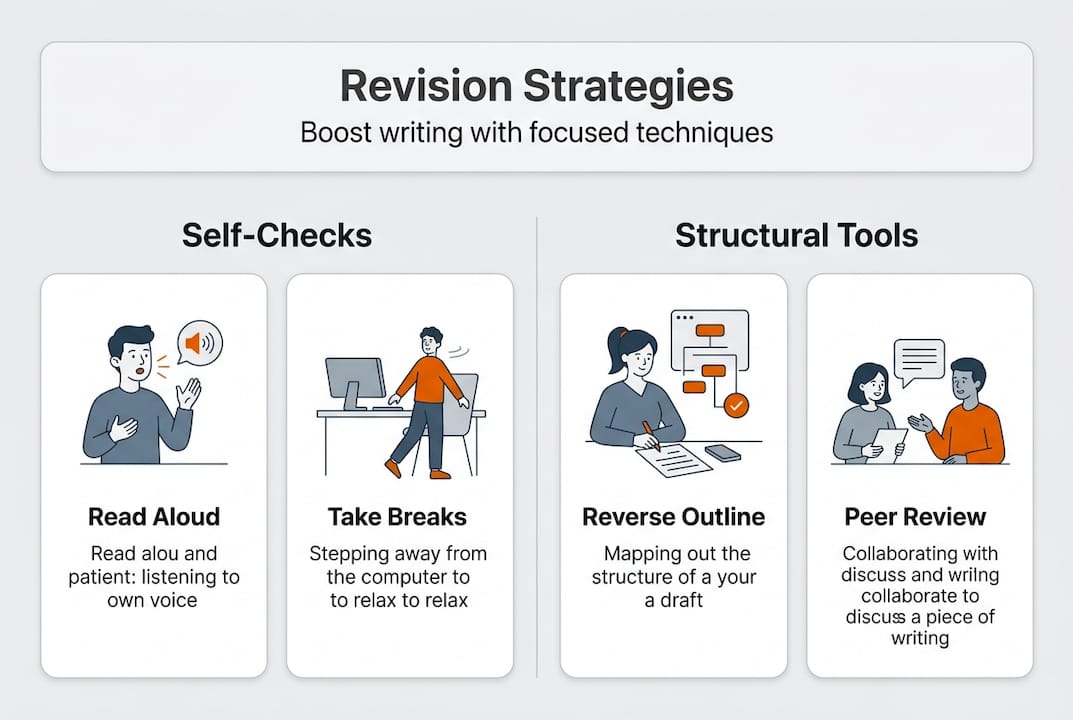
Here is how they compare:
| Strategy | Main focus | Best used when |
|---|---|---|
| Take a break | Fresh perspective | After completing a draft |
| Read aloud | Flow and rhythm | Checking sentence naturalness |
| Reverse outline | Structure and logic | Longer or complex texts |
| Peer review | Audience clarity | Preparing a final version |
| Highlighter method | Patterns and variety | Spotting repetition or gaps |
The reverse outline is especially useful for intermediate learners. Instead of outlining before you write, you create an outline after by summarizing each paragraph in one sentence. This reveals whether your ideas are actually organized the way you thought they were.
The read-aloud strategy is powerful for language learners specifically. Hearing your own writing forces you to notice awkward phrasing, missing words, and unnatural sentence flow. It activates a different part of your brain than reading silently.

For intermediate learners, peer editing builds critical thinking and structured checklists guide focus on organization, clarity, and grammar. If you have a language partner or study group, exchanging drafts is one of the most effective things you can do.
Pro Tip: Avoid jumping straight to grammar fixes. Always prioritize big-picture elements first. If you correct every comma before realizing a whole paragraph needs to be rewritten, you've wasted effort.
You can find more structured approaches in this interactive writing practice guide, which walks through exercise types that reinforce revision habits. Combining revision with reflection in stories also deepens the learning process significantly.
- Start with the big picture, always.
- Use one strategy per revision pass to stay focused.
- Keep a running list of your most common errors to check each time.
Applying revision through story-based practices
Equipped with these strategies, you'll get the most from practice when you apply them in meaningful stories. Stories are not just engaging reading material. They are ideal revision contexts because they have structure, characters, and purpose built in.
When you write or rewrite a short story in your target language, you practice revision in a way that feels purposeful rather than mechanical. Instruction in revision strategies increases writing accuracy, production, story elements, and quality beyond planning alone. Stories give you a natural framework to evaluate: does the sequence make sense? Is the character's motivation clear? Does the ending follow logically?
Here is a step-by-step process for revising a short story draft:
- Read the full draft once without making any changes. Get the overall picture.
- Check story logic: Does the sequence of events make sense? Are there gaps?
- Evaluate character and voice: Is it clear who is speaking or acting, and why?
- Revise for clarity: Rewrite any sentence that required more than one read to understand.
- Read aloud: Listen for unnatural phrasing or missing connective words.
- Final grammar pass: Only now address verb forms, agreement, and vocabulary.
Here is a quick before-and-after example. Original: "The man go to market and he buy bread because hungry." Revised: "The man went to the market and bought bread because he was hungry." The revision does not just fix grammar. It clarifies the sequence and makes the action feel complete.
"Review and revision are integral, reducing cognitive load and improving outcomes."
One common pitfall is focusing only on surface errors while ignoring whether the story actually lands with a reader. Ask yourself: would someone who has never read this story understand what happened and why it matters? That question is the heart of substantive revision.
You can find great starting points in these story exercises for practice, and pair them with top language tips to keep your overall progress on track.
Why most revision advice misses the real breakthrough for learners
Having reviewed the practical side, here is the deeper truth most guides miss: the biggest gains from revision come when you treat it as discovery, not correction.
Most revision guides tell you to fix what is wrong. But the learners who improve fastest are the ones who revise to find out what they actually meant to say. That is a fundamentally different mindset. You are not patching a broken draft. You are excavating the real idea underneath it.
Here is the uncomfortable part: some students focus only on mechanical fixes, yielding lower gains than those who revise substantively. Correct writing is not always the most original or engaging writing. When learners over-correct toward "safe" language, they often strip out the voice that made their writing interesting in the first place.
The best growth we see comes from bold, iterative revisions on stories where the learner is genuinely invested in the outcome. Revising a story you care about is completely different from revising a grammar exercise. Emotional investment drives deeper thinking. And deeper thinking is where language acquisition actually happens. Explore a workflow for real conversations to see how this connects to speaking fluency too.
Take your writing improvement further with AktivLang
Revision is a skill, and like any skill, it improves with consistent, structured practice. The strategies covered here work best when you have rich, engaging material to apply them to.
AktivLang gives you exactly that. Read compelling stories in French, Spanish, German, Dutch, Italian, or Portuguese, then practice through 12+ exercise types including grammar rewrites, sentence building, and speaking feedback. Every story becomes a revision opportunity. Explore writing resources and see how story-based learning accelerates your progress. For a structured starting point, check out the writing practice guide to begin applying these strategies today.
Frequently asked questions
What are the main steps to revising my writing?
Start with big-picture elements like structure and meaning before moving to grammar and vocabulary. Addressing big-picture elements first ensures your core message is clear before you polish the details.
How can revision help me avoid repeating mistakes?
Revising your drafts trains you to notice patterns in your own writing, which builds better habits over time. Revision identifies weaknesses and corrects them so you are less likely to repeat them in future drafts.
Are peer reviews effective for improving my writing?
Yes, peer editing is one of the most effective revision tools available to intermediate learners. Peer editing builds critical thinking and helps you see your writing from an outside perspective.
What simple strategies make revision easier?
Take a break after writing, then read your text aloud and use a checklist for each revision pass. Breaks, read-aloud, and checklists are among the most reliable methods for catching issues you would otherwise miss.